Thank you for visiting SNEWPapers!
Sign up free
Story
April 22, 1837
New Hampshire Statesman And State Journal
Concord, Merrimack County, New Hampshire
What is this article about?
A detailed account of the courtship process at the Parramatta Factory in Botany Bay, where male settlers select convict women as wives through a public inspection, leading to hasty marriages and relocation to rudimentary frontier farms, often met with disappointment.
Clipping
OCR Quality
95%
Excellent
Full Text
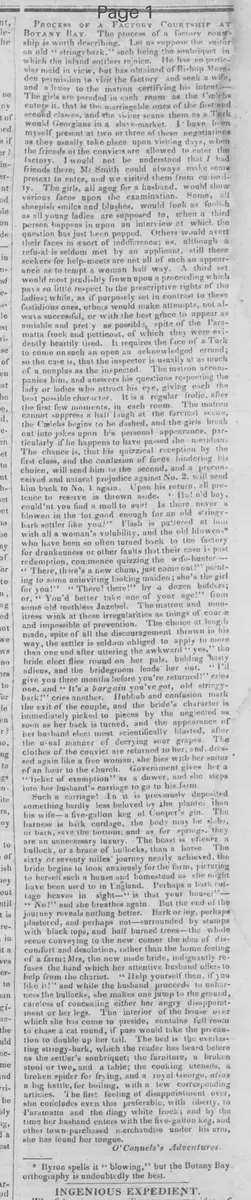
Process of A Factory Courtship At Botany Bay. The process of a factory courtship is worth describing. Let us suppose the suitor an old "stringybark," such being the soubriquet in which the inland settlers rejoice. He has no particular maid in view, but has obtained of Bishop Marsden permission to visit the factory and seek a wife, and a letter to the matron certifying his intent.—The girls are paraded in each room as the Celebs enters it, that is the marriageable ones of the first and second classes, and the visitor scans them as a Turk would Georgians in a slave-market. I have been myself present at two or three of these negotiations as they usually take place upon visiting days, when the friends of the convicts are allowed to enter the factory. I would not be understood that I had friends there; Mr. Smith could always make some pretext to enter, and we visited them from curiosity. The girls, all agog for a husband, would show various faces upon the examination. Some, all sheepish smiles and blushes, would look as foolish as all young ladies are supposed to, when a third person happens in upon an interview at which the question has just been popped. Others would avert their faces in a sort of indifference; as, although a refusal is seldom met by an applicant, still these seekers for help-meets are not all of such an appearance as to tempt a woman half way. A third set would most prudishly frown upon a proceeding which passes so little respect to the prescriptive rights of the ladies; while, as if purposely set in contrast to these fastidious ones, others would make attempts, not always successful, or with the best grace to appear as amiable and pretty as possible, spite of the Parramatta frock and petticoat, of which they were evidently heartily tired. It requires the face of a Turk to come on such an open and acknowledged errand; so the case is, that the inspector is usually at as much of a nonplus as the inspected. The matron accompanies him, and answers his questions respecting the lady or ladies who attract his eye, giving each the best possible character. It is a regular frolic, after the first few moments, in each room. The matron cannot suppress a half laugh at the farcical scene, the Celebs begins to be dashed, and the girls break out into jokes upon his personal appearance, particularly if he happens to have passed the meridian. The chance is, that his quizzical reception by the first class, and the confusion of faces hindering his choice, will send him to the second, and a preconceived and natural prejudice against No. 2. will send him back to No. 1 again. Upon his return, all pretence to reserve is thrown aside. "Ha! old boy, couldn't you find a moll to suit? Is there never a blowen in the lot good enough for an old stringybark settler like you?" Flash is pattered at him with all a woman's volubility, and the old blowen, who have been so often turned back to the factory for drunkenness or other faults that their case is past redemption, commence quizzing the wife-hunter—"There, there's a newchum, just come out!" pointing to some uninviting looking maiden; she's the girl for you!" "There! there!" by a dozen bidders; or, "You'd better take one of your age!" from some old toothless Jezebel. The matron and monitress wink at these irregularities as things of course and impossible of prevention. The choice at length made, spite of all the discouragement thrown in his way, the settler is seldom obliged to apply to more than one and after uttering the awkward "yes," the bride elect flies round on her pals, bidding hasty adieus, and the bridegroom leads her out. "I'll give you three months before you're returned!" cries one, and "It's a bargain you've got, old stringybark!" cries another. Uproar and confusion mark the exit of the couple, and the bride's character is immediately picked to pieces by the neglected as soon as her back is turned, and the appearance of her husband elect most scientifically blasted, after the usual manner of decrying sour grapes. The clothes of the convict are returned to her, and, dressed again like a free woman, she hies with her suitor of an hour to the church. Government gives her a "ticket of exemption" as a dower, and she steps into her husband's carriage to go to his farm—something hardly less beloved by the planter than his wife—a five-gallon keg of Cooper's gin. The harness is bark cordage, the body may be slabs, and as for springs, they are an unnecessary luxury. The beast is oftener a bullock, or a brace of bullocks, than a horse. The sixty or seventy miles' journey nearly achieved, the bride begins to look anxiously for the farm, picturing to herself such a house and homestead as she might have been used to in England. Perhaps a bark cottage heaves in sight—"is that your house?"—"No!" and she breathes again. But the end of the journey reveals nothing better. Bark or log, perhaps plastered, and perhaps not—surrounded by stumps with black tops, and half burned trees—the whole scene conveying to the new comer the idea of discomfort and desolation, rather than the home feeling of a farm; Mrs., the new made bride, indignantly refuses the hand which her attentive husband offers to help from the chariot. "Help yourself then, if you like it!" and while the husband proceeds to unharness the bullocks, she makes one jump to the ground, careless of concealing either her angry disappointment or her legs. The interior of the house over which she has come to preside, contains full room to chase a cat round, if puss would take the precaution to double up her tail. The bed is the everlasting stringy-bark, which the reader has heard before as the settler's soubriquet; the furniture, a broken stool or two, and a table; the cooking utensils, a broken spider for frying, and a royal George, alias a big kettle, for boiling, with a few corresponding articles. The first feeling of disappointment over, she concludes even this preferable, with liberty, to Parramatta and the dingy white frock; and by the time her husband enters with the five-gallon keg, and other town-purchased merchandise under his arm, she has found her tongue.
*Byron spells it "blowing," but the Botany Bay orthography is undoubtedly the best.
*Byron spells it "blowing," but the Botany Bay orthography is undoubtedly the best.
What sub-type of article is it?
Curiosity
Historical Event
Romance
What themes does it cover?
Social Manners
Fortune Reversal
Misfortune
What keywords are associated?
Factory Courtship
Convict Wives
Botany Bay
Stringybark Settler
Parramatta Factory
Colonial Marriage
Frontier Farm
What entities or persons were involved?
Bishop Marsden
Mr. Smith
Where did it happen?
Parramatta Factory, Botany Bay
Story Details
Key Persons
Bishop Marsden
Mr. Smith
Location
Parramatta Factory, Botany Bay
Story Details
A settler visits the factory to select a convict wife through public inspection and banter, marries her promptly, and takes her to a primitive farm where she faces disappointment but accepts her new life.