Thank you for visiting SNEWPapers!
Sign up free
Story
July 4, 1904
The Topeka State Journal
Topeka, Shawnee County, Kansas
What is this article about?
Lafayette Young, editor of the Des Moines Capital, delivers a patriotic Fourth of July oration at the St. Louis World's Fair, extolling American unity, historical triumphs, economic success, liberty, and the indomitable spirit of the nation under Uncle Sam's reign.
Clipping
OCR Quality
98%
Excellent
Full Text
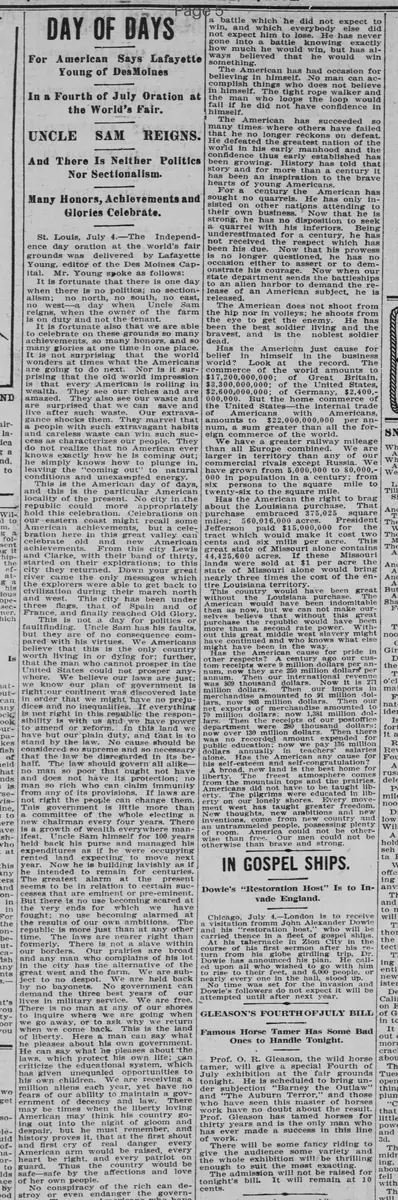
DAY OF DAYS
For American Says Lafayette Young of Des Moines
In a Fourth of July Oration at the World's Fair.
UNCLE SAM REIGNS.
And There Is Neither Politics Nor Sectionalism.
Many Honors, Achievements and Glories Celebrate.
St. Louis, July 4.—The Independence day oration at the world's fair grounds was delivered by Lafayette Young, editor of the Des Moines Capital. Mr. Young spoke as follows:
It is fortunate that there is one day when there is no politics; no sectionalism; no north, no south, no east, no west—a day when Uncle Sam reigns, when the owner of the farm is on duty and not the tenant.
It is fortunate also that we are able to celebrate on these grounds so many achievements, so many honors, and so many glories at one time in one place.
It is not surprising that the world wonders at times what the Americans are going to do next. Nor is it surprising that the old world impression is that every American is rolling in wealth. They see our riches and are amazed. They also see our waste and are surprised that we can save and live after such waste. Our extravagance shocks them. They marvel that a people with such extravagant habits and careless waste can win such success as characterizes our people. They do not realize that no American ever knows exactly how he is coming out; he simply knows how to plunge in, leaving the "coming out" to natural conditions and unexampled energy.
This is the American day of days, and this is the particular American locality of the present. No city in the republic could more appropriately hold this celebration. Celebrations on our eastern coast might recall some American achievements, but a celebration here in this great valley can celebrate old and new American achievements. From this city Lewis and Clarke, with their band of thirty, started on their explorations; to this city they returned. Down your great river came the only messages which the explorers were able to get back to civilization during their march north and west. This city has been under three flags, that of Spain and of France, and finally reached Old Glory.
This is not a day for politics or faultfinding. Uncle Sam has his faults, but they are of no consequence compared with his virtues. We Americans believe that this is the only country worth living in or dying for; further, that the man who cannot prosper in the United States could not prosper anywhere. We believe our laws are just; we know our plan of government is right; our continent was discovered late in order that we might have no prejudices and no inequalities. If everything is not right in this republic the responsibility is with us and we have power to amend or reform. In this land we have but our plain duty, and that is to stand by the law. No cause should be considered so supreme and so necessary that the law be disregarded in its behalf. The law should govern all alike—no man so poor that ought not have and does not have its protection; no man so rich who can claim immunity from any of its provisions. If laws are not right the people can change them.
This government is little more than a committee of the whole electing a new chairman every four years. There is a growth of wealth everywhere manifest. Uncle Sam himself for 100 years held back his purse and managed his expenditures as if he were occupying rented land expecting to move next year. Now he is building lavishly as if he intended to remain for centuries.
The greatest alarm at the present seems to be in relation to certain successes that are eminent or pre-eminent. But there is no use becoming scared at the very ends for which we have fought; no use becoming alarmed at the results of our own ambitions. The republic is more just than at any other time. The laws are nearer right than formerly. There is not a slave within our borders. Our prairies are broad and any man who complains of his lot in the city has the alternative of the great west and the farm. We are subject to no despot. We are held back by no bayonets. No government can demand the three best years of our lives in military service. We are free. There is no man at any of our shores to inquire where we are going when we go away, or to ask why we return when we come back. This is the land of liberty. Here a man can say what he pleases about his own government. He can say what he pleases about the laws, which protect his own life; can criticize the educational system, which has given unequaled opportunities to his own children. We are receiving a million aliens each year, yet have no fears of our ability to maintain a government of decency and law. There may be times when the liberty loving American may think his country going out into the night of gloom and despair, but he must remember, and history proves it, that at the first shout and first cry of real danger every American arm would be raised, every heart be right, and every patriot on guard. Thus the country would be safe—safe by the affections and love of her own people.
No conspiracy of the rich can destroy or even endanger the government. There are Americans who have been discovered to hinder their age—too much money and no way has yet been found to manage the over-rich accumulations. The question of managing the over-rich is one for the future. We do not know its solution, but we do know that as we have solved all things heretofore rightly, we will so determine this question and it will be without resort to anarchy or the torch. The first tyrannies of the over-rich would be resented. The future will point the way for settlement; point the way to a nearer approach to equality.
For one hundred and twenty-five years the world has considered the American a bluffer. But during all that time the American has not been defeated on land or sea.
For more than a century the world has considered the American a wild west performer, wearing clothing simply as a concession to the tastes of other people. But during that time the American has been harmonizing himself, stirring and assimilating the different bloods in his veins preparatory to finally turning out the finished American product—the best man alive.
The American, for a century and a quarter, has gone into every contest underestimated by everybody except himself and has come out with all the trophies of victory.
a battle which he did not expect to win, and which everybody else did not expect him to lose. He has never gone into a battle knowing exactly how much he would win, but has always believed that he would win something.
The American has had occasion for believing in himself. No man can accomplish things who does not believe in himself. The tight rope walker and the man who loops the loop would fail if he did not have confidence in himself.
The American has succeeded so many times where others have failed that he no longer reckons on defeat.
He defeated the greatest nation of the world in his early manhood and the confidence thus early established has been growing. History has told that story and for more than a century it has been an inspiration to the brave hearts of young Americans.
For a century the American has sought no quarrels. He has only insisted on other nations attending to their own business. Now that he is strong, he has no disposition to seek a quarrel with his inferiors. Being underestimated for a century, he has not received the respect which has been his due. Now that his prowess is no longer questioned, he has no occasion either to assert or to demonstrate his courage. Now when our state department sends the battleships to an alien harbor to demand the release of an American subject, he is released.
The American does not shoot from the hip nor in volleys; he shoots from the eye to get the enemy. He has been the best soldier living and the bravest, and is the noblest soldier dead.
Has the American just cause for belief in himself in the business world? Look at the record. The commerce of the world amounts to $17,200,000,000; of Great Britain, $3,300,000,000; of the United States, $2,600,000,000; of Germany, $2,400,000,000. But the home commerce of the United States—the internal trade of Americans with Americans, amounts to $22,000,000,000 per annum, a sum greater than all the foreign commerce of the world.
We have a greater railway mileage than all Europe combined. We are larger in territory than any of our commercial rivals except Russia. We have grown from 5,000,000 to 80,000,000 in population in a century; from six persons to the square mile to twenty-six to the square mile.
Has the American the right to brag about the Louisiana purchase. That purchase embraced 375,025 square miles; 560,016,000 acres. President Jefferson paid $15,000,000 for the tract which would make it cost two cents and six mills per acre.
This great state of Missouri alone contains 44,425,600 acres. If these Missouri lands were sold at $1 per acre the state of Missouri alone would bring nearly three times the cost of the entire Louisiana territory.
This country would have been great without the Louisiana purchase. The American would have been indomitable then as now, but we can not make ourselves believe that without this great purchase the republic would have been more than a second rate power. Without this great middle west slavery might have continued and who knows what else might have been in the way.
Has the American cause for pride in other respects? A century ago our custom receipts were 9 million dollars per annum, now they are 250 million dollars per annum.
Then our international revenue was $9 thousand dollars. Now it is 271 million dollars.
Then our imports in merchandise amounted to 91 million dollars, now 903 million dollars. Then our net exports of merchandise amounted to 70 million dollars; now 1,381 million dollars. Then the receipts of our postoffice department were $250 thousand dollars; now over 130 million dollars. Then there was no recorded amount expended for public education; now we pay 136 million dollars annually in teachers' salaries alone. Has the American any cause for his self-esteem and self-congratulation?
A broad, new land is the best home for liberty. The freest atmosphere comes from the mountain tops and the prairies. Americans did not have to be taught liberty. The pilgrims were educated in liberty on our lonely shores. Every movement west has taught greater freedom. New thoughts, new ambitions and new inventions, come from new country and an untrammeled people, possessing plenty of room. America could not be otherwise than free. Our men could not be otherwise than brave and strong.
For American Says Lafayette Young of Des Moines
In a Fourth of July Oration at the World's Fair.
UNCLE SAM REIGNS.
And There Is Neither Politics Nor Sectionalism.
Many Honors, Achievements and Glories Celebrate.
St. Louis, July 4.—The Independence day oration at the world's fair grounds was delivered by Lafayette Young, editor of the Des Moines Capital. Mr. Young spoke as follows:
It is fortunate that there is one day when there is no politics; no sectionalism; no north, no south, no east, no west—a day when Uncle Sam reigns, when the owner of the farm is on duty and not the tenant.
It is fortunate also that we are able to celebrate on these grounds so many achievements, so many honors, and so many glories at one time in one place.
It is not surprising that the world wonders at times what the Americans are going to do next. Nor is it surprising that the old world impression is that every American is rolling in wealth. They see our riches and are amazed. They also see our waste and are surprised that we can save and live after such waste. Our extravagance shocks them. They marvel that a people with such extravagant habits and careless waste can win such success as characterizes our people. They do not realize that no American ever knows exactly how he is coming out; he simply knows how to plunge in, leaving the "coming out" to natural conditions and unexampled energy.
This is the American day of days, and this is the particular American locality of the present. No city in the republic could more appropriately hold this celebration. Celebrations on our eastern coast might recall some American achievements, but a celebration here in this great valley can celebrate old and new American achievements. From this city Lewis and Clarke, with their band of thirty, started on their explorations; to this city they returned. Down your great river came the only messages which the explorers were able to get back to civilization during their march north and west. This city has been under three flags, that of Spain and of France, and finally reached Old Glory.
This is not a day for politics or faultfinding. Uncle Sam has his faults, but they are of no consequence compared with his virtues. We Americans believe that this is the only country worth living in or dying for; further, that the man who cannot prosper in the United States could not prosper anywhere. We believe our laws are just; we know our plan of government is right; our continent was discovered late in order that we might have no prejudices and no inequalities. If everything is not right in this republic the responsibility is with us and we have power to amend or reform. In this land we have but our plain duty, and that is to stand by the law. No cause should be considered so supreme and so necessary that the law be disregarded in its behalf. The law should govern all alike—no man so poor that ought not have and does not have its protection; no man so rich who can claim immunity from any of its provisions. If laws are not right the people can change them.
This government is little more than a committee of the whole electing a new chairman every four years. There is a growth of wealth everywhere manifest. Uncle Sam himself for 100 years held back his purse and managed his expenditures as if he were occupying rented land expecting to move next year. Now he is building lavishly as if he intended to remain for centuries.
The greatest alarm at the present seems to be in relation to certain successes that are eminent or pre-eminent. But there is no use becoming scared at the very ends for which we have fought; no use becoming alarmed at the results of our own ambitions. The republic is more just than at any other time. The laws are nearer right than formerly. There is not a slave within our borders. Our prairies are broad and any man who complains of his lot in the city has the alternative of the great west and the farm. We are subject to no despot. We are held back by no bayonets. No government can demand the three best years of our lives in military service. We are free. There is no man at any of our shores to inquire where we are going when we go away, or to ask why we return when we come back. This is the land of liberty. Here a man can say what he pleases about his own government. He can say what he pleases about the laws, which protect his own life; can criticize the educational system, which has given unequaled opportunities to his own children. We are receiving a million aliens each year, yet have no fears of our ability to maintain a government of decency and law. There may be times when the liberty loving American may think his country going out into the night of gloom and despair, but he must remember, and history proves it, that at the first shout and first cry of real danger every American arm would be raised, every heart be right, and every patriot on guard. Thus the country would be safe—safe by the affections and love of her own people.
No conspiracy of the rich can destroy or even endanger the government. There are Americans who have been discovered to hinder their age—too much money and no way has yet been found to manage the over-rich accumulations. The question of managing the over-rich is one for the future. We do not know its solution, but we do know that as we have solved all things heretofore rightly, we will so determine this question and it will be without resort to anarchy or the torch. The first tyrannies of the over-rich would be resented. The future will point the way for settlement; point the way to a nearer approach to equality.
For one hundred and twenty-five years the world has considered the American a bluffer. But during all that time the American has not been defeated on land or sea.
For more than a century the world has considered the American a wild west performer, wearing clothing simply as a concession to the tastes of other people. But during that time the American has been harmonizing himself, stirring and assimilating the different bloods in his veins preparatory to finally turning out the finished American product—the best man alive.
The American, for a century and a quarter, has gone into every contest underestimated by everybody except himself and has come out with all the trophies of victory.
a battle which he did not expect to win, and which everybody else did not expect him to lose. He has never gone into a battle knowing exactly how much he would win, but has always believed that he would win something.
The American has had occasion for believing in himself. No man can accomplish things who does not believe in himself. The tight rope walker and the man who loops the loop would fail if he did not have confidence in himself.
The American has succeeded so many times where others have failed that he no longer reckons on defeat.
He defeated the greatest nation of the world in his early manhood and the confidence thus early established has been growing. History has told that story and for more than a century it has been an inspiration to the brave hearts of young Americans.
For a century the American has sought no quarrels. He has only insisted on other nations attending to their own business. Now that he is strong, he has no disposition to seek a quarrel with his inferiors. Being underestimated for a century, he has not received the respect which has been his due. Now that his prowess is no longer questioned, he has no occasion either to assert or to demonstrate his courage. Now when our state department sends the battleships to an alien harbor to demand the release of an American subject, he is released.
The American does not shoot from the hip nor in volleys; he shoots from the eye to get the enemy. He has been the best soldier living and the bravest, and is the noblest soldier dead.
Has the American just cause for belief in himself in the business world? Look at the record. The commerce of the world amounts to $17,200,000,000; of Great Britain, $3,300,000,000; of the United States, $2,600,000,000; of Germany, $2,400,000,000. But the home commerce of the United States—the internal trade of Americans with Americans, amounts to $22,000,000,000 per annum, a sum greater than all the foreign commerce of the world.
We have a greater railway mileage than all Europe combined. We are larger in territory than any of our commercial rivals except Russia. We have grown from 5,000,000 to 80,000,000 in population in a century; from six persons to the square mile to twenty-six to the square mile.
Has the American the right to brag about the Louisiana purchase. That purchase embraced 375,025 square miles; 560,016,000 acres. President Jefferson paid $15,000,000 for the tract which would make it cost two cents and six mills per acre.
This great state of Missouri alone contains 44,425,600 acres. If these Missouri lands were sold at $1 per acre the state of Missouri alone would bring nearly three times the cost of the entire Louisiana territory.
This country would have been great without the Louisiana purchase. The American would have been indomitable then as now, but we can not make ourselves believe that without this great purchase the republic would have been more than a second rate power. Without this great middle west slavery might have continued and who knows what else might have been in the way.
Has the American cause for pride in other respects? A century ago our custom receipts were 9 million dollars per annum, now they are 250 million dollars per annum.
Then our international revenue was $9 thousand dollars. Now it is 271 million dollars.
Then our imports in merchandise amounted to 91 million dollars, now 903 million dollars. Then our net exports of merchandise amounted to 70 million dollars; now 1,381 million dollars. Then the receipts of our postoffice department were $250 thousand dollars; now over 130 million dollars. Then there was no recorded amount expended for public education; now we pay 136 million dollars annually in teachers' salaries alone. Has the American any cause for his self-esteem and self-congratulation?
A broad, new land is the best home for liberty. The freest atmosphere comes from the mountain tops and the prairies. Americans did not have to be taught liberty. The pilgrims were educated in liberty on our lonely shores. Every movement west has taught greater freedom. New thoughts, new ambitions and new inventions, come from new country and an untrammeled people, possessing plenty of room. America could not be otherwise than free. Our men could not be otherwise than brave and strong.
What sub-type of article is it?
Historical Event
Personal Triumph
What themes does it cover?
Triumph
Bravery Heroism
Justice
What keywords are associated?
Fourth Of July Oration
American Achievements
National Pride
Liberty
Worlds Fair
St Louis
Uncle Sam
Louisiana Purchase
What entities or persons were involved?
Lafayette Young
Uncle Sam
Lewis And Clarke
President Jefferson
Where did it happen?
St. Louis World's Fair Grounds
Story Details
Key Persons
Lafayette Young
Uncle Sam
Lewis And Clarke
President Jefferson
Location
St. Louis World's Fair Grounds
Event Date
July 4
Story Details
Lafayette Young delivers an oration celebrating American independence, achievements, liberty, and future prosperity, emphasizing national unity, historical explorations, economic growth, and the superiority of the American spirit without politics or sectionalism.