Thank you for visiting SNEWPapers!
Sign up free
Editorial
February 5, 1839
The New Hampshire Gazette
Portsmouth, Rockingham County, New Hampshire
What is this article about?
This editorial defends the Democratic administration of Jackson and Van Buren against accusations of financial misconduct by arguing that principal defaulters like Swartwout, Price, and Gratiot were Federalists or conservatives who sought opposition protection. It details their peculations, criticizes partisan obstruction of investigations, and notes Webster's Senate re-election.
Clipping
OCR Quality
95%
Excellent
Full Text
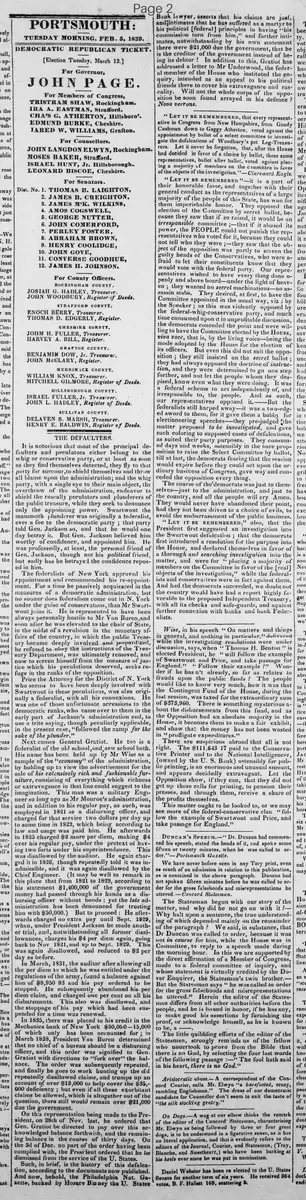
THE DEFAULTERS
It is notorious that most of the principal defaulters and peculators either belong to the whig or conservative party, or at least as soon as they find themselves detected, they fly to that party for succour, to shield themselves and throw all blame upon the administration; and the whig party, with a single eye to their main object, the overthrow of the administration, endeavor to shield the rascally peculators and plunderers of the public treasure, while they seek to denounce only the appointing power. Swartwout the mammoth plunderer was originally a federalist, ever a foe to the democratic party ; that party told Gen. Jackson so, and that he would one day betray it. But Gen. Jackson believed him worthy of confidence, and appointed him. He was professedly, at least, the personal friend of Gen. Jackson, though not his political friend, but sadly has he betrayed the confidence reposed in him. The federalists of New York approved his appointment and recommended his re-appointment. For a time he passively acquiesced in the measures of a democratic administration, but no sooner does federalism come out in N. York under the guise of conservatism, than Mr Swartwout joins it. He is represented to have been always personally hostile to Mr Van Buren, and soon after he was elevated to the chair of State in the midst of a revulsion in the monetary affairs of the country, in which the public Treasury became deeply involved and jeopardized, he refused to obey the instructions of the Treasury Department, was ultimately removed, and now to screen himself from the measure of justice which his peculations deserved, seeks refuge in the ranks of the opposition. Price the Attorney for the District of N. York who seems to have been deeply involved with Swartwout in these peculations, was also originally a federalist, with all his connexions. He was one of those unfortunate accessions to the democratic ranks, who came over to them in the early part of Jackson's administration and, to use a trite saying, though peculiarly applicable, in the present case, "followed the camp for the sake of the plunder." Next comes General Gratiot. He too is a federalist of the old school, and new school both. His name has been held up by Mr Wise as a sample of the "economy" of the administration. by holding up to view the advertisement for the sale of his extensively rich and fashionable furniture, consisting of everything which richness or extravagance in that line could suggest to the imagination. This man was a military Engineer so long ago as Mr Monroe's administration, and in addition to his regular pay, as such, was employed in 1821 as a disbursing officer, and charged for that service two dollars per day up to some time in 1822, which being according to law and usage was paid him. He afterwards in 1825 charged $2 more per diem, making $4 over his regular pay, under the pretext of having two forts under his superintendence. This was disallowed by the auditor. He again charged it in 1826, though repeatedly told it was inadmissible, and it was again disallowed by the Chief Engineer. (It may be well to remark in this place that from 1821 to 1829, according to his statement $1,400,000 of the government money had passed through his hands as a disbursing officer without bonds : yet the late administration has been denounced for trusting him with $50,000.) But to proceed: He afterwards charged no extra pay until Sept. 1829, when, under President Jackson he made another trial, and, notwithstanding all former disallowances, charges his $4 per diem again, going back to Nov 1821, and up to Sept. 1829. This was again disallowed, and reduced to $2 per day as before. In March, 1831, the auditor after allowing all the per diem to which he was entitled under the regulations of the army, found a balance against him of $8,950 83 and his pay ordered to be stopped. He subsequently abandoned his per diem claim, and charged one per cent on all his disbursements. This also was disallowed, and the stoppage of his pay which had been suspended for a time was renewed. In 1835, there was placed to his credit in the Mechanics bank of New York $50,000—$15,000 of which only has been accounted for ; in March 1838, President Van Buren determined that no chief of a bureau should be a disbursing officer, and this order was signified to Gen. Gratiot with directions to "work over" the balance. The order was subsequently repeated, and finally he goes to work hunting up the old repeatedly disallowed claims, and trumps up an account of over $13,000 to help cover the $35,000 deficiency ; but even if all these exorbitant claims be allowed, which is altogether out of the question, there still would remain over $21,000 due the government. On this representation being made to the President, on 28th of Nov. last, he ordered that Gen. Gratiot be directed to pay over this acknowledged balance forthwith. and the remaining balance in the course of thirty days. On the 3d of Dec. no part of the order having been complied with, the President ordered that he be dismissed from the service of the U. States. Such, in brief, is the history of this defalcation, according to the documents now published. And now, behold, the Philadelphia Nat. Gazette, backed by Horace Binney the U. States Bank lawyer, asserts that his claims are just, and intimates that he has suffered as a martyr to his political [federal] principles in having "his commission torn from him," and further intimates, notwithstanding by his own statement there were $21,000 due the government, that he is the creditor of the government instead of being its debtor ! In addition to this, Gratiot has addressed a letter to Mr Underwood, the federal member of the House who instituted the enquiry, intended as an appeal to his political friends there to cover his extravagance and rascality. Will not the whole corps of the opposition be soon found arrayed in his defence ? Nous verrons.
" Let it be remembered, that every representative in Congress from New Hampshire, from Goody Cushman down to Gaggy Atherton, voted against the appointment by ballot of a select committee to investigate the defalcations of Woodbury's pet Leg-Treasurers. Let it never be forgotten, that, after the House had decided in favor of a choice by ballot, these same representatives, ballot after ballot, voted against placing a majority of members on the committee in favor of the objects of the investigation."—Claremont Eagle.
"Let it be remembered"—it is a part of their honorable fame, and together with their general conduct as the representatives of a large majority of the people of this State, has won for them imperishable honor. They opposed the election of the Committee by secret ballot, because they saw that if so raised, it would be an irresponsible committee ;-that if it abused its power, the PEOPLE could not punish the representatives who voted for it, because they could not tell who they were ;-they saw that the object of the opposition was partly to screen the guilty heads of the Conservatives, who were afraid to let their constituents know that they would vote with the federal party. Our representatives wished to have every thing done openly and above board—under the light of heaven ; they wanted no secret machinations—no assassin stabs. They desired, at first, to have the Committee appointed in the usual way, viz : by the Speaker ; as this was violently opposed by the federal-whig-conservative party, and much time consumed upon it in unprofitable discussion, the democrats conceded the point and were willing to have the Committee elected by the House, viva voce, that is, by the living voice—being the mode adopted by the House for the election of its officers. But even this did not suit the opposition ; they still insisted on the secret ballot ; they had always opposed the doctrine of instruction, and they were determined to go one step further, and not let the people whom they despised, know even what they were doing. It was a federal scheme to act independently of, and irresponsible to, the people. And as such, our representatives opposed it.—But the federalists still harped away—it was a two-edged sword to them, for it gave them a hobbs for electioneering speeches—they pre-judged the matter proposed to be investigated, and gave such coloring to supposed cases of defalcations, as suited their party purposes. They consumed days and weeks, ostensibly in the bare proposition to raise the Select Committee by ballot, till at last, the democrats fearing that the session would expire before they could act upon the ordinary business of Congress, gave way and conceded the opposition every thing. The course of the democrats was just to themselves—just to the administration, and just to the country, and all the people will cry Amen. They would never have abandoned their point, had they not been driven to a choice of evils, to avoid the embarrassment of the public business.
"LET IT BE REMEMBERED," also, that the President first suggested an investigation into the Swartwout defalcation ; that the democrats first introduced a resolution for the purpose into the House, and declared themselves in favor of a thorough and searching investigation into the matter, and were for "placing a majority of members on the Committee in favor of the [real] objects of the investigation," while the federalists and conservatives were in fact against them. And had the democrats succeeded, we doubt not the country would have had a report highly favorable to the proposed Independent Treasury, with all its checks and safe-guards, and against further connexion with banks and bank Federalists.
Wise, in his speech " On matters and things in general, and nothing in particular," delivered while the investigating resolutions were under discussion, says, when " Thomas H. Benton " is elected President. he " will follow the example of Swartwout and Price, and take passage for England." "Follow their example ?" Wonder if he hasn't already, so far as relates to frauds upon the public funds ? The people would like to know very much, how it was that the Contingent Fund of the House, during the last session, was taxed for the extraordinary sum of $373,960. There is something mysterious about the disbursements from this fund, and as the Opposition had an absolute majority in the House, it becomes them to make a fair exhibit, and show that the money has not been wasted in "profligate expenditures." There are suspicions abroad that all is not right. The $111,643 17 paid to the Conservative Printer and to the National Intelligencer, (owned by the U. S. Bank) ostensibly for public printing, is an enormous and unusual amount, and appears decidedly extravagant. Let the Opposition show, if they can, that they did not get up these calls for printing, to pension their presses, and through them, receive a share of the profits themselves. This matter ought to be looked to, or we may see more of the federal-conservative clan "follow the example of Swartwout and Price, and take passage for England."
Duncan's Speech.—" Dr. Duncan had commenced his speech, stated the heads of it, and spoke some fifteen or twenty minutes, when he was called to order."—Portsmouth Gazette.
We have never before seen in any Tory print, even as much of an admission in relation to this publication, as is contained in the above paragraph. Duncan had not spoken fifteen minutes before he was called to order for the gross falsehoods and misrepresentations he uttered.—Concord Statesman.
The Statesman begun with our story of the matter, and why did he not go on with it?— Why halt upon a sentence. the true understanding of which depended mainly on the remainder of the paragraph ? We said, in substance, that Dr Duncan was called to order, because it was not in course for him, while the House was in Committee, to reply to a speech made during the morning hour, In this we are supported by the direct affirmation of a Member of Congress, made to a federal committee of inquiry, and whose statement is virtually credited by the Dover Enquirer, the Statesman's twin brother.— But the Statesman says " he was called to order for the gross falsehoods and misrepresentations he uttered." Herein the editor of the Statesman differs from all other authorities before the people, and he is bound in honor, if he has any, to make good his assertions by furnishing the proof, or acknowledge himself, as he is known to be, a
The little quibbling efforts of the editor of the Statesman, strongly reminds us of the fellow who undertook to prove from the Bible that there is no God, by selecting the four last words of the following passage :—" The fool hath said in his heart, there is no God."
Aristocratic abuse.—A correspondent of the Concord Courier, calls Mr. Elwyn "a barefooted, crazy, rambling Englishman." The dress of our democratic candidate for Councillor don't seem to suit the taste of "the silk stocking gentry.
On Dogs. A wag at our elbow thinks the remark of the editor of the Concord Statesman, characterising Mr. Elwyn as being followed by three or four great dogs, is to be understood in a figurative sense, as it has no literal application, and that it evidently refers to the editors of the Journal, Courier, and Statesman, (Tray, Blanche, and Sweetheart,) who have been barking at his heels ever since he was put in nomination.
Daniel Webster has been re-elected to the U. States Senate for another term of six years. He received 364 votes, B. F. Hallett 169, scattering 8.
It is notorious that most of the principal defaulters and peculators either belong to the whig or conservative party, or at least as soon as they find themselves detected, they fly to that party for succour, to shield themselves and throw all blame upon the administration; and the whig party, with a single eye to their main object, the overthrow of the administration, endeavor to shield the rascally peculators and plunderers of the public treasure, while they seek to denounce only the appointing power. Swartwout the mammoth plunderer was originally a federalist, ever a foe to the democratic party ; that party told Gen. Jackson so, and that he would one day betray it. But Gen. Jackson believed him worthy of confidence, and appointed him. He was professedly, at least, the personal friend of Gen. Jackson, though not his political friend, but sadly has he betrayed the confidence reposed in him. The federalists of New York approved his appointment and recommended his re-appointment. For a time he passively acquiesced in the measures of a democratic administration, but no sooner does federalism come out in N. York under the guise of conservatism, than Mr Swartwout joins it. He is represented to have been always personally hostile to Mr Van Buren, and soon after he was elevated to the chair of State in the midst of a revulsion in the monetary affairs of the country, in which the public Treasury became deeply involved and jeopardized, he refused to obey the instructions of the Treasury Department, was ultimately removed, and now to screen himself from the measure of justice which his peculations deserved, seeks refuge in the ranks of the opposition. Price the Attorney for the District of N. York who seems to have been deeply involved with Swartwout in these peculations, was also originally a federalist, with all his connexions. He was one of those unfortunate accessions to the democratic ranks, who came over to them in the early part of Jackson's administration and, to use a trite saying, though peculiarly applicable, in the present case, "followed the camp for the sake of the plunder." Next comes General Gratiot. He too is a federalist of the old school, and new school both. His name has been held up by Mr Wise as a sample of the "economy" of the administration. by holding up to view the advertisement for the sale of his extensively rich and fashionable furniture, consisting of everything which richness or extravagance in that line could suggest to the imagination. This man was a military Engineer so long ago as Mr Monroe's administration, and in addition to his regular pay, as such, was employed in 1821 as a disbursing officer, and charged for that service two dollars per day up to some time in 1822, which being according to law and usage was paid him. He afterwards in 1825 charged $2 more per diem, making $4 over his regular pay, under the pretext of having two forts under his superintendence. This was disallowed by the auditor. He again charged it in 1826, though repeatedly told it was inadmissible, and it was again disallowed by the Chief Engineer. (It may be well to remark in this place that from 1821 to 1829, according to his statement $1,400,000 of the government money had passed through his hands as a disbursing officer without bonds : yet the late administration has been denounced for trusting him with $50,000.) But to proceed: He afterwards charged no extra pay until Sept. 1829, when, under President Jackson he made another trial, and, notwithstanding all former disallowances, charges his $4 per diem again, going back to Nov 1821, and up to Sept. 1829. This was again disallowed, and reduced to $2 per day as before. In March, 1831, the auditor after allowing all the per diem to which he was entitled under the regulations of the army, found a balance against him of $8,950 83 and his pay ordered to be stopped. He subsequently abandoned his per diem claim, and charged one per cent on all his disbursements. This also was disallowed, and the stoppage of his pay which had been suspended for a time was renewed. In 1835, there was placed to his credit in the Mechanics bank of New York $50,000—$15,000 of which only has been accounted for ; in March 1838, President Van Buren determined that no chief of a bureau should be a disbursing officer, and this order was signified to Gen. Gratiot with directions to "work over" the balance. The order was subsequently repeated, and finally he goes to work hunting up the old repeatedly disallowed claims, and trumps up an account of over $13,000 to help cover the $35,000 deficiency ; but even if all these exorbitant claims be allowed, which is altogether out of the question, there still would remain over $21,000 due the government. On this representation being made to the President, on 28th of Nov. last, he ordered that Gen. Gratiot be directed to pay over this acknowledged balance forthwith. and the remaining balance in the course of thirty days. On the 3d of Dec. no part of the order having been complied with, the President ordered that he be dismissed from the service of the U. States. Such, in brief, is the history of this defalcation, according to the documents now published. And now, behold, the Philadelphia Nat. Gazette, backed by Horace Binney the U. States Bank lawyer, asserts that his claims are just, and intimates that he has suffered as a martyr to his political [federal] principles in having "his commission torn from him," and further intimates, notwithstanding by his own statement there were $21,000 due the government, that he is the creditor of the government instead of being its debtor ! In addition to this, Gratiot has addressed a letter to Mr Underwood, the federal member of the House who instituted the enquiry, intended as an appeal to his political friends there to cover his extravagance and rascality. Will not the whole corps of the opposition be soon found arrayed in his defence ? Nous verrons.
" Let it be remembered, that every representative in Congress from New Hampshire, from Goody Cushman down to Gaggy Atherton, voted against the appointment by ballot of a select committee to investigate the defalcations of Woodbury's pet Leg-Treasurers. Let it never be forgotten, that, after the House had decided in favor of a choice by ballot, these same representatives, ballot after ballot, voted against placing a majority of members on the committee in favor of the objects of the investigation."—Claremont Eagle.
"Let it be remembered"—it is a part of their honorable fame, and together with their general conduct as the representatives of a large majority of the people of this State, has won for them imperishable honor. They opposed the election of the Committee by secret ballot, because they saw that if so raised, it would be an irresponsible committee ;-that if it abused its power, the PEOPLE could not punish the representatives who voted for it, because they could not tell who they were ;-they saw that the object of the opposition was partly to screen the guilty heads of the Conservatives, who were afraid to let their constituents know that they would vote with the federal party. Our representatives wished to have every thing done openly and above board—under the light of heaven ; they wanted no secret machinations—no assassin stabs. They desired, at first, to have the Committee appointed in the usual way, viz : by the Speaker ; as this was violently opposed by the federal-whig-conservative party, and much time consumed upon it in unprofitable discussion, the democrats conceded the point and were willing to have the Committee elected by the House, viva voce, that is, by the living voice—being the mode adopted by the House for the election of its officers. But even this did not suit the opposition ; they still insisted on the secret ballot ; they had always opposed the doctrine of instruction, and they were determined to go one step further, and not let the people whom they despised, know even what they were doing. It was a federal scheme to act independently of, and irresponsible to, the people. And as such, our representatives opposed it.—But the federalists still harped away—it was a two-edged sword to them, for it gave them a hobbs for electioneering speeches—they pre-judged the matter proposed to be investigated, and gave such coloring to supposed cases of defalcations, as suited their party purposes. They consumed days and weeks, ostensibly in the bare proposition to raise the Select Committee by ballot, till at last, the democrats fearing that the session would expire before they could act upon the ordinary business of Congress, gave way and conceded the opposition every thing. The course of the democrats was just to themselves—just to the administration, and just to the country, and all the people will cry Amen. They would never have abandoned their point, had they not been driven to a choice of evils, to avoid the embarrassment of the public business.
"LET IT BE REMEMBERED," also, that the President first suggested an investigation into the Swartwout defalcation ; that the democrats first introduced a resolution for the purpose into the House, and declared themselves in favor of a thorough and searching investigation into the matter, and were for "placing a majority of members on the Committee in favor of the [real] objects of the investigation," while the federalists and conservatives were in fact against them. And had the democrats succeeded, we doubt not the country would have had a report highly favorable to the proposed Independent Treasury, with all its checks and safe-guards, and against further connexion with banks and bank Federalists.
Wise, in his speech " On matters and things in general, and nothing in particular," delivered while the investigating resolutions were under discussion, says, when " Thomas H. Benton " is elected President. he " will follow the example of Swartwout and Price, and take passage for England." "Follow their example ?" Wonder if he hasn't already, so far as relates to frauds upon the public funds ? The people would like to know very much, how it was that the Contingent Fund of the House, during the last session, was taxed for the extraordinary sum of $373,960. There is something mysterious about the disbursements from this fund, and as the Opposition had an absolute majority in the House, it becomes them to make a fair exhibit, and show that the money has not been wasted in "profligate expenditures." There are suspicions abroad that all is not right. The $111,643 17 paid to the Conservative Printer and to the National Intelligencer, (owned by the U. S. Bank) ostensibly for public printing, is an enormous and unusual amount, and appears decidedly extravagant. Let the Opposition show, if they can, that they did not get up these calls for printing, to pension their presses, and through them, receive a share of the profits themselves. This matter ought to be looked to, or we may see more of the federal-conservative clan "follow the example of Swartwout and Price, and take passage for England."
Duncan's Speech.—" Dr. Duncan had commenced his speech, stated the heads of it, and spoke some fifteen or twenty minutes, when he was called to order."—Portsmouth Gazette.
We have never before seen in any Tory print, even as much of an admission in relation to this publication, as is contained in the above paragraph. Duncan had not spoken fifteen minutes before he was called to order for the gross falsehoods and misrepresentations he uttered.—Concord Statesman.
The Statesman begun with our story of the matter, and why did he not go on with it?— Why halt upon a sentence. the true understanding of which depended mainly on the remainder of the paragraph ? We said, in substance, that Dr Duncan was called to order, because it was not in course for him, while the House was in Committee, to reply to a speech made during the morning hour, In this we are supported by the direct affirmation of a Member of Congress, made to a federal committee of inquiry, and whose statement is virtually credited by the Dover Enquirer, the Statesman's twin brother.— But the Statesman says " he was called to order for the gross falsehoods and misrepresentations he uttered." Herein the editor of the Statesman differs from all other authorities before the people, and he is bound in honor, if he has any, to make good his assertions by furnishing the proof, or acknowledge himself, as he is known to be, a
The little quibbling efforts of the editor of the Statesman, strongly reminds us of the fellow who undertook to prove from the Bible that there is no God, by selecting the four last words of the following passage :—" The fool hath said in his heart, there is no God."
Aristocratic abuse.—A correspondent of the Concord Courier, calls Mr. Elwyn "a barefooted, crazy, rambling Englishman." The dress of our democratic candidate for Councillor don't seem to suit the taste of "the silk stocking gentry.
On Dogs. A wag at our elbow thinks the remark of the editor of the Concord Statesman, characterising Mr. Elwyn as being followed by three or four great dogs, is to be understood in a figurative sense, as it has no literal application, and that it evidently refers to the editors of the Journal, Courier, and Statesman, (Tray, Blanche, and Sweetheart,) who have been barking at his heels ever since he was put in nomination.
Daniel Webster has been re-elected to the U. States Senate for another term of six years. He received 364 votes, B. F. Hallett 169, scattering 8.
What sub-type of article is it?
Partisan Politics
Crime Or Punishment
Economic Policy
What keywords are associated?
Defaulters
Peculators
Swartwout
Gratiot
Federalists
Democrats
Partisan Politics
Congressional Investigations
Public Funds
Daniel Webster
What entities or persons were involved?
Swartwout
Gen. Jackson
Mr Van Buren
Price
General Gratiot
Mr Wise
Horace Binney
Daniel Webster
Thomas H. Benton
Dr. Duncan
Mr. Elwyn
Editorial Details
Primary Topic
Defalcations By Federalist Officials And Partisan Defense Of Democratic Administration
Stance / Tone
Defensive Of Democrats, Accusatory Towards Federalists And Conservatives
Key Figures
Swartwout
Gen. Jackson
Mr Van Buren
Price
General Gratiot
Mr Wise
Horace Binney
Daniel Webster
Thomas H. Benton
Dr. Duncan
Mr. Elwyn
Key Arguments
Principal Defaulters Are Whigs, Conservatives, Or Former Federalists Seeking Opposition Protection
Swartwout Betrayed Jackson's Trust And Joined Conservatives
Price Joined Democrats For Plunder
Gratiot's Repeated Disallowed Claims And $21,000 Deficiency Led To Dismissal
Opposition Obstructed Open Investigations To Screen Allies
Democrats Favored Thorough Probes Into Defalcations
Suspicions Of Opposition Misuse Of Contingent Fund For Party Presses
Webster Re Elected To Senate