Thank you for visiting SNEWPapers!
Sign up free
Editorial
June 29, 1808
The National Intelligencer And Washington Advertiser
Washington, District Of Columbia
What is this article about?
An anonymous 'Farmer' argues in the National Intelligencer for James Madison's election as President to ensure continuity of Thomas Jefferson's policies, particularly maintaining U.S. neutrality in foreign affairs amid European conflicts, warning that other candidates might signal weakness to belligerents.
Clipping
OCR Quality
98%
Excellent
Full Text
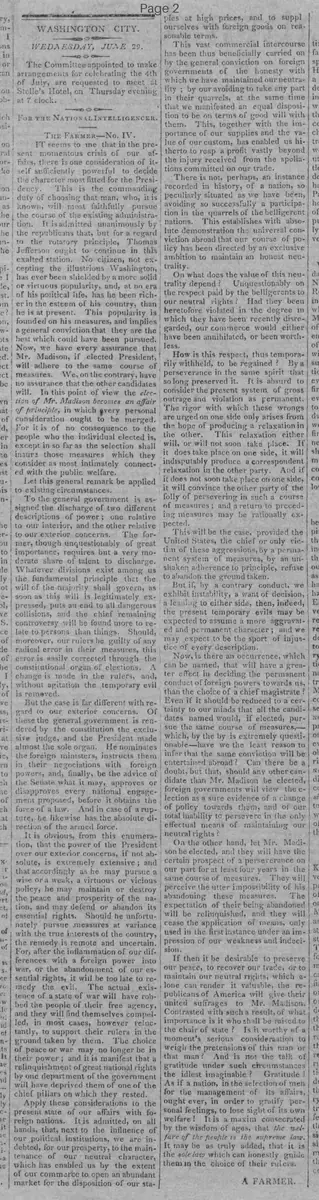
FOR THE NATIONAL INTELLIGENCER.
THE FARMER—No. IV.
It seems to me that in the present momentous crisis of our affairs, there is one consideration of itself sufficiently powerful to decide the character most fitted for the Presidency. This is the commanding duty of choosing that man, who, it is known, will most faithfully pursue the course of the existing administration. It is admitted unanimously by the republicans that, but for a regard to the rotatory principle, Thomas Jefferson ought to continue in this exalted station. No citizen, not excepting the illustrious Washington, has ever been shielded by a more solid or virtuous popularity, and, at no era of his political life, has he been richer in the esteem of his country, than he is at present. This popularity is founded on his measures, and implies a general conviction that they are the best which could have been pursued.
Now, we have every assurance that Mr. Madison, if elected President, will adhere to the same course of measures. We, on the contrary, have no assurance that the other candidates will. In this point of view the election of Mr. Madison becomes an affair of principle, in which every personal consideration ought to be merged. For it is of no consequence to the people who the individual elected is, except in so far as the selection shall insure those measures which they consider as most intimately connected with the public welfare.
Let this general remark be applied to existing circumstances.
To the general government is assigned the discharge of two different descriptions of power; one relative to our interior, and the other relative to our exterior concerns. The former, though unquestionably of great importance, requires but a very moderate share of talent to discharge. Whatever divisions exist among us the fundamental principle that the will of the majority shall govern, as soon as this will is legitimately expressed, puts an end to all dangerous collisions, and the chief remaining controversy will be found more to relate to persons than things. Should, moreover, our rulers be guilty of any radical error in their measures, this error is easily corrected through the constitutional organ of elections. A change is made in the rulers, and without agitation the temporary evil is removed.
But the case is far different with regard to our exterior concerns. Of these the general government is rendered by the constitution the exclusive judge, and the President made almost the sole organ. He nominates the foreign ministers, instructs them in their negociations with foreign powers, and, finally, be the advice of the Senate what it may, approves or disapproves every national engagement proposed, before it obtains the force of a law. And in case of a rupture, he likewise has the absolute direction of the armed force.
It is obvious, from this enumeration, that the power of the President over our exterior concerns, if not absolute, is extremely extensive; and that accordingly as he may pursue a wise or a weak, a virtuous or vicious policy, he may maintain or destroy the peace and prosperity of the nation, and may defend or abandon its essential rights. Should he unfortunately pursue measures at variance with the true interests of the country, the remedy is remote and uncertain. For, after the inflammation of our differences with a foreign power into war, or the abandonment of our essential rights, it will be too late to remedy the evil. The actual existence of a state of war will have robbed the people of their free agency, and they will find themselves compelled, in most cases, however reluctantly, to support their rulers in the ground taken by them. The choice of peace or war may no longer be in their power; and it is manifest that a relinquishment of great national rights by one department of the government will have deprived them of one of the chief pillars on which they rested.
Apply these considerations to the present state of our affairs with foreign nations. It is admitted, on all hands, that, next to the influence of our political institutions, we are indebted, for our prosperity, to the maintenance of our neutral character, which has enabled us by the extent of our commerce to open an abundant market for the disposition of our staples at high prices, and to supply ourselves with foreign goods on reasonable terms.
This vast commercial intercourse has been thus beneficially carried on by the general conviction on foreign governments of the honesty with which we have maintained our neutrality; by our avoiding to take any part in their quarrels, at the same time that we manifested an equal disposition to be on terms of good will with them. This, together with the importance of our supplies and the value of our custom, has enabled us hitherto to reap a profit vastly beyond the injury received from the spoliations committed on our trade.
There is not, perhaps, an instance recorded in history, of a nation, so peculiarly situated as we have been, avoiding so successfully a participation in the quarrels of the belligerent nations. This establishes with absolute demonstration the universal conviction abroad that our course of policy has been directed by an exclusive ambition to maintain an honest neutrality.
On what does the value of this neutrality depend? Unquestionably on the respect paid by the belligerents to our neutral rights? Had they been heretofore violated in the degree in which they have been recently disregarded, our commerce would either have been annihilated, or been worthless.
How is this respect, thus temporarily withheld, to be regained? By a perseverance in the same spirit that so long preserved it. It is absurd to consider the present system of gross outrage and violation as permanent. The rigor with which these wrongs are urged on one side only arises from the hope of producing a relaxation in the other. This relaxation either will, or will not soon take place. If it does take place on one side, it will indisputably produce a correspondent relaxation in the other party. And if it does not soon take place on one side, it will convince the other party of the folly of persevering in such a course of measures; and a return to preceding measures may be rationally expected.
This will be the case, provided the United States, the chief or only victim of these aggressions, by a permanent system of measures, by an unshaken adherence to principle, refuse to abandon the ground taken. But if, by a contrary conduct, we exhibit instability, a want of decision, a leaning to either side, then, indeed, the present temporary evils may be expected to assume a more aggravated and permanent character; and we may expect to be the sport of injustice of every description.
Now, is there an occurrence, which can be named, that will have a greater effect in deciding the permanent conduct of foreign powers towards us, than the choice of a chief magistrate? Even if it should be reduced to a certainty to our minds that all the candidates named would, if elected, pursue the same course of measures,—which, by the by is extremely questionable—have we the least reason to infer that the same conviction will be entertained abroad? Can there be a doubt, but that, should any other candidate than Mr. Madison be elected, foreign governments will view the election as a sure evidence of a change of policy towards them, and of our total inability to persevere in the only effectual means of maintaining our neutral rights?
On the other hand, let Mr. Madison be elected, and they will have the certain prospect of a perseverance on our part for at least four years in the same course of measures. They will perceive the utter impossibility of his abandoning these measures. The expectation of their being abandoned will be relinquished, and they will cease the application of means, only used in the first instance under an impression of our weakness and indecision.
If then it be desirable to preserve our peace, to recover our trade, or to maintain our neutral rights, which alone can render it valuable, the republicans of America will give their united suffrages to Mr. Madison.
Contrasted with such a result, of what importance is it who shall be raised to the chair of state? Is it worthy of a moment's serious consideration to weigh the pretensions of this man or that man? And is not the talk of gratitude under such circumstances the idlest imaginable? Gratitude! As if a nation, in the selection of men for the management of its affairs, ought ever, in order to gratify personal feelings, to lose sight of its own welfare! It is a maxim consecrated by the wisdom of ages, that the welfare of the people is the supreme law. It may be as truly added, that it is the sole law which can honestly guide them in the choice of their rulers.
A FARMER.
THE FARMER—No. IV.
It seems to me that in the present momentous crisis of our affairs, there is one consideration of itself sufficiently powerful to decide the character most fitted for the Presidency. This is the commanding duty of choosing that man, who, it is known, will most faithfully pursue the course of the existing administration. It is admitted unanimously by the republicans that, but for a regard to the rotatory principle, Thomas Jefferson ought to continue in this exalted station. No citizen, not excepting the illustrious Washington, has ever been shielded by a more solid or virtuous popularity, and, at no era of his political life, has he been richer in the esteem of his country, than he is at present. This popularity is founded on his measures, and implies a general conviction that they are the best which could have been pursued.
Now, we have every assurance that Mr. Madison, if elected President, will adhere to the same course of measures. We, on the contrary, have no assurance that the other candidates will. In this point of view the election of Mr. Madison becomes an affair of principle, in which every personal consideration ought to be merged. For it is of no consequence to the people who the individual elected is, except in so far as the selection shall insure those measures which they consider as most intimately connected with the public welfare.
Let this general remark be applied to existing circumstances.
To the general government is assigned the discharge of two different descriptions of power; one relative to our interior, and the other relative to our exterior concerns. The former, though unquestionably of great importance, requires but a very moderate share of talent to discharge. Whatever divisions exist among us the fundamental principle that the will of the majority shall govern, as soon as this will is legitimately expressed, puts an end to all dangerous collisions, and the chief remaining controversy will be found more to relate to persons than things. Should, moreover, our rulers be guilty of any radical error in their measures, this error is easily corrected through the constitutional organ of elections. A change is made in the rulers, and without agitation the temporary evil is removed.
But the case is far different with regard to our exterior concerns. Of these the general government is rendered by the constitution the exclusive judge, and the President made almost the sole organ. He nominates the foreign ministers, instructs them in their negociations with foreign powers, and, finally, be the advice of the Senate what it may, approves or disapproves every national engagement proposed, before it obtains the force of a law. And in case of a rupture, he likewise has the absolute direction of the armed force.
It is obvious, from this enumeration, that the power of the President over our exterior concerns, if not absolute, is extremely extensive; and that accordingly as he may pursue a wise or a weak, a virtuous or vicious policy, he may maintain or destroy the peace and prosperity of the nation, and may defend or abandon its essential rights. Should he unfortunately pursue measures at variance with the true interests of the country, the remedy is remote and uncertain. For, after the inflammation of our differences with a foreign power into war, or the abandonment of our essential rights, it will be too late to remedy the evil. The actual existence of a state of war will have robbed the people of their free agency, and they will find themselves compelled, in most cases, however reluctantly, to support their rulers in the ground taken by them. The choice of peace or war may no longer be in their power; and it is manifest that a relinquishment of great national rights by one department of the government will have deprived them of one of the chief pillars on which they rested.
Apply these considerations to the present state of our affairs with foreign nations. It is admitted, on all hands, that, next to the influence of our political institutions, we are indebted, for our prosperity, to the maintenance of our neutral character, which has enabled us by the extent of our commerce to open an abundant market for the disposition of our staples at high prices, and to supply ourselves with foreign goods on reasonable terms.
This vast commercial intercourse has been thus beneficially carried on by the general conviction on foreign governments of the honesty with which we have maintained our neutrality; by our avoiding to take any part in their quarrels, at the same time that we manifested an equal disposition to be on terms of good will with them. This, together with the importance of our supplies and the value of our custom, has enabled us hitherto to reap a profit vastly beyond the injury received from the spoliations committed on our trade.
There is not, perhaps, an instance recorded in history, of a nation, so peculiarly situated as we have been, avoiding so successfully a participation in the quarrels of the belligerent nations. This establishes with absolute demonstration the universal conviction abroad that our course of policy has been directed by an exclusive ambition to maintain an honest neutrality.
On what does the value of this neutrality depend? Unquestionably on the respect paid by the belligerents to our neutral rights? Had they been heretofore violated in the degree in which they have been recently disregarded, our commerce would either have been annihilated, or been worthless.
How is this respect, thus temporarily withheld, to be regained? By a perseverance in the same spirit that so long preserved it. It is absurd to consider the present system of gross outrage and violation as permanent. The rigor with which these wrongs are urged on one side only arises from the hope of producing a relaxation in the other. This relaxation either will, or will not soon take place. If it does take place on one side, it will indisputably produce a correspondent relaxation in the other party. And if it does not soon take place on one side, it will convince the other party of the folly of persevering in such a course of measures; and a return to preceding measures may be rationally expected.
This will be the case, provided the United States, the chief or only victim of these aggressions, by a permanent system of measures, by an unshaken adherence to principle, refuse to abandon the ground taken. But if, by a contrary conduct, we exhibit instability, a want of decision, a leaning to either side, then, indeed, the present temporary evils may be expected to assume a more aggravated and permanent character; and we may expect to be the sport of injustice of every description.
Now, is there an occurrence, which can be named, that will have a greater effect in deciding the permanent conduct of foreign powers towards us, than the choice of a chief magistrate? Even if it should be reduced to a certainty to our minds that all the candidates named would, if elected, pursue the same course of measures,—which, by the by is extremely questionable—have we the least reason to infer that the same conviction will be entertained abroad? Can there be a doubt, but that, should any other candidate than Mr. Madison be elected, foreign governments will view the election as a sure evidence of a change of policy towards them, and of our total inability to persevere in the only effectual means of maintaining our neutral rights?
On the other hand, let Mr. Madison be elected, and they will have the certain prospect of a perseverance on our part for at least four years in the same course of measures. They will perceive the utter impossibility of his abandoning these measures. The expectation of their being abandoned will be relinquished, and they will cease the application of means, only used in the first instance under an impression of our weakness and indecision.
If then it be desirable to preserve our peace, to recover our trade, or to maintain our neutral rights, which alone can render it valuable, the republicans of America will give their united suffrages to Mr. Madison.
Contrasted with such a result, of what importance is it who shall be raised to the chair of state? Is it worthy of a moment's serious consideration to weigh the pretensions of this man or that man? And is not the talk of gratitude under such circumstances the idlest imaginable? Gratitude! As if a nation, in the selection of men for the management of its affairs, ought ever, in order to gratify personal feelings, to lose sight of its own welfare! It is a maxim consecrated by the wisdom of ages, that the welfare of the people is the supreme law. It may be as truly added, that it is the sole law which can honestly guide them in the choice of their rulers.
A FARMER.
What sub-type of article is it?
Partisan Politics
Foreign Affairs
War Or Peace
What keywords are associated?
Presidential Election
James Madison
Thomas Jefferson
Neutrality
Foreign Policy
Republicans
Neutral Rights
What entities or persons were involved?
James Madison
Thomas Jefferson
George Washington
Republicans
Belligerent Nations
Editorial Details
Primary Topic
Endorsement Of James Madison For President To Maintain Neutrality Policy
Stance / Tone
Strong Advocacy For Madison's Election To Ensure Policy Continuity
Key Figures
James Madison
Thomas Jefferson
George Washington
Republicans
Belligerent Nations
Key Arguments
Madison Will Faithfully Continue Jefferson's Successful Administration Policies
Presidential Power Over Foreign Affairs Is Extensive And Critical For Peace And Neutrality
Election Of Other Candidates Would Signal Instability To Foreign Powers, Worsening Violations Of Neutral Rights
U.S. Prosperity Depends On Maintaining Honest Neutrality Amid European Wars
Personal Considerations Like Gratitude Should Not Override National Welfare In Choosing Leaders