Thank you for visiting SNEWPapers!
Sign up free
The Portland Daily Press
Portland, Cumberland County, Maine
What is this article about?
An article challenges the theory that Black children cannot be educated beyond age 14 by recounting the self-education of a slave named George, who secretly learned to read, mastered Latin and Greek grammars alone, and received brief tutoring from an Irish instructor in exchange for whiskey, eventually becoming a freeman during the Civil War.
Clipping
OCR Quality
Full Text
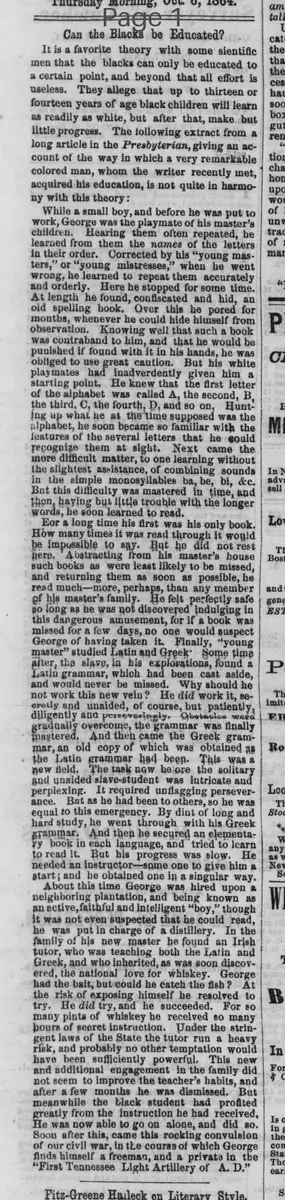
It is a favorite theory with some scientific men that the blacks can only be educated to a certain point, and beyond that all effort is useless. They allege that up to thirteen or fourteen years of age black children will learn as readily as white, but after that, make but little progress. The following extract from a long article in the Presbyterian, giving an account of the way in which a very remarkable colored man, whom the writer recently met, acquired his education, is not quite in harmony with this theory:
While a small boy, and before he was put to work, George was the playmate of his master's children. Hearing them often repeated, he learned from them the names of the letters in their order, Corrected by his "young masters," or "young mistresses," when he went wrong, he learned to repeat them accurately and orderly. Here he stopped for some time. At length he found, confiscated and hid, an old spelling book. Over this he pored for months, whenever he could hide himself from observation. Knowing well that such a book was contraband to him, and that he would be punished if found with it in his hands, he was obliged to use great caution. But his white playmates had inadvertently given him a starting point. He knew that the first letter of the alphabet was called A, the second, B, the third, C, the fourth, D, and so on. Hunting out what he at the time supposed was the alphabet, he soon became so familiar with the features of the several letters that he could recognize them at sight. Next came the more difficult matter, to one learning without the slightest assistance, of combining sounds in the simple monosyllables ba, be, bi, &c. But this difficulty was mastered in time, and then, having but little trouble with the longer words, he soon learned to read.
For a long time his first was his only book. How many times it was read through it would be impossible to say. But he did not rest here. Abstracting from his master's house such books as were least likely to be missed, and returning them as soon as possible, he read much more, perhaps, than any member of his master's family. He felt perfectly safe so long as he was not discovered indulging in this dangerous amusement, for if a book was missed for a few days, no one would suspect George of having taken it. Finally, "young master" studied Latin and Greek. Some time after, the slave, in his explorations, found a Latin grammar, which had been cast aside, and would never be missed. Why should he not work this new vein? He did work it, secretly and unaided, of course, but patiently, diligently and perseveringly. Obstacles were gradually overcome, the grammar was finally mastered. And then came the Greek grammar, an old copy of which was obtained as the Latin grammar had been. This was a new field. The task now before the solitary and unaided slave-student was intricate and perplexing. It required unflagging perseverance. But as he had been to others, so he was equal to this emergency. By dint of long and hard study, he went through with his Greek grammar. And then he secured an elementary book in each language, and tried to learn to read it. But his progress was slow. He needed an instructor some one to give him a start; and he obtained one in a singular way. About this time George was hired upon a neighboring plantation, and being known as an active, faithful and intelligent "boy," though it was not even suspected that he could read, he was put in charge of a distillery. In the family of his new master he found an Irish tutor, who was teaching both the Latin and Greek, and who inherited, as was soon discovered, the national love for whiskey. George had the bait, but could he catch the fish? At the risk of exposing himself he resolved to try. He did try, and he succeeded. For so many pints of whiskey he received so many hours of secret instruction. Under the stringent laws of the State the tutor run a heavy risk, and probably no other temptation would have been sufficiently powerful. This new and additional engagement in the family did not seem to improve the teacher's habits, and after a few months he was dismissed. But meanwhile the black student had profited greatly from the instruction he had received. He was now able to go on alone, and did so. Soon after this, came this rocking convulsion of our civil war, in the course of which George finds himself a freeman, and a private in the "First Tennessee Light Artillery of A. D."
What sub-type of article is it?
What themes does it cover?
What keywords are associated?
What entities or persons were involved?
Where did it happen?
Story Details
Key Persons
Location
Tennessee Plantation
Event Date
Before Civil War
Story Details
Enslaved George secretly learns alphabet from master's children, teaches himself to read using a hidden spelling book, steals and reads other books, masters Latin and Greek grammars alone, trades whiskey for lessons from an Irish tutor, and becomes a freeman and soldier during the Civil War.