Thank you for visiting SNEWPapers!
Sign up free
Story
December 2, 1842
The Liberator
Boston, Suffolk County, Massachusetts
What is this article about?
Citizens of Plymouth hold a town meeting to protest the arrest and jailing of fugitive slave George Latimer in Boston, passing resolutions against such abuses, appointing a committee to petition the legislature, and expressing thanks for his deliverance.
Clipping
OCR Quality
98%
Excellent
Full Text
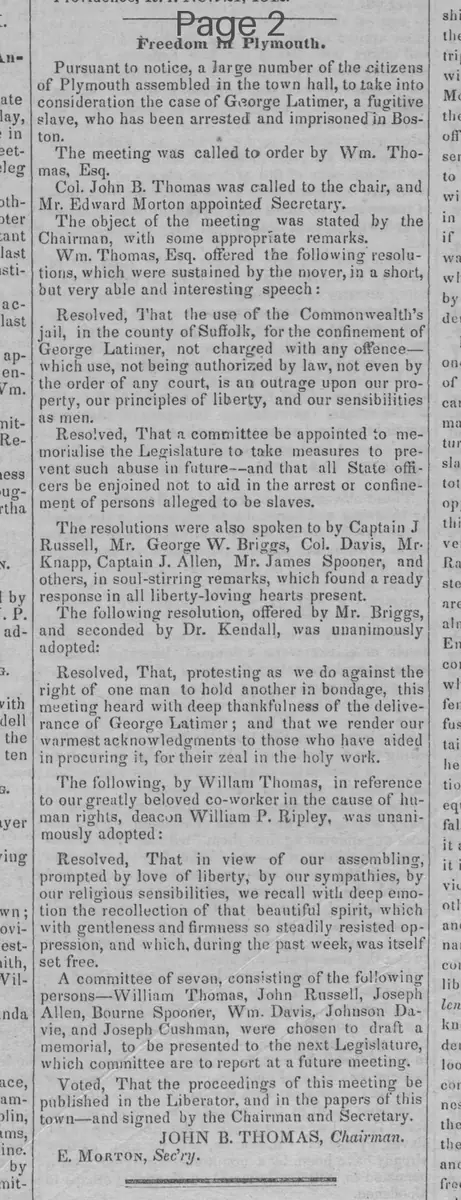
Freedom in Plymouth.
Pursuant to notice, a large number of the citizens of Plymouth assembled in the town hall, to take into consideration the case of George Latimer, a fugitive slave, who has been arrested and imprisoned in Boston.
The meeting was called to order by Wm. Thomas, Esq.
Col. John B. Thomas was called to the chair, and Mr. Edward Morton appointed Secretary.
The object of the meeting was stated by the Chairman, with some appropriate remarks.
Wm. Thomas, Esq. offered the following resolutions, which were sustained by the mover, in a short, but very able and interesting speech:
Resolved, That the use of the Commonwealth's jail, in the county of Suffolk, for the confinement of George Latimer, not charged with any offence—which use, not being authorized by law, not even by the order of any court, is an outrage upon our property, our principles of liberty, and our sensibilities as men.
Resolved, That a committee be appointed to memorialise the Legislature to take measures to prevent such abuse in future—and that all State officers be enjoined not to aid in the arrest or confinement of persons alleged to be slaves.
The resolutions were also spoken to by Captain J. Russell, Mr. George W. Briggs, Col. Davis, Mr. Knapp, Captain J. Allen, Mr. James Spooner, and others, in soul-stirring remarks, which found a ready response in all liberty-loving hearts present.
The following resolution, offered by Mr. Briggs and seconded by Dr. Kendall, was unanimously adopted:
Resolved, That, protesting as we do against the right of one man to hold another in bondage, this meeting heard with deep thankfulness of the deliverance of George Latimer; and that we render our warmest acknowledgments to those who have aided in procuring it, for their zeal in the holy work.
The following, by William Thomas, in reference to our greatly beloved co-worker in the cause of human rights, deacon William P. Ripley, was unanimously adopted:
Resolved, That in view of our assembling prompted by love of liberty, by our sympathies, by our religious sensibilities, we recall with deep emotion the recollection of that beautiful spirit, which with gentleness and firmness so steadily resisted oppression, and which, during the past week, was itself set free.
A committee of seven, consisting of the following persons—William Thomas, John Russell, Joseph Allen, Bourne Spooner, Wm. Davis, Johnson Davie, and Joseph Cushman, were chosen to draft a memorial, to be presented to the next Legislature, which committee are to report at a future meeting.
Voted, That the proceedings of this meeting be published in the Liberator, and in the papers of this town—and signed by the Chairman and Secretary.
JOHN B. THOMAS, Chairman.
E. MORTON, Sec'y.
Pursuant to notice, a large number of the citizens of Plymouth assembled in the town hall, to take into consideration the case of George Latimer, a fugitive slave, who has been arrested and imprisoned in Boston.
The meeting was called to order by Wm. Thomas, Esq.
Col. John B. Thomas was called to the chair, and Mr. Edward Morton appointed Secretary.
The object of the meeting was stated by the Chairman, with some appropriate remarks.
Wm. Thomas, Esq. offered the following resolutions, which were sustained by the mover, in a short, but very able and interesting speech:
Resolved, That the use of the Commonwealth's jail, in the county of Suffolk, for the confinement of George Latimer, not charged with any offence—which use, not being authorized by law, not even by the order of any court, is an outrage upon our property, our principles of liberty, and our sensibilities as men.
Resolved, That a committee be appointed to memorialise the Legislature to take measures to prevent such abuse in future—and that all State officers be enjoined not to aid in the arrest or confinement of persons alleged to be slaves.
The resolutions were also spoken to by Captain J. Russell, Mr. George W. Briggs, Col. Davis, Mr. Knapp, Captain J. Allen, Mr. James Spooner, and others, in soul-stirring remarks, which found a ready response in all liberty-loving hearts present.
The following resolution, offered by Mr. Briggs and seconded by Dr. Kendall, was unanimously adopted:
Resolved, That, protesting as we do against the right of one man to hold another in bondage, this meeting heard with deep thankfulness of the deliverance of George Latimer; and that we render our warmest acknowledgments to those who have aided in procuring it, for their zeal in the holy work.
The following, by William Thomas, in reference to our greatly beloved co-worker in the cause of human rights, deacon William P. Ripley, was unanimously adopted:
Resolved, That in view of our assembling prompted by love of liberty, by our sympathies, by our religious sensibilities, we recall with deep emotion the recollection of that beautiful spirit, which with gentleness and firmness so steadily resisted oppression, and which, during the past week, was itself set free.
A committee of seven, consisting of the following persons—William Thomas, John Russell, Joseph Allen, Bourne Spooner, Wm. Davis, Johnson Davie, and Joseph Cushman, were chosen to draft a memorial, to be presented to the next Legislature, which committee are to report at a future meeting.
Voted, That the proceedings of this meeting be published in the Liberator, and in the papers of this town—and signed by the Chairman and Secretary.
JOHN B. THOMAS, Chairman.
E. MORTON, Sec'y.
What sub-type of article is it?
Historical Event
What themes does it cover?
Justice
Moral Virtue
What keywords are associated?
Fugitive Slave
George Latimer
Plymouth Meeting
Anti Slavery Resolutions
Latimer Case
Abolitionism
Town Hall Assembly
What entities or persons were involved?
George Latimer
Wm. Thomas
Col. John B. Thomas
Edward Morton
Captain J. Russell
George W. Briggs
Col. Davis
Mr. Knapp
Captain J. Allen
Mr. James Spooner
Dr. Kendall
William P. Ripley
Joseph Allen
Bourne Spooner
Wm. Davis
Johnson Davie
Joseph Cushman
Where did it happen?
Plymouth Town Hall
Story Details
Key Persons
George Latimer
Wm. Thomas
Col. John B. Thomas
Edward Morton
Captain J. Russell
George W. Briggs
Col. Davis
Mr. Knapp
Captain J. Allen
Mr. James Spooner
Dr. Kendall
William P. Ripley
Joseph Allen
Bourne Spooner
Wm. Davis
Johnson Davie
Joseph Cushman
Location
Plymouth Town Hall
Story Details
Plymouth citizens assemble to protest George Latimer's unauthorized imprisonment as a fugitive slave in Boston, pass resolutions condemning the act as an outrage on liberty, appoint a committee to petition the legislature against future abuses, express thanks for Latimer's deliverance, and honor the late abolitionist William P. Ripley.