Thank you for visiting SNEWPapers!
Sign up free
The Enquirer
Richmond, Henrico County, Virginia
What is this article about?
Sir John Moore's letter from Corunna, Jan 18, 1809, details the British army's retreat from Spain amid Spanish inaction, French pursuit by Marshal Soult, skirmishes at Calcabelos and Lugo, and critical situation awaiting transports for embarkation.
Clipping
OCR Quality
Full Text
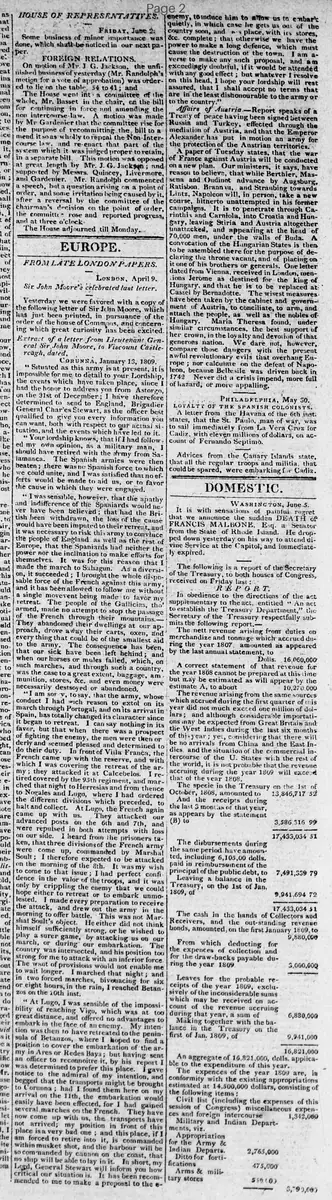
FROM LATE LONDON PAPERS.
London, April 9.
Sir John Moore's celebrated last letter.
Yesterday we were favored with a copy of the following letter of Sir John Moore, which has just been printed, in pursuance of the order of the house of Commons, and concerning which great curiosity has been excited.
Extract of a letter from Lieutenant General Sir John Moore, to Viscount Castlereagh, dated,
Corunna, January 18, 1809.
"Situated as this army is at present, it is impossible for me to detail to your Lordship, the events which have taken place, since I had the honor to address you from Astorga, on the 31st of December; I have therefore determined to send to England, Brigadier General Charles Stewart, as the officer best qualified to give you every information you can want, both with respect to our actual situation, and the events which have led to it.
"Your lordship knows, that if I had followed my own opinion, as a military man, I should have retired with the army from Salamanca. The Spanish armies were then beaten; there was no Spanish force to which we could unite, and I was satisfied that no efforts would be made to aid us, or to favor the cause in which they were engaged.
"I was sensible, however, that the apathy and indifference of the Spaniards would never have been believed; that had the British been withdrawn, the loss of the cause would have been imputed to their retreat, and it was necessary to risk this army to convince the people of England as well as the rest of Europe, that the Spaniards had neither the power nor the inclination to make efforts for themselves. It was for this reason that I made the march to Sahagun. As a diversion, it succeeded; I brought the whole disposable force of the French against this army, and it has been allowed to follow me without a single movement being made to favor my retreat. The people of the Gallicias, though armed, made no attempt to stop the passage of the French through their mountains. They abandoned their dwellings at our approach, drove away their carts, oxen, and everything that could be of the smallest aid to the army. The consequence has been, that our sick have been left behind; and when our horses or mules failed, which, on such marches, and through such a country, was the case to a great extent, baggage, ammunition, stores, &c. and even money were necessarily destroyed or abandoned.
"I am sorry to say, that the army, whose conduct I had such reason to extol on its march through Portugal, and on its arrival in Spain, has totally changed its character since it began to retreat. I can say nothing in its favor, but that when there was a prospect of fighting the enemy, the men were then orderly and seemed pleased and determined to do their duty. In front of Villa Franca, the French came up with the reserve, and with which I was covering the retreat of the army; they attacked it at Calcabelos. I retired covered by the 95th regiment, and marched that night to Herrerias and from thence to Nogales and Lugo, where I had ordered the different divisions which preceded, to halt and collect. At Lugo, the French again came up with us. They attacked our advanced posts on the 6th and 7th, and were repulsed in both attempts with loss on our side. I heard from the prisoners taken, that three divisions of the French army were come up, commanded by Marshal Soult; I therefore expected to be attacked on the morning of the 8th. It was my wish to come to that issue; I had perfect confidence in the valor of the troops, and it was only by crippling the enemy that we could hope either to retreat or to embark unmolested. I made every preparation to receive the attack, and drew out the army in the morning to offer battle. This was not Marshal Soult's object. He either did not think himself sufficiently strong, or he wished to play a surer game, by attacking us on our march, or during our embarkation. The country was intersected, and his position too strong for me to attack with an inferior force. The want of provisions would not enable me to wait longer. I marched that night; and in two forced marches, bivouacking for six or eight hours, in the rain, I reached Betanzos on the 10th inst.
"At Lugo, I was sensible of the impossibility of reaching Vigo, which was at too great distance, and offered no advantages to embark in the face of an enemy. My intention was then to have retreated to the peninsula of Betanzos, where I hoped to find a position to cover the embarkation of the army in Ares or Ferrol Bay; but having sent an officer to reconnoitre it, by his report I was determined to prefer this place. I gave notice to the admiral of my intention, and begged that the transports might be brought to Corunna; had I found them here on my arrival on the 11th, the embarkation would easily have been effected, for I had gained several marches on the French. They have now come up with us, the transports have not arrived; my position in front of this place is a very bad one; and this place, if I am forced to retire into it, is commanded within musket shot, and the harbour will be so commanded by cannon on the coast, that no ship will be able to lay in it. In short, my Lord, General Stewart will inform you how critical our situation is. It has been recommended to me to make a proposal to the enemy, to induce him to allow us to embark quietly, in which case he gets us out of the country soon, and in our place, with its stores, &c. complete; that otherwise we have the power to make a long defence, which must cause the destruction of the town. I am averse to make any such proposal, and am exceedingly doubtful, if it would be attended with any good effect; but whatever I resolve on this head, I hope your lordship will rest assured, that I shall accept no terms that are in the least dishonourable to the army or to the country."
What sub-type of article is it?
What keywords are associated?
What entities or persons were involved?
Where did it happen?
Foreign News Details
Primary Location
Corunna
Event Date
January 18, 1809
Key Persons
Outcome
repulsed french attacks at lugo on 6th and 7th with loss on our side; critical situation at corunna awaiting transports; baggage and stores abandoned; sick left behind
Event Details
Letter details retreat from Salamanca via Sahagun, Astorga; Spanish apathy; French pursuit; skirmishes at Calcabelos and Lugo; march to Betanzos and Corunna; preparations for battle unmet by Soult; intent to embark but transports delayed; consideration of proposal to enemy rejected