Thank you for visiting SNEWPapers!
Sign up free
Letter to Editor
April 20, 1874
The Daily Dispatch
Richmond, Virginia
What is this article about?
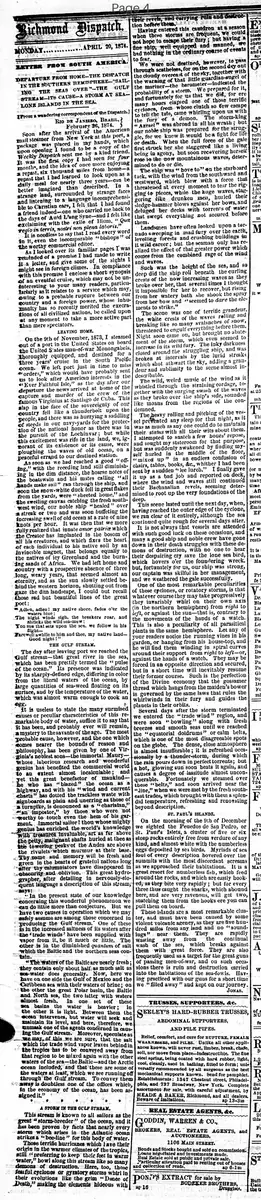
Sailor Jonas recounts departing the US on November 9, 1873, aboard USS Monongahela for a South Pacific cruise amid the Virginius crisis. Describes Gulf Stream, surviving a cyclone, trade winds, doldrums, and sighting barren St. Paul's Islets.
Clipping
OCR Quality
85%
Good
Full Text
To the worthy commercial editor.
In it, even the incomparable 'bishops' of
It is needless to say that I read every word
reminded of a promise I had made to write
As I looked over its familiar pages I was
it a letter, and give some of the sights I
might see in foreign climes. In compliance
of an eventful cruise, which may not be un-
with this promise I enclose a short synopsis
interesting to your many readers, particu-
owing to a probable rupture between our
Largely as it relates to a service which may,
man's humanity has so recently merited the execra-
country and a foreign power, whose inhu-
fions of all civilized nations, be called upon
at any moment to take a more active part
than mere spectators.
LEAVING HOME.
out of a port in the United States on board
On the 9th of November, 1873, I steamed
the United States man-of-war Monongahela,
I thoroughly equipped, and destined for a
three years' cruise in the South Pacific
"orders," which would have probably sent
ocean. We left port just in time to miss
departure the news arrived at home of the
famous Virginius at Santiago de Cuba. This
us to look after American interests in the
country fell like a thunderbolt upon the
people, and there was as hurrying a saddling
of steeds in our navy-yards for the protec-
slap in the face of the sovereignty of our
on of the national honor as there was in
the pursuit of the Lochinvar; but while
his excitement was rife in the land, we, ig-
porant of its existence or its cause, were
ploughing the waves of old ocean, on a
peaceful errand to our destined station.
As soon as we had reached a good 'off-
ing,' with the receding land still diminish-
ing in the dim distance, the hoarse notes of
bands make sail' ran through the ship, and
the boatswain and his mates calling 'all
soon the snow-white duck fell in great flakes
from the yards, were 'sheeted home.' and
She swelling canvas catching the fresh south-
west wind, our noble ship 'heeled' over
a streak or two and was soon buffeting the
Increasing swell of old ocean at a rate of nine
knots per hour. It was then that we more
fully realized that inborn amor patriae which
the Creator has implanted in the bosom of
all His creatures, and which fixes the heart
of each individual to his native soil by an
indivisible magnet, that belongs 'equally to
the natives of icy Greenland and the burn-
ing sands of Africa. We had left home and
country with a prospective absence of three
long, weary years, that seemed almost an
eternity, and as the sun slowly settled be-
hind the western horizon, shutting out from
gaze the dim landscape, I could but recall
Those sad but beautiful lines of the great
poet:
Adieu, adieu! my native shore, fades o'er the
waters blue:
The night winds sigh, the breakers roar, and
shrieks the wild sea-mew;
The sun that sets upon the sea, we follow in his
flight-
Farewell awhile to him and thee, my native land-
Good night!"
THE GULF STREAM,
The day after leaving port we reached the
Gulf stream-that great river in the sea.
which has been prettily termed the 'pulse
of the ocean.' Its presence was indicated
by its sharply-defined edge, differing in color
from the literal waters' of the ocean, by
large quantities of sea-weed floating on its
surface, and by the temperature of the water.
which was almost warm enough to cook an
egg.
It is useless to state the many surmised
causes or peculiar characteristics of this remarkable body of water, suffice it to say that
it has been, and probably ever will remain,
a mystery to the savants of the age. The most
probable cause, however, and the one which
comes nearer the bounds of reason and
philosophy, has been given by one of Vir-
ginia's noblest sons-the immortal Maury-
whose laborious research and wonderful
genius has benefited the commercial world
to an extent almost incalculable; and
yet this great benefactor of mankind-
he who has 'blazed' the ocean as a
highway, and with his 'wind and current
charts' has dotted the trackless waste with
signboards as plain and unerring as those of
a turnpike, is denounced as a 'charlatan.'
'an impostor,' by those who were not
worthy to touch even the hem of his gar-
ment. Immortal sailor! thou whose mighty
genius has enriched the world's knowledge
with treasures invaluable, art as far above
the petty, malignant shafts hurled at thee as
the towering peaks of the Andes are above
the rivulets which murmur at their base.
Thy name and memory will be fresh and
green in the hearts of grateful nations long
after thy calumniators have disappeared in
obscurity and oblivion. This great hydro-
grapher, after detailing in nervously-elo-
quent language a description of this stream;
says:
'In the present state of our knowledge
concerning this wonderful phenomenon we
can do little more than conjecture. But we
have two causes in operation which we may
safely assume are among those concerned in
producing the Gulf stream.' One of these
is in the increased saltness of its waters after
the 'trade winds' have been supplied with
vapor from it, be it much or little. The
other is in the diminished quantum of salt
which the Baltic and the northern seas con-
tain.
'The waters of the Baltic are nearly fresh;
they contain only about half as much salt as
sea-water does generally. Now, here we
have on one side the Gulf of Mexico and the
Caribbean sea with their waters of brine; on
the other the great Polar basin, the Baltic
and North sea, the two latter with waters
almost fresh. In one set of these
sea basins the water is heavier; in
the other it is light. Between them the
Ocean intervenes, but water will seek and
maintain its level, and here, therefore, we
unmask one of the agents concerned in caus-
ing the Gulf stream. Moreover, speculate as
we may, of this we are sure, that the salt
which the trade wind vapor leaves behind in
the tropics-has to be conveyed away from
that region to be mixed again with the other
waters of the sea-the Baltic-and the Arctic
ocean included,' and that these are some of
the waters at least, which we see running off
through the Gulf stream. To convey them
away is doubtless one of the offices which,
in the economy of the ocean, has been as-
signed it.'
A STORM IN THE GULF STREAM.
This stream is known to all sailors as the
great 'storm-breeder' of the ocean, and it
has been proven by facts that nearly every
storm which arises in the Atlantic ocean
strikes a 'bee-line' for this body of water.
Those terrific hurricanes which have their
origin in the warmer climates of the tropics,
still 'preferring to keep their feet in warm
water,' bowl along this stream like so many
demons of destruction. Here, too, those
fearful cyclones or gyratory storms whirl in
their evolutions like the grim Dance of
Death, making the elements hideous with
their revels, and carrying ruin and destruc-
tion before them. Having entered this cauldron at a season
when these storms are frequent, we could
not hope to escape their fury; but having a
fine ship-well equipped-and manned, we
had nothing in the ordinary course of events
to fear.
We were not destined, however, to pass
through scatheless, for on the second day out
the cloudy overcast of the sky, together with
the warning of that little guardian-angel of
the mariner-the barometer-indicated the
probability of a storm. We prepared for it,
and fortunately for us that we did, for ere
many hours elapsed one of those terrific
cyclones, from whose clutch so few escape
'Azrael' was abroad in all his wrath; but
to tell the tale, came whirling upon us with
the fury of a demon. The storm-king
our noble ship was prepared for the strug-
gle, for we knew it would be a fight for life
or death. When the full force of the gale
first struck her she staggered like a living
being in agony, but soon recovering herself
rose to the now mountainous waves, deter-
mined to do or die.
The ship was 'hove to' on the starboard
tack, with the wind from the southward and
westward, which blew with a force that
threatened at every moment to tear the rig-
ging to pieces, while the huge waves, stag-
gering like drunken men, hurled their
sledge-hammer blows against her bows, and
deluged her decks with torrents of water
that swept everything not secured before
them.
Landsmen have often looked upon a ter-
nado sweeping in mad fury over the earth.
levelling forests and crushing buildings in
its wild career; but the seaman only has re-
alized the effect of that greater power which
comes from the combined rage of the wind
and waves.
Such was the height of the sea, and so
deep did the ship roll beneath the curling
crests of the now increasing waves as they
broke over her, that several times I thought
it impossible for her to recover, but rising
from her watery bath she shook the spray
from her bow and 'seemed to dare the ele-
ments to strike.'
The scene was one of terrific grandeur.
The white crests of the waves rolling and
breaking like so many avalanches of snow,
threatened to engulf everything before them.
Night soon came on, but brought no abate-
ment of the storm, which even seemed to
increase in its wild fury. The inky darkness
closed around the struggling ship, and was
broken at intervals by the lurid streaks
which shot athwart the sky, adding a gran-
deur and sublimity to the scene almost in-
describable.
The wild, weird music of the wind as it
whistled through the straining cordage, to-
gether with the surging swash of the waves
as they broke over the ship's side, sounded
like moans from the regions of the con-
demned.
This scene lasted until the next day,
having reached the outer edge of the cyclone,
we ran clear of it entirely, although the sea
continued quite rough for several days after.
It is not always that vessels are attended
with such good luck on these occasions, and
many a good ship and noble crew have gone
down in their death struggles with these de-
mons of destruction, with no one to hear
their despairing cry save the lone sea bird,
which hovers o'er the foundering wreck.
But, fortunately for us, our ship was strong,
our captain was skilful in her management
and we weathered the gale successfully.
One of the most remarkable peculiarities
of these cyclones, or rotatory storms, is that
whatever course they may take progressively
they invariably whirl on their own axis
(in the northern hemisphere) from right to
left, or against the sun-that is, contrary to
the movements of the hands of a watch.
This is also a peculiarity of all parasitical
plants in the same hemisphere. Let any of
your readers notice the running vines in his
garden, or hanging from his house-top, and
he will find them winding in spiral curves
around their support from right to left-or,
against the hands of a watch. They may be
forced in an opposite direction and secured,
but in a short time will inevitably resume
their former course. Such is the perfection
of the Divine economy that the gossamer
thread which hangs from the maiden's bower
is governed by the same laws that rules the
whirlwinds in their fury and guides the
planets in their orbits.
Several days after the storm terminated
we entered the 'trade wind' region, and
were soon 'bowling' along with fresh
breezes and smooth seas until we reached
the 'equatorial doldrums' or calm belts,
which is one of the most disagreeable spots
on the globe. The dense, close atmosphere
is almost insufferable; it is refreshed occa-
sionally by a thunder-storm, during which
the rain pours down in perfect torrents; but
a hot, glowing sun soon beats it again, and
causes a degree of lassitude almost uncon-
querable. Fortunately we steamed over
these 'belts,' and soon arrived near the
'line,' when we were met by the fresh south-
east trades, which brought with them a splen-
did temperature, refreshing and renovating
beyond description.
ST. PAUL'S ISLANDS
On the morning of the 9th of December
we sighted the Pedros de San Pedro, or
St. Paul's Islets, a cluster of five or six
steep rocks entirely free from verdure of any
kind, and almost white with the numberless
eggs deposited by sea birds. Myriads of sea
fowl of every description hovered over the
summits with the most discordant screams
as we approached their habitations. It is a
great resort for numberless fish, which feed
around the rocks, and which are easily hook-
ed; as they bite very rapidly; but for every
three thus caught the sharks, which abound
here, and are very ravenous, will get two,
snatching them from the hooks ere you can
pull them on board.
These islands are a most remarkable clus-
ter, and must have been caused by some
violent volcanic agency, as they are five hun-
dred miles from any land and no 'sound-
ings' near them. They are rapidly
wasting away from the continual
wash of the sea,
which breaks against them with great force. They are also
frequently used as a target for the great guns
of passing men-of-war, and on such occa-
sions there is ruin and destruction carried
into the habitations of the sea-fowls. Hav-
ing practiced with our guns for a short time
we 'filled away' and kept on our journey.
Jonas.
In it, even the incomparable 'bishops' of
It is needless to say that I read every word
reminded of a promise I had made to write
As I looked over its familiar pages I was
it a letter, and give some of the sights I
might see in foreign climes. In compliance
of an eventful cruise, which may not be un-
with this promise I enclose a short synopsis
interesting to your many readers, particu-
owing to a probable rupture between our
Largely as it relates to a service which may,
man's humanity has so recently merited the execra-
country and a foreign power, whose inhu-
fions of all civilized nations, be called upon
at any moment to take a more active part
than mere spectators.
LEAVING HOME.
out of a port in the United States on board
On the 9th of November, 1873, I steamed
the United States man-of-war Monongahela,
I thoroughly equipped, and destined for a
three years' cruise in the South Pacific
"orders," which would have probably sent
ocean. We left port just in time to miss
departure the news arrived at home of the
famous Virginius at Santiago de Cuba. This
us to look after American interests in the
country fell like a thunderbolt upon the
people, and there was as hurrying a saddling
of steeds in our navy-yards for the protec-
slap in the face of the sovereignty of our
on of the national honor as there was in
the pursuit of the Lochinvar; but while
his excitement was rife in the land, we, ig-
porant of its existence or its cause, were
ploughing the waves of old ocean, on a
peaceful errand to our destined station.
As soon as we had reached a good 'off-
ing,' with the receding land still diminish-
ing in the dim distance, the hoarse notes of
bands make sail' ran through the ship, and
the boatswain and his mates calling 'all
soon the snow-white duck fell in great flakes
from the yards, were 'sheeted home.' and
She swelling canvas catching the fresh south-
west wind, our noble ship 'heeled' over
a streak or two and was soon buffeting the
Increasing swell of old ocean at a rate of nine
knots per hour. It was then that we more
fully realized that inborn amor patriae which
the Creator has implanted in the bosom of
all His creatures, and which fixes the heart
of each individual to his native soil by an
indivisible magnet, that belongs 'equally to
the natives of icy Greenland and the burn-
ing sands of Africa. We had left home and
country with a prospective absence of three
long, weary years, that seemed almost an
eternity, and as the sun slowly settled be-
hind the western horizon, shutting out from
gaze the dim landscape, I could but recall
Those sad but beautiful lines of the great
poet:
Adieu, adieu! my native shore, fades o'er the
waters blue:
The night winds sigh, the breakers roar, and
shrieks the wild sea-mew;
The sun that sets upon the sea, we follow in his
flight-
Farewell awhile to him and thee, my native land-
Good night!"
THE GULF STREAM,
The day after leaving port we reached the
Gulf stream-that great river in the sea.
which has been prettily termed the 'pulse
of the ocean.' Its presence was indicated
by its sharply-defined edge, differing in color
from the literal waters' of the ocean, by
large quantities of sea-weed floating on its
surface, and by the temperature of the water.
which was almost warm enough to cook an
egg.
It is useless to state the many surmised
causes or peculiar characteristics of this remarkable body of water, suffice it to say that
it has been, and probably ever will remain,
a mystery to the savants of the age. The most
probable cause, however, and the one which
comes nearer the bounds of reason and
philosophy, has been given by one of Vir-
ginia's noblest sons-the immortal Maury-
whose laborious research and wonderful
genius has benefited the commercial world
to an extent almost incalculable; and
yet this great benefactor of mankind-
he who has 'blazed' the ocean as a
highway, and with his 'wind and current
charts' has dotted the trackless waste with
signboards as plain and unerring as those of
a turnpike, is denounced as a 'charlatan.'
'an impostor,' by those who were not
worthy to touch even the hem of his gar-
ment. Immortal sailor! thou whose mighty
genius has enriched the world's knowledge
with treasures invaluable, art as far above
the petty, malignant shafts hurled at thee as
the towering peaks of the Andes are above
the rivulets which murmur at their base.
Thy name and memory will be fresh and
green in the hearts of grateful nations long
after thy calumniators have disappeared in
obscurity and oblivion. This great hydro-
grapher, after detailing in nervously-elo-
quent language a description of this stream;
says:
'In the present state of our knowledge
concerning this wonderful phenomenon we
can do little more than conjecture. But we
have two causes in operation which we may
safely assume are among those concerned in
producing the Gulf stream.' One of these
is in the increased saltness of its waters after
the 'trade winds' have been supplied with
vapor from it, be it much or little. The
other is in the diminished quantum of salt
which the Baltic and the northern seas con-
tain.
'The waters of the Baltic are nearly fresh;
they contain only about half as much salt as
sea-water does generally. Now, here we
have on one side the Gulf of Mexico and the
Caribbean sea with their waters of brine; on
the other the great Polar basin, the Baltic
and North sea, the two latter with waters
almost fresh. In one set of these
sea basins the water is heavier; in
the other it is light. Between them the
Ocean intervenes, but water will seek and
maintain its level, and here, therefore, we
unmask one of the agents concerned in caus-
ing the Gulf stream. Moreover, speculate as
we may, of this we are sure, that the salt
which the trade wind vapor leaves behind in
the tropics-has to be conveyed away from
that region to be mixed again with the other
waters of the sea-the Baltic-and the Arctic
ocean included,' and that these are some of
the waters at least, which we see running off
through the Gulf stream. To convey them
away is doubtless one of the offices which,
in the economy of the ocean, has been as-
signed it.'
A STORM IN THE GULF STREAM.
This stream is known to all sailors as the
great 'storm-breeder' of the ocean, and it
has been proven by facts that nearly every
storm which arises in the Atlantic ocean
strikes a 'bee-line' for this body of water.
Those terrific hurricanes which have their
origin in the warmer climates of the tropics,
still 'preferring to keep their feet in warm
water,' bowl along this stream like so many
demons of destruction. Here, too, those
fearful cyclones or gyratory storms whirl in
their evolutions like the grim Dance of
Death, making the elements hideous with
their revels, and carrying ruin and destruc-
tion before them. Having entered this cauldron at a season
when these storms are frequent, we could
not hope to escape their fury; but having a
fine ship-well equipped-and manned, we
had nothing in the ordinary course of events
to fear.
We were not destined, however, to pass
through scatheless, for on the second day out
the cloudy overcast of the sky, together with
the warning of that little guardian-angel of
the mariner-the barometer-indicated the
probability of a storm. We prepared for it,
and fortunately for us that we did, for ere
many hours elapsed one of those terrific
cyclones, from whose clutch so few escape
'Azrael' was abroad in all his wrath; but
to tell the tale, came whirling upon us with
the fury of a demon. The storm-king
our noble ship was prepared for the strug-
gle, for we knew it would be a fight for life
or death. When the full force of the gale
first struck her she staggered like a living
being in agony, but soon recovering herself
rose to the now mountainous waves, deter-
mined to do or die.
The ship was 'hove to' on the starboard
tack, with the wind from the southward and
westward, which blew with a force that
threatened at every moment to tear the rig-
ging to pieces, while the huge waves, stag-
gering like drunken men, hurled their
sledge-hammer blows against her bows, and
deluged her decks with torrents of water
that swept everything not secured before
them.
Landsmen have often looked upon a ter-
nado sweeping in mad fury over the earth.
levelling forests and crushing buildings in
its wild career; but the seaman only has re-
alized the effect of that greater power which
comes from the combined rage of the wind
and waves.
Such was the height of the sea, and so
deep did the ship roll beneath the curling
crests of the now increasing waves as they
broke over her, that several times I thought
it impossible for her to recover, but rising
from her watery bath she shook the spray
from her bow and 'seemed to dare the ele-
ments to strike.'
The scene was one of terrific grandeur.
The white crests of the waves rolling and
breaking like so many avalanches of snow,
threatened to engulf everything before them.
Night soon came on, but brought no abate-
ment of the storm, which even seemed to
increase in its wild fury. The inky darkness
closed around the struggling ship, and was
broken at intervals by the lurid streaks
which shot athwart the sky, adding a gran-
deur and sublimity to the scene almost in-
describable.
The wild, weird music of the wind as it
whistled through the straining cordage, to-
gether with the surging swash of the waves
as they broke over the ship's side, sounded
like moans from the regions of the con-
demned.
This scene lasted until the next day,
having reached the outer edge of the cyclone,
we ran clear of it entirely, although the sea
continued quite rough for several days after.
It is not always that vessels are attended
with such good luck on these occasions, and
many a good ship and noble crew have gone
down in their death struggles with these de-
mons of destruction, with no one to hear
their despairing cry save the lone sea bird,
which hovers o'er the foundering wreck.
But, fortunately for us, our ship was strong,
our captain was skilful in her management
and we weathered the gale successfully.
One of the most remarkable peculiarities
of these cyclones, or rotatory storms, is that
whatever course they may take progressively
they invariably whirl on their own axis
(in the northern hemisphere) from right to
left, or against the sun-that is, contrary to
the movements of the hands of a watch.
This is also a peculiarity of all parasitical
plants in the same hemisphere. Let any of
your readers notice the running vines in his
garden, or hanging from his house-top, and
he will find them winding in spiral curves
around their support from right to left-or,
against the hands of a watch. They may be
forced in an opposite direction and secured,
but in a short time will inevitably resume
their former course. Such is the perfection
of the Divine economy that the gossamer
thread which hangs from the maiden's bower
is governed by the same laws that rules the
whirlwinds in their fury and guides the
planets in their orbits.
Several days after the storm terminated
we entered the 'trade wind' region, and
were soon 'bowling' along with fresh
breezes and smooth seas until we reached
the 'equatorial doldrums' or calm belts,
which is one of the most disagreeable spots
on the globe. The dense, close atmosphere
is almost insufferable; it is refreshed occa-
sionally by a thunder-storm, during which
the rain pours down in perfect torrents; but
a hot, glowing sun soon beats it again, and
causes a degree of lassitude almost uncon-
querable. Fortunately we steamed over
these 'belts,' and soon arrived near the
'line,' when we were met by the fresh south-
east trades, which brought with them a splen-
did temperature, refreshing and renovating
beyond description.
ST. PAUL'S ISLANDS
On the morning of the 9th of December
we sighted the Pedros de San Pedro, or
St. Paul's Islets, a cluster of five or six
steep rocks entirely free from verdure of any
kind, and almost white with the numberless
eggs deposited by sea birds. Myriads of sea
fowl of every description hovered over the
summits with the most discordant screams
as we approached their habitations. It is a
great resort for numberless fish, which feed
around the rocks, and which are easily hook-
ed; as they bite very rapidly; but for every
three thus caught the sharks, which abound
here, and are very ravenous, will get two,
snatching them from the hooks ere you can
pull them on board.
These islands are a most remarkable clus-
ter, and must have been caused by some
violent volcanic agency, as they are five hun-
dred miles from any land and no 'sound-
ings' near them. They are rapidly
wasting away from the continual
wash of the sea,
which breaks against them with great force. They are also
frequently used as a target for the great guns
of passing men-of-war, and on such occa-
sions there is ruin and destruction carried
into the habitations of the sea-fowls. Hav-
ing practiced with our guns for a short time
we 'filled away' and kept on our journey.
Jonas.
What sub-type of article is it?
Informative
Reflective
Historical
What themes does it cover?
Military War
Science Nature
What keywords are associated?
Uss Monongahela
South Pacific Cruise
Gulf Stream
Cyclone Storm
Virginius Incident
St Pauls Islands
Trade Winds
Equatorial Doldrums
What entities or persons were involved?
Jonas
To The Worthy Commercial Editor
Letter to Editor Details
Author
Jonas
Recipient
To The Worthy Commercial Editor
Main Argument
provides a short synopsis of an eventful cruise on the united states man-of-war monongahela, departing november 9, 1873, for three years in the south pacific, relating to potential conflict following the virginius incident.
Notable Details
Quotes Byron's 'Adieu, Adieu! My Native Shore'
References Matthew Maury's Theory On The Gulf Stream
Describes A Cyclone In The Gulf Stream
Mentions St. Paul's Islets As Volcanic Rocks Frequented By Sea Birds And Fish