Thank you for visiting SNEWPapers!
Sign up free
Virginia Advocate
Charlottesville, Virginia
What is this article about?
C. Crozet responds to Th. W. Gilmer's inquiry on Rivanna River navigation improvements, recommending a $132,500 plan for steam boats compatible with James River, over a cheaper $63,509 batteaux system, citing long-term economic benefits and cost calculations for various trade volumes.
Clipping
OCR Quality
Full Text
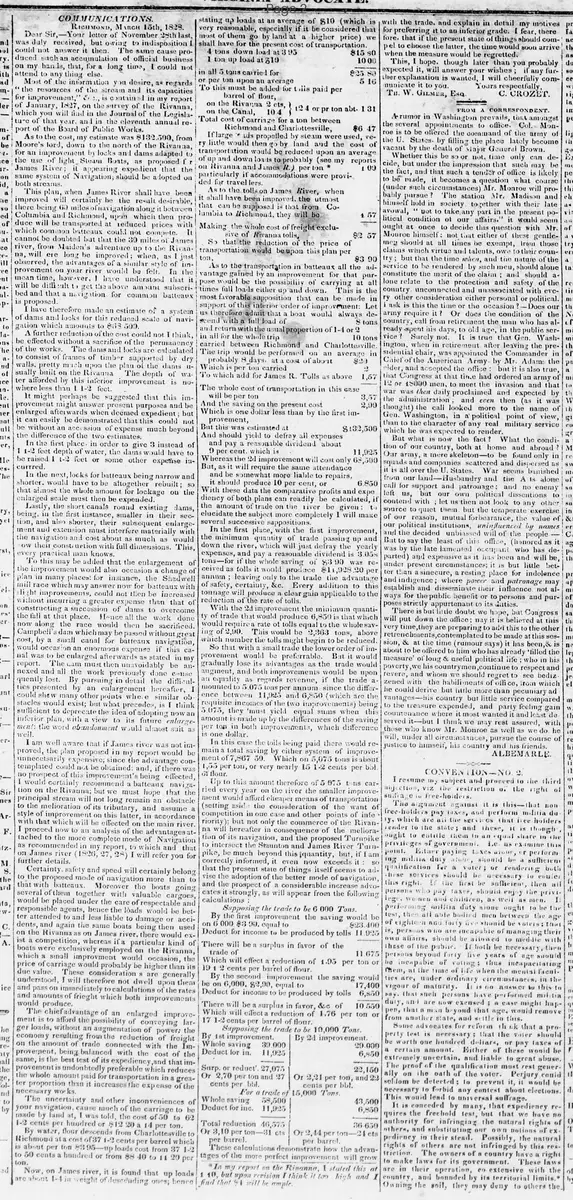
RICHMOND, March 15th, 1828
Dear Sir,--Your letter of November 28th last, was duly received, but owing to indisposition I could not answer it then. The same cause produced such an accumulation of official business on my hands, that, for a long time, I could not attend to any thing else.
Most of the information you desire, as regards "the resources of the stream and its capacities for improvement," &c., is contained in my report of January, 1827, on the survey of the Rivanna, which you will find in the Journal of the Legislature of that year, and in the eleventh annual report of the Board of Public Works.
As to the cost, my estimate was $132,500, from Moore's ford, down to the north of the Rivanna, for an improvement by locks and dams adapted to the use of light Steam Boats, as proposed for James River; it appearing expedient that the same system of Navigation should be adopted on both streams.
This plan, when James River shall have been improved will certainly be the result desirable, there being 60 miles of navigation along it between Columbia and Richmond, upon which then produce will be transported at reduced prices with which common batteaux could not compete. It cannot be doubted but that the 30 miles of James river, from Maiden's adventure up to the Rivanna, will ere long be improved: when, as I just observed, the advantages of a similar style of improvement on your river would be felt. In the mean time, however, I have understood that it will be difficult to get the above amount subscribed and that a navigation for common batteaux is proposed.
I have therefore made an estimate of a system of dams and locks for this reduced scale of navigation which amounts to $63,509.
A further reduction of the cost could not I think, be effected without a sacrifice of the permanency of the works. The dams and locks are calculated to consist of frames of timber supported by dry walls, pretty much upon the plan of the dams usually built on the Rivanna. The depth of water afforded by this inferior improvement is nowhere less than 1 1-2 feet.
It might perhaps be suggested that this improvement might answer present purposes and be enlarged afterwards when deemed expedient; but it can easily be demonstrated that this could not be without an accession of expense much beyond the difference of the two estimates.
In the first place, in order to give 3 instead of 1 1-2 feet depth of water, the dams would have to be raised 1 1-2 feet or some other expense incurred.
In the next, locks for batteaux being narrow and shorter, would have to be altogether rebuilt; so that almost the whole amount for lockage on the enlarged scale must then be expended.
Lastly, the short canals round existing dams, being, in the first instance, smaller in their section, and also shorter, their subsequent enlargement and extension must interfere materially with the navigation and cost about as much as would their construction with full dimensions. This, every practical man knows.
To this may be added that the enlargement of the improvement would also occasion a change of plan in many places: for instance, the Shadwell mill race which may answer now for batteaux with slight improvements, could not then be increased without incurring a greater expense than that of constructing a succession of dams to overcome the fall at that place. Hence all the work done now along the race would then be sacrificed.
Campbell's dam which may be passed without great cost, by a small canal for batteaux navigation, would occasion an enormous expense if this canal was to be enlarged afterwards as stated in my report. The dam must then unavoidably be annexed and all the work previously done consequently lost. By pursuing in detail the difficulties presented by an enlargement hereafter, I could show many other points where similar obstacles would exist; but what precedes, is I think sufficient to deprecate the idea of adopting now an inferior plan, with a view to its future enlargement: the word abandonment would almost suit as well.
I am well aware that if James river was not improved, the plan proposed in my report would be unnecessarily expensive; since the advantage contemplated could not be obtained: and, if there was no prospect of this improvement's being effected, I would certainly recommend a batteaux navigation on the Rivanna; but we must hope that the principal stream will not long remain an obstacle to the melioration of its tributary, and assume a style of improvement on this latter, in accordance with that which will be effected on the main river.
I proceed now to an analysis of the advantages attached to the more complete mode of Navigation as recommended in my report, to which and that on James river (1826, 27, 28) I will refer you for further details.
Certainty, safety and speed will certainly belong to the proposed mode of navigation more than to that with batteaux. Moreover the boats going several of them together with valuable cargoes, would be placed under the care of respectable and responsible agents, hence the loads would be better attended to and less liable to damage or accidents, and again the same boats being then used on the Rivanna as on James river, there would exist a competition, whereas if a particular kind of boats were exclusively employed on the Rivanna, which a small improvement would occasion, the price of carriage would probably be higher than its due value. These considerations are generally understood, I will therefore not dwell upon them and pass on immediately to calculations of the rates and amounts of freight which both improvements would produce.
The chief advantage of an enlarged improvement is to afford the possibility of conveying larger loads, without an augmentation of power; the economy resulting from the reduction of freight on the amount of trade connected with the Improvement, being balanced with the cost of the same, is the best test of its expediency, and that improvement is undoubtedly preferable which reduces the whole amount paid for transportation in a greater proportion than it increases the expense of the necessary works.
The uncertainty and other inconveniences of your navigation, cause much of the carriage to be made by land at, I was told, the cost of 50 to 62 1-2 cents per hundred or $12 20 a 14 per ton.
By water, flour descends from Charlottesville to Richmond at a cost of 37 1-2 cents per barrel which is about per ton $3.95 up loads cost from 37 1-2 to 50 cents a hundred or from $8 40 to 11 20 per ton.
Now, on James river, it is found that up loads are about 1-4 in weight of descending ones; hence stating up loads at an average of $10 (which is very reasonable, especially if it be considered that most of them go by land at a higher price) we shall have for the present cost of transportation.
4 tons down load at $3 95 $15 80
1 ton up load at $10 $10 00
in all 5 tons carried for $25 80 or per ton upon an average $5 16
To this must be added for tolls paid per barrel of flour, on the Canal, 10 cts, on the Rivanna 2 cts, 12 cts or per ton abt. $1 31
Total cost of carriage for a ton between Richmond and Charlottesville, $6 47
If large boats propelled by steam were used, very little would then go by land and the cost of transportation would be reduced upon an average of up and down loads to probably (see my reports on Rivanna and James R.) per ton $1 00 particularly if accommodations were provided for travellers.
As to the tolls on James River, when it shall have been improved, the utmost that can be supposed is that from Columbia to Richmond, they will be 57 cts.
Making the whole cost of freight exclusive of Rivanna tolls $2 57
So that the reduction of the price of transportation would be upon this plan per ton $3 90
As to the transportation in batteaux all the advantage gained by an improvement for that purpose would be the possibility of carrying at all times full loads either up and down. This is the most favorable supposition that can be made in support of this inferior order of improvement: Let us therefore admit that a boat would always descend with a full load of 3 tons and return with the usual proportion of 1-4 or 2 tons in all for the whole trip 10 tons carried between Richmond and Charlottesville.
The trip would be performed on an average in probably 8 days, at a cost of about $20 Which is per ton carried $2
To which add for James R. Tolls as above 1.57
The whole cost of transportation in this case will be per ton $3.57
And the saving on the present cost $2.99
Which is one dollar less than by the first improvement,
But this was estimated at $132,500 And should yield to defray all expenses and pay a reasonable dividend, about 9 per cent. which is $11,925
Whereas the 2d improvement will cost only $63,500 But, as it will require the same attendance and be somewhat more liable to repairs, it should produce 10 per cent, or $6,350
With these data the comparative profits and expediency of both plans can readily be calculated, if the amount of trade on the river be given: to elucidate the subject more completely I will make several successive suppositions.
In the first place, with the first improvement, the minimum quantity of trade passing up and down the river, which will just defray the yearly expenses, and pay a reasonable dividend is 3,055 tons--for if the whole saving of $3 90 was received as tolls it would produce $11,928.20 per annum; leaving only to the trade the advantage of safety, certainty, &c. Every addition to this tonnage will produce a clear gain applicable to the reduction of the rate of tolls.
With the 2d improvement the minimum quantity of trade that would produce $6,350 is that which would require a rate of tolls equal to the whole saving of $2.90. This would be 2,193 tons, above which number the tolls might begin to be reduced.
So that with a small trade the lower order of improvement would be preferable. But it would gradually lose its advantages as the trade would augment, and both improvements would be upon an equality as regards revenue, if the trade amounted to 5,075 tons per annum. since the difference between $11,925 and $6,350 (which are the requisite incomes of the two improvements) being $5,075, they must yield equal sums when this amount is made up by the differences of the saving per ton in both improvements, which difference is one dollar.
In this case the tolls being paid there would remain a total saving by either system of improvement of $7,867 50. Which on 5,075 tons is about $1.55 per ton, or very nearly 15 1-2 cents per bbl. of flour.
Up to this amount therefore of 5,075 tons carried every year on the river the smaller improvement would afford cheaper means of transportation (setting aside the consideration of the want of competition in one case and other points of inferiority); but not only the commerce of the Rivanna will hereafter in consequence of the melioration of its navigation, and the proposed Turnpike to intersect the Staunton and James River Turnpike, be much beyond this quantity, but, if I am correctly informed, it even now exceeds it: so that the present state of things itself seems to advise the adoption of the better mode of navigation, and the prospect of a considerable increase advocates it strongly, as will appear from the following calculations:
Supposing the trade to be 6,000 Tons.
By the first improvement the saving would be on 6,000 $3 90. equal to $23,400
Deduct for income to be produced by tolls $11,925
There will be a surplus in favor of the trade of $11,475
Which will effect a reduction of $1.91 per ton or 19 1-2 cents per barrel of flour.
By the second improvement the saving would be on 6,000. $2.90, equal to $17,400
Deduct for income to be produced by tolls $6,350
There will be a surplus in favor, &c of $11,050
Which will effect a reduction of $1.84 per ton or 18 1-2 cents per barrel of flour.
Supposing the trade to be 10,000 Tons.
By 1st improvement. By 2d improvement.
Whole saving $39,000 $29,000
Deduct for inc. $11,925 $6,850
Surp. or reduct'. $27,075 $22,150
Or $2.70 per ton and 27 Or $2.21 per ton, and 22
cents per bbl. cents per bbl.
For a trade of 15,000 Tons.
Whole saving $58,500 $43,500
Deduct for inc. $11,925 $6,850
Total reduction $46,575 $36,650
Or $3.10 per ton 31 cts Or $2.44 per ton--24 cts
per barrel. per barrel.
These calculations demonstrate how the advantages of the more perfect improvement will grow with the trade. and explain in detail my motives for preferring it to an inferior grade. I fear, therefore, that if the present state of things should compel to choose the latter, the time would soon arrive when the measure would be regretted.
This, I hope, though later than you probably expected it, will answer your wishes; if any further explanation is wanted, I will cheerfully communicate it to you.
Yours respectfully,
To. W. GILMER, Esq.
C. CROZET.
What sub-type of article is it?
What themes does it cover?
What keywords are associated?
What entities or persons were involved?
Letter to Editor Details
Author
C. Crozet
Recipient
To. W. Gilmer, Esq.
Main Argument
recommends adopting the more complete $132,500 navigation improvement for the rivanna river using locks and dams for light steam boats, compatible with james river improvements, over the cheaper $63,509 batteaux system, as it provides greater long-term economic benefits, safety, and reduced transportation costs despite higher initial expense.
Notable Details