Thank you for visiting SNEWPapers!
Sign up free
The Key West Citizen
Key West, Monroe County, Florida
What is this article about?
1952 Hollywood box office hits led by male stars like John Wayne and Gary Cooper in adventure films, with only Doris Day and Susan Hayward in top 10. Article contrasts this with past eras dominated by female stars like Mary Pickford and Bette Davis, attributing shift to post-war preference for male-oriented escapism.
Clipping
OCR Quality
Full Text
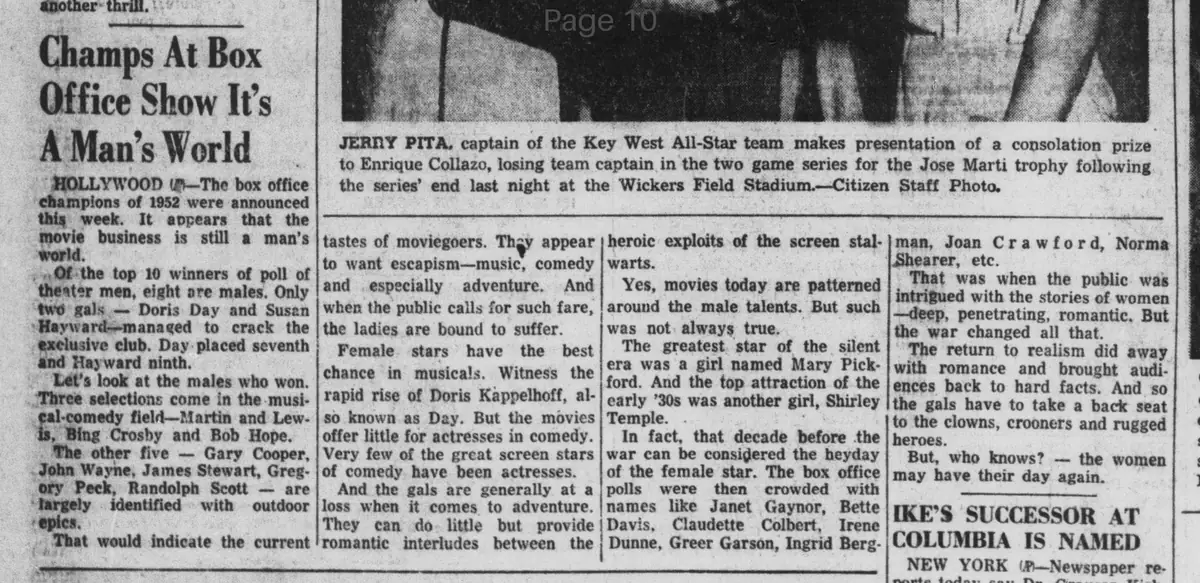
HOLLYWOOD — The box office champions of 1952 were announced this week. It appears that the movie business is still a man's world.
Of the top 10 winners of poll of theater men, eight are males. Only two gals - Doris Day and Susan Hayward--managed to crack the exclusive club. Day placed seventh and Hayward ninth.
Let's look at the males who won. Three selections come in the musical-comedy field-Martin and Lewis, Bing Crosby and Bob Hope.
The other five - Gary Cooper, John Wayne, James Stewart, Gregory Peck, Randolph Scott - are largely identified with outdoor epics.
That would indicate the current tastes of moviegoers. They appear to want escapism-music, comedy and especially adventure. And when the public calls for such fare, the ladies are bound to suffer.
Female stars have the best chance in musicals. Witness the rapid rise of Doris Kappelhoff, also known as Day. But the movies offer little for actresses in comedy. Very few of the great screen stars of comedy have been actresses.
And the gals are generally at a loss when it comes to adventure. They can do little but provide romantic interludes between the heroic exploits of the screen stalwarts.
Yes, movies today are patterned around the male talents. But such was not always true.
The greatest star of the silent era was a girl named Mary Pickford. And the top attraction of the early '30s was another girl, Shirley Temple.
In fact, that decade before the war can be considered the heyday of the female star. The box office polls were then crowded with names like Janet Gaynor, Bette Davis, Claudette Colbert, Irene Dunne, Greer Garson, Ingrid Bergman, Joan Crawford, Norma Shearer, etc.
That was when the public was intrigued with the stories of women -deep, penetrating, romantic. But the war changed all that.
The return to realism did away with romance and brought audiences back to hard facts. And so the gals have to take a back seat to the clowns, crooners and rugged heroes.
But, who knows? -- the women may have their day again.
What sub-type of article is it?
What themes does it cover?
What keywords are associated?
What entities or persons were involved?
Where did it happen?
Story Details
Key Persons
Location
Hollywood
Event Date
1952
Story Details
The 1952 box office top 10 is dominated by eight male stars in musical-comedy and outdoor epics, with only Doris Day and Susan Hayward ranking. This reflects audience preference for escapism in music, comedy, and adventure, sidelining female stars except in musicals. Contrasts with silent era's Mary Pickford and 1930s female stars like Bette Davis, whose romantic stories declined post-war toward realism and male heroes.