Thank you for visiting SNEWPapers!
Sign up free
Editorial
November 25, 1941
The Ypsilanti Daily Press
Ypsilanti, Washtenaw County, Michigan
What is this article about?
Charles P. Stewart discusses Agricultural Secretary Claude R. Wickard's advocacy for advanced economic planning to prevent post-war depression, drawing from successful agricultural stabilization and proposing similar measures for industry, including public works and decentralization, despite opposition.
Clipping
OCR Quality
96%
Excellent
Full Text
Observations
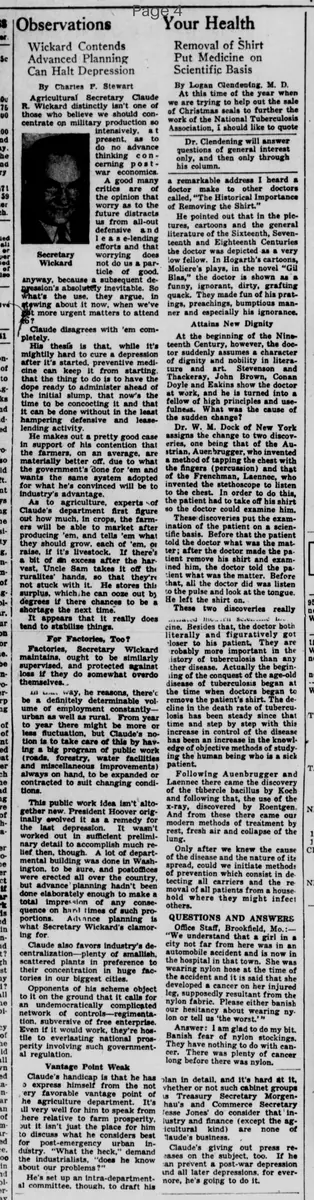
Wickard Contends Advanced Planning Can Halt Depression
By Charles P. Stewart
Agricultural Secretary Claude R. Wickard distinctly isn't one of those who believe we should concentrate on military production so intensively, at present, as to do no advance thinking concerning post-war economics.
A good many critics are of the opinion that worry as to the future distracts us from all-out defensive and lease-lending efforts and that Secretary Wickard does not do us a particle of good, anyway, because a subsequent depression's absolutely inevitable. So what's the use, they argue, in fretting about it now, when we've more urgent matters to attend to?
Claude disagrees with 'em completely.
His thesis is that, while it's mightily hard to cure a depression after it's started, preventive medicine can keep it from starting, that the thing to do is to have the dope ready to administer ahead of the initial slump, that now's the time to be concocting it and that it can be done without in the least hampering defensive and lease-lending activity.
He makes out a pretty good case in support of his contention that the farmers, on an average, are materially better off, due to what the government's done for 'em and wants the same system adopted for what he's convinced will be to industry's advantage.
As to agriculture, experts of Claude's department first figure out how much, in crops, the farmers will be able to market after producing 'em, and tells 'em what they should grow, each of 'em, or raise, if it's livestock. If there's a bit of an excess after the harvest, Uncle Sam takes it off the ruralites' hands, so that they're not stuck with it. He stores this surplus, which he can ooze out by degrees if there chances to be a shortage the next time.
It appears that it really does tend to stabilize things.
For Factories, Too?
Factories, Secretary Wickard maintains, ought to be similarly supervised, and protected against loss if they do somewhat overdo themselves.
In that way, he reasons, there'll be a definitely determinable volume of employment constantly- urban as well as rural. From year to year there might be more or less fluctuation, but Claude's notion is to take care of this by having a big program of public work (roads, forestry, water facilities and miscellaneous improvements) always on hand, to be expanded or contracted to suit changing conditions.
This public work idea isn't altogether new. President Hoover originally evolved it as a remedy for the last depression. It wasn't worked out in sufficient preliminary detail to accomplish much relief then, though. A lot of departmental building was done in Washington, to be sure, and postoffices were erected all over the country, but advance planning hadn't been done elaborately enough to make a total impression of any consequence on hard times of such proportions. Advance planning is what Secretary Wickard's clamoring for.
Claude also favors industry's decentralization-plenty of smallish, scattered plants in preference to their concentration in huge factories in our biggest cities.
Opponents of his scheme object to it on the ground that it calls for an undemocratically complicated network of controls-regimentation, subversive of free enterprise. Even if it would work, they're hostile to everlasting national prosperity involving such governmental regulation.
Vantage Point Weak
Claude's handicap is that he has to express himself from the not very favorable vantage point of the agriculture department. It's all very well for him to speak from here relative to farm prosperity, but it isn't just the place for him to discuss what he considers best for post-emergency urban industry. "What the heck," demand the industrialists, "does he know about our problems?"
He's set up an intra-departmental committee, though, to draft his plan in detail, and it's hard at it. Whether or not such cabinet groups as Treasury Secretary Morgenthau's and Commerce Secretary Jesse Jones' do consider that industry and finance (except the agricultural kind) are none of Claude's business, Claude's giving out press releases on the subject, too. If he can prevent a post-war depression and all later depressions, forevermore, he's going to do it.
Wickard Contends Advanced Planning Can Halt Depression
By Charles P. Stewart
Agricultural Secretary Claude R. Wickard distinctly isn't one of those who believe we should concentrate on military production so intensively, at present, as to do no advance thinking concerning post-war economics.
A good many critics are of the opinion that worry as to the future distracts us from all-out defensive and lease-lending efforts and that Secretary Wickard does not do us a particle of good, anyway, because a subsequent depression's absolutely inevitable. So what's the use, they argue, in fretting about it now, when we've more urgent matters to attend to?
Claude disagrees with 'em completely.
His thesis is that, while it's mightily hard to cure a depression after it's started, preventive medicine can keep it from starting, that the thing to do is to have the dope ready to administer ahead of the initial slump, that now's the time to be concocting it and that it can be done without in the least hampering defensive and lease-lending activity.
He makes out a pretty good case in support of his contention that the farmers, on an average, are materially better off, due to what the government's done for 'em and wants the same system adopted for what he's convinced will be to industry's advantage.
As to agriculture, experts of Claude's department first figure out how much, in crops, the farmers will be able to market after producing 'em, and tells 'em what they should grow, each of 'em, or raise, if it's livestock. If there's a bit of an excess after the harvest, Uncle Sam takes it off the ruralites' hands, so that they're not stuck with it. He stores this surplus, which he can ooze out by degrees if there chances to be a shortage the next time.
It appears that it really does tend to stabilize things.
For Factories, Too?
Factories, Secretary Wickard maintains, ought to be similarly supervised, and protected against loss if they do somewhat overdo themselves.
In that way, he reasons, there'll be a definitely determinable volume of employment constantly- urban as well as rural. From year to year there might be more or less fluctuation, but Claude's notion is to take care of this by having a big program of public work (roads, forestry, water facilities and miscellaneous improvements) always on hand, to be expanded or contracted to suit changing conditions.
This public work idea isn't altogether new. President Hoover originally evolved it as a remedy for the last depression. It wasn't worked out in sufficient preliminary detail to accomplish much relief then, though. A lot of departmental building was done in Washington, to be sure, and postoffices were erected all over the country, but advance planning hadn't been done elaborately enough to make a total impression of any consequence on hard times of such proportions. Advance planning is what Secretary Wickard's clamoring for.
Claude also favors industry's decentralization-plenty of smallish, scattered plants in preference to their concentration in huge factories in our biggest cities.
Opponents of his scheme object to it on the ground that it calls for an undemocratically complicated network of controls-regimentation, subversive of free enterprise. Even if it would work, they're hostile to everlasting national prosperity involving such governmental regulation.
Vantage Point Weak
Claude's handicap is that he has to express himself from the not very favorable vantage point of the agriculture department. It's all very well for him to speak from here relative to farm prosperity, but it isn't just the place for him to discuss what he considers best for post-emergency urban industry. "What the heck," demand the industrialists, "does he know about our problems?"
He's set up an intra-departmental committee, though, to draft his plan in detail, and it's hard at it. Whether or not such cabinet groups as Treasury Secretary Morgenthau's and Commerce Secretary Jesse Jones' do consider that industry and finance (except the agricultural kind) are none of Claude's business, Claude's giving out press releases on the subject, too. If he can prevent a post-war depression and all later depressions, forevermore, he's going to do it.
What sub-type of article is it?
Economic Policy
Agriculture
Infrastructure
What keywords are associated?
Post War Planning
Depression Prevention
Agricultural Stabilization
Public Works
Industry Decentralization
Economic Controls
What entities or persons were involved?
Claude R. Wickard
Charles P. Stewart
President Hoover
Henry Morgenthau
Jesse Jones
Editorial Details
Primary Topic
Advanced Planning To Prevent Post War Depression
Stance / Tone
Supportive Of Wickard's Preventive Economic Planning
Key Figures
Claude R. Wickard
Charles P. Stewart
President Hoover
Henry Morgenthau
Jesse Jones
Key Arguments
Preventive Planning Can Stop Depression Before It Starts Without Hindering War Efforts
Agricultural Policies Have Stabilized Farming Through Market Predictions And Surplus Management
Similar Supervision And Protection Should Apply To Factories For Steady Employment
Public Works Programs Should Be Ready To Expand Or Contract Based On Economic Needs
Industry Decentralization Into Smaller Plants Is Preferable To Large Urban Factories
Opponents View It As Undemocratic Regimentation Subverting Free Enterprise