Thank you for visiting SNEWPapers!
Sign up free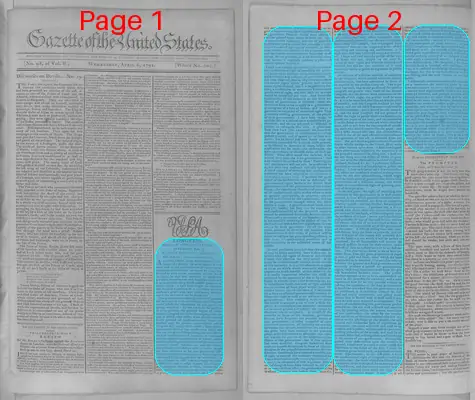
Gazette Of The United States
New York, New York County, New York
What is this article about?
On Saturday, February 7, Mr. Giles concluded his speech in the House of Representatives opposing the Bank Bill. He critiqued interpretations of 'necessary' in the Constitution, argued against implied powers for establishing a bank, highlighted risks to state sovereignty, and raised objections to the bill's details like land purchases and duration limits.
Merged-components note: Continuation of Mr. Giles' speech on the Bank Bill in the House of Representatives across pages 1 and 2.
Clippings
1 of 2
OCR Quality
Full Text
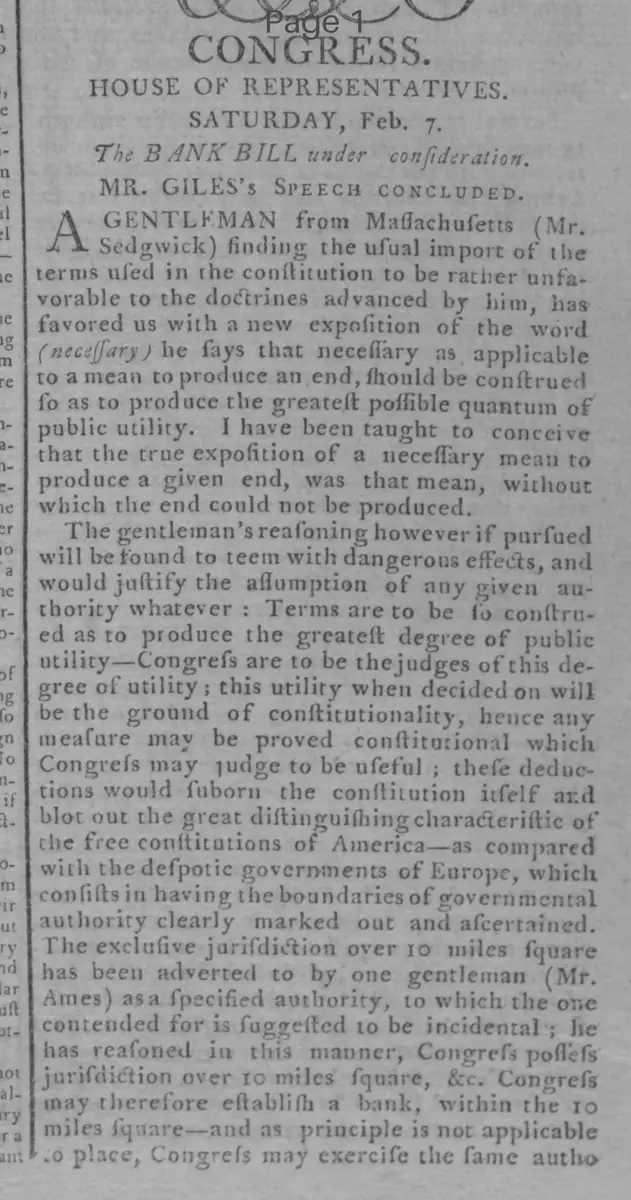
HOUSE OF REPRESENTATIVES.
SATURDAY, Feb. 7.
The BANK BILL under consideration.
MR. GILES's SPEECH CONCLUDED.
GENTLEMAN from Massachusetts (Mr. Sedgwick) finding the usual import of the terms used in the constitution to be rather unfavorable to the doctrines advanced by him, has favored us with a new exposition of the word (necessary) he says that necessary as applicable to a mean to produce an end, should be construed so as to produce the greatest possible quantum of public utility. I have been taught to conceive that the true exposition of a necessary mean to produce a given end, was that mean, without which the end could not be produced.
The gentleman's reasoning however if pursued will be found to teem with dangerous effects, and would justify the assumption of any given authority whatever: Terms are to be so construed as to produce the greatest degree of public utility—Congress are to be the judges of this degree of utility; this utility when decided on will be the ground of constitutionality, hence any measure may be proved constitutional which Congress may judge to be useful; these deductions would suborn the constitution itself and blot out the great distinguishing characteristic of the free constitutions of America—as compared with the despotic governments of Europe, which consists in having the boundaries of governmental authority clearly marked out and ascertained.
The exclusive jurisdiction over 10 miles square has been adverted to by one gentleman (Mr. Ames) as a specified authority, to which the one contended for is suggested to be incidental; he has reasoned in this manner, Congress possesses jurisdiction over 10 miles square, &c. Congress may therefore establish a bank, within the 10 miles square—and as principle is not applicable to place, Congress may exercise the same authority
security anywhere else this seems to me to be an ingenious improvement upon sophistical deduction; the gentleman however should have reflected, that the ground upon which he built the right to exercise this authority, was that of exclusive jurisdiction, and to extend the principle it is necessary to extend the right of exclusive jurisdiction, without this the basis of his argument fails, and the superstructure however beautified must follow, for the principle, if at all deducible from that source, is expressly confined to place and cannot operate beyond it.
I shall now consider the second resource, whence the constitutional right of exercising the proposed authority is derived—its incidentality to the mere creation and existence of government It has been observed. that in all governments there are certain rights tacitly granted and certain other rights retained, that it is impossible in framing a constitution to enumerate every minute governmental right, and that such an attempt would be chimerical and vain. And hence the incidentality of this authority to the mere existence of government is inferred ; these observations seem to me to apply to a government growing out of a state of society, and not to a government composed of chartered rights from previously existing governments, or the people of those governments. I have been taught to consider this as a federal not as a consolidated government, and am not prepared or disposed at present to relinquish that idea. A gentleman from New-York (Mr. Lawrence) has remarked, that the government is consolidated quoad the powers granted, and of course quoad their incidents ; but he should first have shown that the authority contended for is one of those granted, or incidental to some one of them, before the application can be made--the observation can have no tendency to establish either of those positions. What effect would this doctrine, if admitted, have upon the State governments ? And how would it be relished by them ? Their dignity and consequence will not only be prostrated by it, but their very existence radically subverted.
A third resource of deducing this constitutional authority has been resorted to, the expediency of the proposed measure itself. I presume the great object of the constitution was to distribute all governmental rights between the several State governments and the government of the United States ; the expediency therefore of the exercise of all constitutional rights as they relate to State or general government, is properly contemplated and decided by the constitution, and not by the governments amongst which the distribution is made. A gentleman from South-Carolina (Mr. Smith) has said, that the expediency and constitutionality of the proposed measure, cannot be considered separately, because the constitutionality grows out of the expediency, this is but candidly unveiling the subject of that sophistical mask which has been ingeniously thrown over it by some gentlemen : for all the arguments adduced in favor of the measure. from whatever source they arise, if pursued will be found to rush into the great one of expediency, to bear down all constitutional provisions and to end themselves in the unlimited ocean of despotism.
Several gentlemen have said that this authority may be safely exercised, since it does not interfere with the rights of States or individuals. I think this assertion not very correct; if the States be constitutionally entitled to the exercise of this authority, it is an intrusion on their rights to do an act which would eventually destroy or impede the freest exercise of that authority;for it is totally immaterial whether the effect be produced by the operation of this or by an inhibition in express terms ; the States may not only incorporate banks, but may of right prohibit the circulation of bank paper within their respective limits; the act therefore if it be intended to have an effectual operation will certainly infringe this right,or exist at the mercy of the State governments. This reasoning however places the subject in another point of view a little singular; it contemplates the authority contended for as vacant ground and justifies the tenure by the mere title of occupancy. In almost all the remarks in favor of the measure, gentlemen seem to have forgotten the peculiar nature of this government ; it being composed of mere chartered authorities, all authority not contained within that charter, would from the nature of the grant have been retained to the granting party, and I will venture to assert that this opinion was the sine qua non of the adoption and existence of this government ; but if this opinion had been doubtful, Congress themselves have made an express declaration in favor of this construction in the proposed amendments to the constitution. Gentlemen have inferred a constitutional right to exercise the authority contended for from a fourth resource,the former usages and habits of Congress, in affirmance of this argument several acts of Congress have been referred to, the power of removal from office, the government of the Western Territory, the cession from North-Carolina, the purchase of West-Point, &c. &c. I shall not examine into the propriety of these several acts, tho I conceive it would not be difficult to show, that they differ materially, upon constitutional grounds, from the one now proposedI shall only remark, that if Congress have heretofore been in the usage and habit of disregarding and violating the constitution, it is high time that that habit and usage was corrected : I hope and trust that the people of the United States will not tamely see the only security of their rights and liberties invaded and violated, but also see one violation of it with impunity, boldly urged as an argument to justify another.
An instance of a similar exercise of authority by the Congress, which existed under the former confederation, has been mentioned in favor of its exercise by the present Congress. The argument has been, that as the powers of the present Congress are greater than those of the former Congress, and the former were competent to the exercise of this right, the present must be so ; it is to be remarked,that that act was the child of necessity, and that Congress doubted its legitimacy, and the act itself was never confirmed by a judicial decision ; and it should be also remarked, that the same Congress did not pretend to possess the right to punish those who should counterfeit the paper of the bank, and recommended it to the states to confirm the act which they had done, and to pass laws for the purpose of punishing those who should counterfeit the paper ; and it is a little remarkable that this circumstance, which is one of the most essential to the existence and operation of this act, is withheld from our view. But as I think arguments drawn from this source wholly foreign to the subject, I shall make no other remark upon then. I shall now suggest a few observations respecting the expediency of the proposed measure —in doing this, I shall not say any thing as to the utility of banks in general, nor as to the effects of the banks of England. Scotland, Holland, &c. &c. I possess not sufficient practical or theoretical knowledge to justify the inquiry; I shall only point out a few circumstances, which are peculiarly attached to the government we are now administering, which might vary the application of general rules, drawn from governments of a different nature, and which possess the unquestioned right of granting charters of incorporation.
In the first place, the right of exercising that authority by this government is at least problematical, it is no where granted in express terms ; the legislature therefore can have no competent security against a judicial decision, but a dependent or a corrupt court. I presume that a law to punish with death those who counterfeit the paper emitted by the bank, will be consequent upon the existence of this act; hence a judicial decision will probably be had of the most serious and awful nature-the life of an individual at stake on one hand—an improvident act of the government on the other. A distrust arising from this cause, will forever keep the bank in jeopardy, and the very first trial of this nature will probably subject the bank to a run which it will be unable to withstand; for all stockholders will require the greatest possible security for their money, and a distrust of such an institution will be its destruction. This observation seems to me to have peculiar force, from the great proportion of paper to that of gold and silver, upon which the bank is proposed to be founded. The peculiar relation between the general and state governments will naturally produce a contest for governmental rights, until long experience shall settle the precise boundaries between them. The present measure appears to me to be an unprovoked advance in this scramble for authority, and a mere experiment how far we may proceed without involving the opposition of the state governments. It should be remarked that this government is in its childhood, it is therefore unfitted for such bold and manly enterprizes, and policy would dictate that it should wait at least until it may have become more matured or invigorated. Two modes of administering this government present themselves—the one with mildness and moderation, by keeping within the known boundaries of the constitution—the other by the creation and operation of fiscal mechanism-the first will insure us the affections of the people, the only natural and substantial basis of republican governmentsthe other will arise and exist in oppression and injustice, will increase the previously existing jealousies of the people, and must be ultimately discarded,or bring about a radical change in the nature of our government. Having suggested these observations upon the measure in general, I shall now proceed to point out a few objections to the detail of the bill: I think the authority given to the bank, to purchase and hold lands, objectionable; in the first place, I doubt the constitutional right of Congress to invest such an authority-the lands within the United States are holden of the individual states,and not of the United States, and that tenure appears to me to be the true ground upon which the right to exercise that authority grows. I believe it is admitted that although Congress may naturalize a foreigner, they cannot authorize him to purchase lands—and I think the case at least as strong, when they first create an artificial person, and then invest the authority ; besides, if we have reference to the experience of other countries, we shall find it dangerous to allow incorporated bodies to hold lands at all : the exercise of that right produced great oppression in England, and nothing but the masterly activity of an absolute Prince, could apply a competent remedy. A gentleman from Massachusetts, (Mr. Sedgwick,) has denied that the Bank is invested with this right—It is true, it is confined to the mode of purchasing by mortgage, but that is the most effectual mode of purchasing, and the most ruinous to the land-holder.
I will merely mention one other objection without a comment-the authority given to make laws not contrary to law or its own constitution —but the most objectionable clause is that which limits its duration, and pledges the faith of the United States that no other Bank shall be established in the mean time, however dangerous and offensive the present measure might prove in its operation, and whatever may be the utility and advantage in any other scheme of banking, which experience may suggest—such a stipulation cannot be justified but from the most pointed necessity, and from the maturest deliberation : When I search for the necessity of this measure, it escapes me-it is not pretended in this bill itself-the chief stimulus which I can discover to the existence of this measure, is to give artificial impulse to the value of stock-This is not a sufficient justification-the subject has not been sufficiently considered, and I therefore hope it may be postponed to some future session of Congress, —many evils may be avoided by such a conduct —none can result from it.
What sub-type of article is it?
What keywords are associated?
What entities or persons were involved?
Domestic News Details
Event Date
Saturday, Feb. 7
Key Persons
Event Details
Mr. Giles concludes his speech opposing the Bank Bill, arguing against expansive interpretations of constitutional terms like 'necessary,' rejecting implied powers from jurisdiction or government existence, critiquing expediency-based justifications, highlighting interference with state rights, referencing past congressional acts, and objecting to bill details such as land holdings, self-lawmaking, and duration limits.