Thank you for visiting SNEWPapers!
Sign up free
Story
December 2, 1926
The Ronan Pioneer
Ronan, Lake County, Montana
What is this article about?
In a conversation, Aunt Emmy explains to Helen the concept of a household budget as a plan to allocate income for needs like rent, food, and savings. She outlines a standard budget for incomes $2,000-$10,000, stresses the importance of saving 10% to avoid future dependency, and advises consulting bankers for adjustments.
Clipping
OCR Quality
95%
Excellent
Full Text
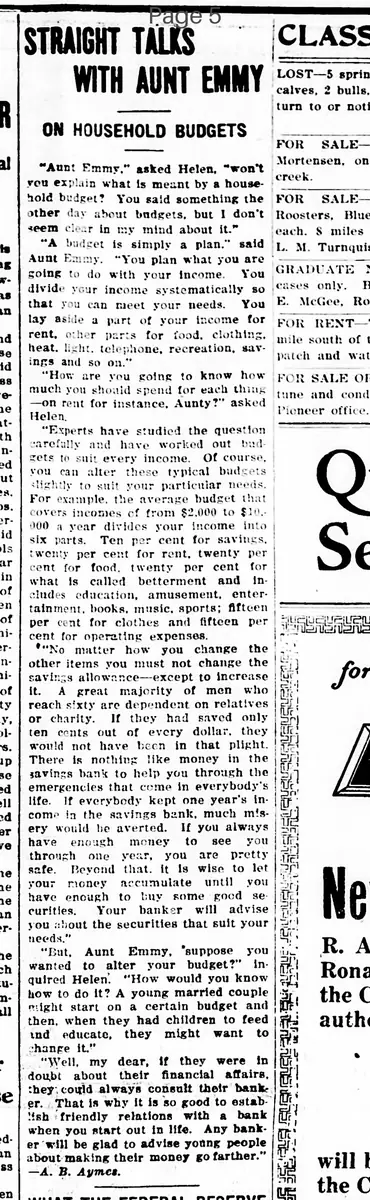
STRAIGHT TALKS WITH AUNT EMMY ON HOUSEHOLD BUDGETS
"Aunt Emmy," asked Helen, "won't you explain what is meant by a household budget? You said something the other day about budgets, but I don't seem clear in my mind about it."
"A budget is simply a plan," said Aunt Emmy. "You plan what you are going to do with your income. You divide your income systematically so that you can meet your needs. You lay aside a part of your income for rent, other parts for food, clothing, heat, light, telephone, recreation, savings and so on."
"How are you going to know how much you should spend for each thing—on rent for instance, Aunty?" asked Helen.
"Experts have studied the question carefully and have worked out budgets to suit every income. Of course, you can alter these typical budgets slightly to suit your particular needs. For example, the average budget that covers incomes of from $2,000 to $10,000 a year divides your income into six parts. Ten per cent for savings, twenty per cent for rent, twenty per cent for food, twenty per cent for what is called betterment and includes education, amusement, entertainment, books, music, sports; fifteen per cent for clothes and fifteen per cent for operating expenses.
"No matter how you change the other items you must not change the savings allowance—except to increase it. A great majority of men who reach sixty are dependent on relatives or charity. If they had saved only ten cents out of every dollar, they would not have been in that plight. There is nothing like money in the savings bank to help you through the emergencies that come in everybody's life. If everybody kept one year's income in the savings bank, much misery would be averted. If you always have enough money to see you through one year, you are pretty safe. Beyond that, it is wise to let your money accumulate until you have enough to buy some good securities. Your banker will advise you about the securities that suit your needs."
"But, Aunt Emmy, suppose you wanted to alter your budget?" inquired Helen. "How would you know how to do it? A young married couple might start on a certain budget and then, when they had children to feed and educate, they might want to change it."
"Well, my dear, if they were in doubt about their financial affairs, they could always consult their banker. That is why it is so good to establish friendly relations with a bank when you start out in life. Any banker will be glad to advise young people about making their money go farther."
—A. B. Aynes.
"Aunt Emmy," asked Helen, "won't you explain what is meant by a household budget? You said something the other day about budgets, but I don't seem clear in my mind about it."
"A budget is simply a plan," said Aunt Emmy. "You plan what you are going to do with your income. You divide your income systematically so that you can meet your needs. You lay aside a part of your income for rent, other parts for food, clothing, heat, light, telephone, recreation, savings and so on."
"How are you going to know how much you should spend for each thing—on rent for instance, Aunty?" asked Helen.
"Experts have studied the question carefully and have worked out budgets to suit every income. Of course, you can alter these typical budgets slightly to suit your particular needs. For example, the average budget that covers incomes of from $2,000 to $10,000 a year divides your income into six parts. Ten per cent for savings, twenty per cent for rent, twenty per cent for food, twenty per cent for what is called betterment and includes education, amusement, entertainment, books, music, sports; fifteen per cent for clothes and fifteen per cent for operating expenses.
"No matter how you change the other items you must not change the savings allowance—except to increase it. A great majority of men who reach sixty are dependent on relatives or charity. If they had saved only ten cents out of every dollar, they would not have been in that plight. There is nothing like money in the savings bank to help you through the emergencies that come in everybody's life. If everybody kept one year's income in the savings bank, much misery would be averted. If you always have enough money to see you through one year, you are pretty safe. Beyond that, it is wise to let your money accumulate until you have enough to buy some good securities. Your banker will advise you about the securities that suit your needs."
"But, Aunt Emmy, suppose you wanted to alter your budget?" inquired Helen. "How would you know how to do it? A young married couple might start on a certain budget and then, when they had children to feed and educate, they might want to change it."
"Well, my dear, if they were in doubt about their financial affairs, they could always consult their banker. That is why it is so good to establish friendly relations with a bank when you start out in life. Any banker will be glad to advise young people about making their money go farther."
—A. B. Aynes.
What sub-type of article is it?
Financial Advice
Dialogue Lesson
What themes does it cover?
Moral Virtue
Misfortune
What keywords are associated?
Household Budget
Income Planning
Savings
Financial Advice
Budget Allocation
What entities or persons were involved?
Aunt Emmy
Helen
Story Details
Key Persons
Aunt Emmy
Helen
Story Details
Aunt Emmy teaches Helen about creating a household budget by dividing income into categories like savings, rent, food, and operating expenses, emphasizing the importance of saving 10% to avoid future financial dependency and suggesting consultation with bankers for adjustments.