Thank you for visiting SNEWPapers!
Sign up free
Alexandria Gazette, Commercial And Political
Alexandria, Virginia
What is this article about?
Editorial contrasts republic and democracy in early U.S. government, praising Washington's administration for prioritizing national good via neutrality proclamation (1793) and Jay's treaty (1796), while criticizing Jefferson's as driven by popular passions and factionalism, leading to calamities and potential despotism.
Merged-components note: These two components form a continuous editorial on republicanism vs. democracy, as indicated by sequential reading order and the second starting with 'The foregoing remarks'.
Clipping
OCR Quality
Full Text
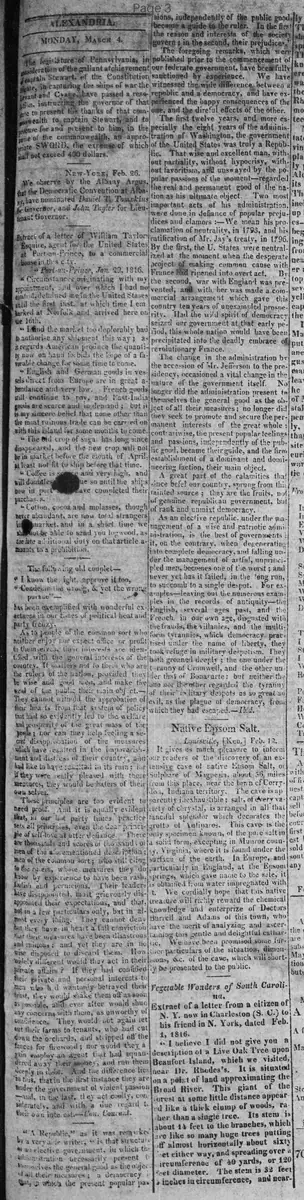
"I know the right, approve it too.
Condemn the wrong, & yet the wrong pursue—"
has been exemplified with wonderful exactness in our times of political heat and party frenzy.
As to people of the common sort who neither enjoy nor expect office or profit to themselves, their interests are identified with the general interests of the country. It matters not to them who are the rulers of the nation, provided they be wise and good men, and make the weal of the public their main object. They cannot withhold the approbation of their hearts from that system of policy that had so evidently led to the welfare and prosperity of the great mass of the people; nor can they help feeling a secret disapprobation of the measures which have resulted in the impoverishment and distress of their country, and had like to have resulted in its ruin: for if they were really pleased with those measures, they would be haters of their own selves.
These principles are too evident to need proof. And it is equally evident that, in our hot party times, practice sets all principles, even the dear principle of self-love at utter defiance. There are thousands and scores of thousands of men of the aforementioned description; men of the common sort; who still cling to the rulers, whose measures they do know by experience to have been rash, foolish and pernicious. Their leaders have disappointed, most grievously disappointed their expectations, and that, not in a few particulars only, but in almost every thing. They cannot deny but they have in heart a full conviction that their measures have been disastrous and ruinous; and yet they are in no wise disposed to discard them. How widely different would they act in their private affairs? if they had consigned their private and personal interests to men who had wantonly betrayed their trust, they would shake them off as soon as possible, and ever after would shun any concerns with them, as unworthy of confidence. They would not again let out their farms to tenants, who had cut down the orchards, and stripped off the fences for firewood; nor would they again employ an agent that had squandered away their money, and ran them deeply in debt. And the difference lies in this, that in the first instance they are under the government of violent passion—and in the last, they act coolly, considerately, and with a due regard to their own interest.—Con. Courant.
"A Republic" as it was remarked by a very able writer, "is that structure of an elective government, in which the administration necessarily present to themselves the general good as the object of all their measures; a democracy is that, in which the present popular passions, independently of the public good, become a guide to the ruler. In the first the reason and interests of the society govern; in the second, their prejudices."
The foregoing remarks, which were published prior to the commencement of our federal government, have been fully sanctioned by experience. We have witnessed the wide difference between a republic and a democracy, and have experienced the happy consequences of the one, and the direful effects of the other.
The first twelve years, and more especially the eight years of the administration of Washington, the government of the United States was truly a Republic. That wise and excellent man, without partiality, without hypocrisy, without favoritism, and unswayed by the popular passions of the moment—regarded the real and permanent good of the nation as his ultimate object. Two most important acts of his administration, were done in defiance of popular prejudices and clamors:—We mean his proclamation of neutrality, in 1793, and his ratification of Mr. Jay's treaty, in 1796.
By the first, the U. States were neutralized at the moment when the desperate project of making common cause with France had ripened into overt act. By the second, war with England was prevented, and with her was made a commercial arrangement which gave this country ten years of unexampled prosperity. Had the wild spirit of democracy seized our government at that early period, this whole nation would have been precipitated into the deadly embrace of revolutionary France.
The change in the administration by the accession of Mr. Jefferson to the presidency, occasioned a vital change in the nature of the government itself. No longer did the administration present themselves the general good as the object of all their measures; no longer did they seek to promote and secure the permanent interests of the great whole: contrariwise, the present popular feelings and passions, independently of the public good, became their guide, and the firm establishment of a dominant and domineering faction, their main object.
A great part of those calamities that since befel our country, sprung from this tainted source: they are the fruits, not of genuine republican government, but of rank and unmixt democracy.
As an elective republic, under the management of a wise and patriotic administration, is the best of governments: it, on the contrary, when degenerating into complete democracy, and falling under the management of artful, unprincipled men, becomes one of the worst; and never yet has it failed, in the long run, to succumb to a single despot. For examples—leaving out the numerous examples in the records of antiquity—the English, several ages past, and the French, in our own age, disgusted with the frauds, the villanies, and the multiform tyrannies, which democracy practised under the name of liberty, they took refuge in military despotism. They both groaned deeply; the one under the tyranny of Cromwell, and the other under that of Bonaparte: but neither the one nor the other regarded the tyranny of their military despots as so great an evil, as the plague of democracy, from which they had escaped.—Ibid.
What sub-type of article is it?
What keywords are associated?
What entities or persons were involved?
Editorial Details
Primary Topic
Republic Versus Democracy In Early U.S. Government
Stance / Tone
Pro Republican Administration, Anti Democratic Factionalism
Key Figures
Key Arguments