Thank you for visiting SNEWPapers!
Sign up free
Alexandria Daily Gazette, Commercial & Political
Alexandria, Virginia
What is this article about?
Diplomatic correspondence from William Pinkney in London details the US request for the recall of British Minister Francis James Jackson due to offensive insinuations in his exchanges with Secretary Smith over the disavowed Erskine arrangement and Orders in Council. Marquis Wellesley agrees to recall Jackson without displeasure, affirming desire for amicable relations.
Merged-components note: This is a continuation of the diplomatic correspondence across pages 2 and 3, forming a single coherent foreign news article.
Clippings
1 of 2
OCR Quality
Full Text
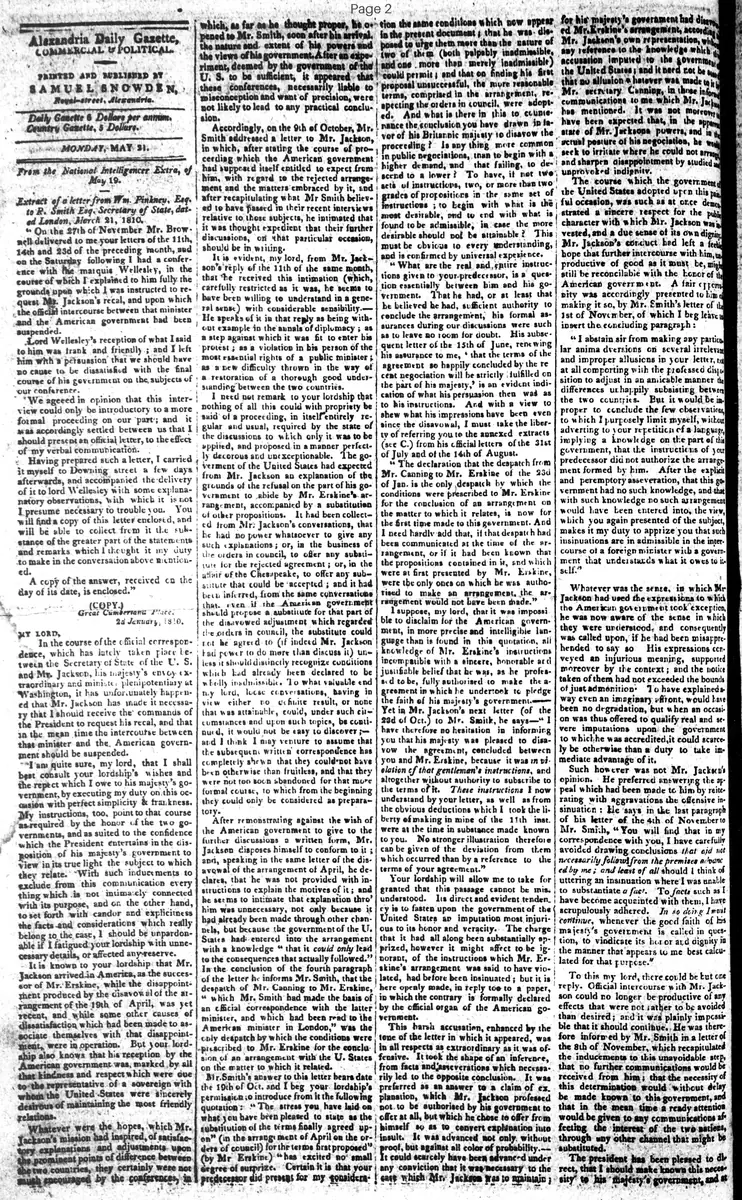
Extract of a letter from Wm. Pinkney, Esq. to R. Smith Esq. Secretary of State, dated London, March 21, 1810.
On the 27th of November Mr. Brownell delivered to me four letters of the 11th, 14th and 23d of the preceding month, and on the Saturday following I had a conference with the marquis Wellesley. In the course of which I explained to him fully the grounds upon which I was instructed to request Mr. Jackson's recall, and upon which the official intercourse between that minister and the American government had been suspended.
Lord Wellesley's reception of what I said to him was frank and friendly; and I left him with a persuasion that we should have no cause to be dissatisfied with the final course of his government on the subjects of our conference.
We agreed in opinion that this interview could only be introductory to a more formal proceeding on our part; and it was accordingly settled between us that I should present an official letter, to the effect of my verbal communication.
Having prepared such a letter, I carried it myself to Downing street a few days afterwards, and accompanied the delivery of it to lord Wellesley with some explanatory observations, with which it is not I presume necessary to trouble you. You will find a copy of this letter enclosed, and will be able to collect from it the substance of the greater part of the statements and remarks which I thought it my duty to make in the conversation above mentioned.
A copy of the answer, received on the day of its date, is enclosed."
(COPY.)
Great Cumberland Place.
2d January, 1810.
MY LORD,
In the course of the official correspondence, which has lately taken place between the Secretary of State of the U. S. and Mr Jackson, his majesty's envoy extraordinary and minister plenipotentiary at Washington, it has unfortunately happened that Mr. Jackson has made it necessary that I should receive the commands of the President to request his recall, and that in the mean time the intercourse between that minister and the American government should be suspended.
I am quite sure, my lord, that I shall best consult your lordship's wishes and the respect which I owe to his majesty's government, by executing my duty on this occasion with perfect simplicity & frankness.
My instructions, too, point to that course as required by the honor of the two governments, and as suited to the confidence which the President entertains in the disposition of his majesty's government to view in its true light the subject to which they relate. With such inducements to exclude from this communication every thing which is not intimately connected with its purpose, and on the other hand to set forth with candor and explicitness the facts and considerations which really belong to the case, I should be unpardonable if I fatigued your lordship with unnecessary details, or affected any reserve.
It is known to your lordship that Mr. Jackson arrived in America, as the successor of Mr. Erskine, while the disappointment produced by the disavowal of the arrangement of the 19th of April, was yet recent, and while some other causes of dissatisfaction which had been made to associate themselves with that disappointment, were in operation. But your lordship also knows that his reception by the American government was, marked by all that kindness and respect which were due to the representative of a sovereign with whom the United States were sincerely desirous of maintaining the most friendly relations.
Whatever were the hopes, which Mr. Jackson's mission had inspired, of satisfactory explanations and adjustments upon the prominent points of difference between the two countries, they certainly were not such encouraged by the conferences, in which, as far as he thought proper, he opened to Mr. Smith, soon after his arrival. the nature and extent of his powers and the views of his government. After an experiment, deemed by the government of the U. S. to be sufficient, it appeared that these conferences, necessarily liable to misconception and want of precision, were not likely to lead to any practical conclusion.
Accordingly, on the 9th of October, Mr Smith addressed a letter to Mr. Jackson, in which, after stating the course of proceedings which the American government had supposed itself entitled to expect from him, with regard to the rejected arrangement and the matters embraced by it, and after recapitulating what Mr Smith believed to have passed in their recent interviews relative to those subjects, he intimated that it was thought expedient that their further discussions, on that particular occasion, should be in writing.
It is evident, my lord, from Mr. Jackson's reply of the 11th of the same month, that he received this intimation (which, carefully restricted as it was, he seems to have been willing to understand in a general sense) with considerable sensibility.-- He speaks of it in that reply as being without example in the annals of diplomacy; as a step against which it was fit to enter his protest; as a violation in his person of the most essential rights of a public minister; as a new difficulty thrown in the way of a restoration of a thorough good understanding between the two countries.
I need not remark to your lordship that nothing of all this could with propriety be said of a proceeding, in itself entirely regular and usual, required by the state of the discussions to which only it was to be applied, and proposed in a manner perfectly decorous and unexceptionable. The government of the United States had expected from Mr. Jackson an explanation of the grounds of the refusal on the part of his government to abide by Mr. Erskine's arrangement, accompanied by a substitution of other propositions. It had been collected from Mr. Jackson's conversations, that he had no power whatsoever to give any such explanations; or, in the business of the orders in council, to offer any substitute for the rejected agreement; or, in the affair of the Chesapeake, to offer any substitute that could be accepted; and it had been inferred, from the same conversations that, even if the American government should propose a substitute for that part of the disavowed adjustment which regarded the orders in council, the substitute could not be agreed to (if indeed Mr. Jackson had power to do more than discuss it) unless it should distinctly recognize conditions which had already been declared to be wholly inadmissible. To what valuable end my lord, loose conversations, having in view either no definite result, or none that was attainable, could, under such circumstances and upon such topics, be continued, it would not be easy to discover;-- and I think I may venture to assume that the subsequent written correspondence has completely shown that they could not have been otherwise than fruitless, and that they were not too soon abandoned for that more formal course, to which from the beginning they could only be considered as preparatory.
After remonstrating against the wish of the American government to give to the further discussions a written form, Mr. Jackson disposes himself to conform to it: and, speaking in the same letter of the disavowal of the arrangement of April, he declares, that he was not provided with instructions to explain the motives of it; and he seems to intimate that explanation thro' him was unnecessary, not only, because it had already been made through other channels, but because the government of the U. States had entered into the arrangement with a knowledge "that it could only lead to the consequences that actually followed."
In the conclusion of the fourth paragraph of the letter he informs Mr. Smith, that the dispatch of Mr. Canning to Mr. Erskine, "which Mr. Smith had made the basis of an official correspondence with the latter minister, and which had been read to the American minister in London," was the only despatch by which the conditions were prescribed to Mr. Erskine for the conclusion of an arrangement with the U. States on the matter to which it related.
Mr. Smith's answer to this letter bears date the 19th of Oct. and I beg your lordship's permission to introduce from it the following quotation: "The stress you have laid on what you have been pleased to state as the substitution of the terms finally agreed upon" (in the arrangement of April on the orders of council) for the terms first proposed" (by Mr Erskine) "has excited no small degree of surprize. Certain it is that your predecessor did present for my consideration the same conditions which now appear in the present document; that he was disposed to urge them more than the nature of two of them (both palpably inadmissible, and one more than merely inadmissible) could permit; and that on finding his first proposal unsuccessful, the more reasonable terms, comprised in the arrangement respecting the orders in council, were adopted. And what is there in this to, countenance the conclusion you have drawn in favor of his Britannic majesty to disavow the proceeding? Is any thing more common in public negotiations, than to begin with a higher demand, and that failing, to descend to a lower? To have, it not two sets of instructions, two, or more than two grades of propositions in the same set of instructions; to begin with what is the most desirable, and to end with what is found to be admissible. in case the more desirable should not be attainable? This must be obvious to every understanding, and is confirmed by universal experience,
"What are the real and entire instructions given to your predecessor, is a question essentially between him and his government. That he had, or at least that he believed he had, sufficient authority to conclude the arrangement, his formal assurances during our discussions were such as to leave no room for doubt. His subsequent letter of the 15th of June, renewing his assurance to me, 'that the terms of the agreement so happily concluded by the recent negotiation will be strictly fulfilled on the part of his majesty.' is an evident indication of what his persuasion then was as to his instructions. And with a view to shew what his impressions have been even since the disavowal. I must take the liberty of referring you to the annexed extracts (see C.) from his official letters of the 31st of July and of the 14th of August.
"The declaration that the despatch from Mr. Canning to Mr. Erskine of the 23d of Jan. is the only dispatch by which the conditions were prescribed to Mr. Erskine for the conclusion of an arrangement on the matter to which it relates, is now for the first time made to this government. And I need hardly add that, if that despatch had been communicated at the time of the arrangement, or if it had been known that the propositions contained in it, and which were at first presented by Mr. Erskine, were the only ones on which he was authorized to make an arrangement, the arrangement would not have been made."
I suppose, my lord, that it was impossible to disclaim for the American government, in more precise and intelligible language than is found in this quotation, all knowledge of Mr. Erskine's instructions incompatible with a sincere, honorable and justifiable belief that he was, as he professed to be, fully authorized to make the agreement in which he undertook to pledge the faith of his majesty's government.-- Yet in Mr. Jackson's next letter (of the 23d of Oct.) to Mr. Smith, he says-"I have therefore no hesitation in informing you that his majesty was pleased to disavow the agreement, concluded between you and Mr. Erskine. because it was in violation of that gentleman's instructions, and altogether without authority to subscribe to the terms of it. These instructions I now understand by your letter, as well as from the obvious deductions which I took the liberty of making in mine of the 11th inst. were at the time in substance made known to you. No stronger illustration therefore can be given of the deviation from them which occurred than by a reference to the terms of your agreement.
Your lordship will allow me to take for granted that this passage cannot be misunderstood. Its direct and evident tendency is to fasten upon the government of the United States an imputation most injurious to its honor and veracity...The charge that it had all along been substantially apprised, however it might affect to be ignorant, of the instructions which Mr. Erskine's arrangement was said to have violated, had before been insinuated': but it is here openly made, in reply too to a paper, in which the contrary is formally declared by the official organ of the American government.
This harsh accusation, enhanced by the tone of the letter in which it appeared, was in all respects as extraordinary as it was offensive. It took the shape of an inference, from acts and asseverations which necessarily led to the opposite conclusion.. It was presented as an answer to a claim of explanation, which Mr. Jackson professed not to be authorized by his government to offer at all, but which he chose to offer from himself so as to convert explanation into insult. It was advanced not only without proof, but against all color of probability.-- It could scarcely have been advanced under any conviction that it was necessary to the case which Mr. Jackson was to maintain; for his majesty's government had disavowed Mr. Erskine's arrangement, according to Mr. Jackson's own representation, without any reference to the knowledge which the accusation imputed to the government of the United States: and it need not be said that no allusion whatever was made to it in Mr. secretary Canning's those information communications to me which Mr. Jackson has mentioned. It was not moreover have been expected that, in the apparent state of Mr. Jackson's powers, and in the actual posture of his negotiation, he would seek to irritate where he could not arrange, and sharpen disappointment by studied, unprovoked indignity.
The course which the government of the United States adopted upon this painful occasion, was such as at once demonstrated a sincere respect for the public character with which Mr. Jackson was invested, and a due sense of its own dignity Mr. Jackson's conduct had left a feeling hope that further intercourse with him, unproductive of good as it must be, might still be reconcilable with the honor of the American government. A fair opportunity was accordingly presented to him of making it so, by Mr. Smith's letter of the 1st of November, of which I beg leave to insert the concluding paragraph:
"I abstain sir from making any particular animadversions on several irrelevant and improper allusions in your letter, and at all comporting with the professed disposition to adjust in an amicable manner the differences unhappily subsisting between the two countries. But it would be improper to conclude the few observations to which I purposely limit myself, without adverting to your repetition of a language implying a knowledge on the part of this government, that the instructions of your predecessor did not authorize the arrangement formed by him. After the explicit and peremptory asseveration, that this government had no such knowledge, and that with such knowledge no such arrangement would have been entered into, the view which you again presented of the subject, makes it my duty to apprise you that such insinuations are inadmissible in the intercourse of a foreign minister with a government that understands what it owes to itself."
Whatever was the sense, in which Mr Jackson had used the expressions to which the American government took exception he was now aware of the sense in which they were understood, and consequently was called upon, if he had been misapprehended to say so His expressions conveyed an injurious meaning, supported moreover by the context: and the notice taken of them had not exceeded the bounds of just admonition: To have explained away even an imaginary afront, would have been no degradation, but when an occasion was thus offered to qualify real and severe imputations upon the government to which he was accredited, it could scarcely be otherwise than a duty to take immediate advantage of it
Such however was not Mr. Jackson's opinion. He preferred answering the appeal which had been made to him by reiterating with aggravations the offensive insinuation: He says in the last paragraph of his letter of the 4th of November to Mr. Smith. "You will find that in my correspondence with you, I have carefully avoided drawing conclusions that did not necessarily follow from the premises advanced by me; and least of all should I think of uttering an insinuation where I was unable to substantiate a fact. To acts such as I have become acquainted with them, I have scrupulously adhered. In so doing I must continue, whenever the good faith of his majesty's government is called in question, to vindicate its honor and dignity in the manner that appears to me best calculated for that purpose."
To this my lord, there could be but one reply. Official intercourse with Mr. Jackson could no longer be productive of any effects that were not rather to be avoided than desired; and it was plainly impossible that it should continue. He was therefore informed by Mr. Smith in a letter of the 8th of November, which recapitulated the inducements to this unavoidable step, that no further communications would be received from him; that the necessity of this determination would without delay be made known to this government, and that in the mean time a ready attention would be given to any communications affecting the interest of the two nations, through any other channel that might be substituted.
The president has been pleased to direct, that I should make known this necessity to his majesty government. and state
the same time request that Mr. Jackson may be recalled. And I am particularly instructed to do this in a manner that will leave no doubt of the undiminished desire of the United States to unite in all the means best calculated to establish the relations of the two countries on the solid foundations of justice, of friendship, and of mutual interest. I am further particularly instructed, my lord, to make his majesty's government sensible, that in requiring the recall of Mr. Jackson the United States wish not to be understood as in any degree obstructing communications which may lead to a friendly accommodation, but that, on the contrary, they sincerely retain the desire, which they have constantly professed, to facilitate so happy an event, and that nothing will be more agreeable to them than to find the minister, who has rendered himself so justly obnoxious, replaced by another, who with a different character, may carry with him all the authorities and instructions requisite for the complete success of his mission, or if the attainment of this object through my agency should be considered more expeditious, or otherwise preferable, that it will be a course entirely satisfactory to the United States.
These instructions which I lay before your lordship without disguise require no comment.
Before I conclude this letter It may be proper very shortly to advert to two communications, received by Mr. Secretary Smith from Mr. Oakley, after the correspondence with Mr. Jackson had ceased.
The first of these communications, of which I am not able to ascertain the date, requested a document having the effect of a special passport or safeguard, for Mr. Jackson and the whole of his family during their further stay in the United States. This application was regarded as somewhat singular, but the document, of which the necessity was not perceived, was nevertheless furnished. The reasons assigned for the application excited some surprise. I have troubled your lordship, in conversation, with a few remarks, from my instructions, upon one of those reasons, which I will take the liberty to repeat.
The paper in question states that Mr. Jackson 'had already been once most grossly insulted by the inhabitants of Hampton, in the unprovoked language of abuse held by them to several officers bearing the king's uniform: when those officers were themselves violently assaulted and put in imminent danger.'
I am given to understand, my lord, that the insult here alluded to, was for the first time brought under the notice of the American government by this paper; that it had indeed been among the rumors of the day that some unbecoming scene had taken place at Hampton or Norfolk, between some officers belonging to the Africaine frigate and some of the inhabitants, and that it took its rise in the indiscretion of the former; that no attention to the circumstance having been called for, and no enquiry having been made the truth of the case is unknown: but that it was never supposed that Mr. Jackson himself, who was onboard the frigate, had been personally insulted; nor is it understood in what way he supposes he was so, I am authorised to add, that any complaint or representation on the subject would instantly have received every proper attention.
The other communications (of which the substance was soon afterwards published to the American people in the form of a circular letter from Mr. Jackson to the British consuls in the United States) seems to have been intended as a justification of his conduct in that part of his correspondence, which had given umbrage to the American government. This paper (bearing date the 13th of Nov.) is not very explicit: but it would appear to be calculated to give rather a new form to the statements, which Mr. Jackson had suffered the government of the U. S. to view in another light, until it had no choice but to act upon the obvious and natural interpretation of them sanctioned by himself.
It was never objected to Mr. Jackson (as this paper seems to suggest) that he had stated, that the three propositions, in Mr. Erskine's original instructions, were submitted to Mr. Smith by that gentleman; or that he had stated it as made known to him by Mr. Canning, that the instruction to Mr. Erskine, containing those three conditions, was the only one from which his authority was derived for the conclusion of an arrangement on the matter to which it related.
The objection was, that he had ascribed to the American government a knowledge, that the propositions submitted to its consideration by Mr. Erskine, were indispensable conditions; and that he did so, even after that knowledge had been distinctly disclaimed, and he had been made to perceive that a repetition of the allegation could not be suffered. I willingly leave your lordship to judge whether Mr. Jackson's correspondence will bear any other construction than it in act received; and whether, supposing it to have been erroneously construed, his letter of the 4th of Nov. should not have corrected the mistake, instead of confirming and establishing it.
As an explanation, this paper was even worse than nothing: It had not the appearance of an attempt to rectify misapprehension. It sought to put the American government in the wrong, by assuming that what had given so much umbrage ought not to have given any. It imported reproach rather than explanation. It kept out of sight the real offence, and, introducing a new and insufficient one in its place, seemed to disclose no other wish than to withdraw from the government of the U S. the ground upon which it had proceeded. Its apparent purpose, in a word, was to fix a charge of injustice upon the past, not to produce a beneficial effect upon the future. In this view, and in this only, it was perfectly consistent that it should announce Mr. Jackson's determination to retire to New York.
The time when this paper was presented will not have escaped your lordship's observations. It followed the demand, already mentioned, of a safeguard for Mr. Jackson his family and the gentlemen attached to his mission; a demand which cannot be regarded, especially if we look to the inducements to which it referred, as either conciliatory or respectful. It followed, the letter of the 4th of Nov. which, had explanation been intended, ought undoubtedly to have contained it, but, which, in lieu of it, contained fresh matter of provocation It was itself followed by the publication of its own substance in another garb. On the very day of its date, when Mr. Jackson, if he meant it as an explanation, could not be justified in concluding that it would not be satisfactory, it was moulded by him into the circular address to which I have before alluded: and immediate steps appear to have been taken to give to it, in that shape, the utmost publicity.
I have no wish my lord, to make any strong remarks upon that proceeding. It will be admitted that it was a great irregularity: and that if Mr. Jackson had been particularly anxious to close every avenue to reconciliation between the American government and himself, he could not have fallen upon a better expedient.
I have now only to add, may lord, the expressions of my own most ardent wish that, out of the incident which has produced this letter, an occasion may be made to arise, which improved as it ought to be, and I trust will be, by our respective governments, may conduct them to cordial and lasting friendship, Thus to endeavor to bring good out of evil, would be worthy of the rulers of two nations that are only in their natural position when they are engaged in offices of mutual kindness, & largely contributing to the prosperity and happiness of each other.
I have the honor to be, with the highest consideration, my lord, your lordship's most obedient, humble servant.
Signed,
WM. PINKNEY.
The most noble
The Marquis Wellesley, &c. &c.
Foreign Office; March 14, 1810.
SIR,
The letter which I had the honor to receive from you under date of 2d January, together with the additional paragraph received on the 24th January, has been laid before the king.
The several conferences which I have held with you respecting the transactions to which your letter referred, have, I trust, satisfied you, that it is the sincere desire of his majesty's government, on the present occasion, to avoid any discussion which might obstruct the renewal of amicable intercourse between the two countries.
The correspondence between Mr Jackson and Mr. Smith has been submitted to his majesty's consideration
His majesty has commanded me to express his concern, that the official communication, between his majesty's minister in America and the government of the United States, should have been interrupted, before it was possible for his majesty, by any interposition of his authority, to manifest his invariable disposition to maintain the relations of amity with the United States.
I am commanded by his majesty to inform you, that I have received from Mr. Jackson the most positive assurances, that it was not his purpose to give offence to the government of the United States, by any expression contained in his letters, or by any part of his conduct.
The expressions and conduct of his majesty's minister in America having, however, appeared to the government of the U. States to be exceptionable, the usual course in such cases would have been, to convey, in the first instance, a formal complaint against his minister, and to desire such redress, as might be deemed suitable to the nature of the alledged offence.
This course of proceeding would have enabled his majesty to have made such arrangements, or to have offered such seasonable explanations, as might have precluded the inconvenience, which must always arise from the suspension of official communication between friendly powers:
His majesty however is always disposed to pay the utmost attention to the wishes and sentiments of states in amity with him; and he has therefore been pleased to direct the return of Mr. Jackson to England:
But his majesty has not marked with any expression of his displeasure, the conduct of Mr. Jackson; whose integrity, zeal and ability have long been distinguished in his majesty's service; and who does not appear, on the present occasion, to have committed any intentional offence against the government of the U. States.
I am commanded to inform you, that Mr. Jackson is ordered to deliver over the charge of his majesty's affairs in America, to a person properly qualified to carry on the ordinary intercourse between the two governments, which his majesty is sincerely desirous of cultivating on the most friendly terms.
As an additional testimony of this disposition, I am authorised to assure you, that his majesty is ready to receive with sentiments of undiminished amity and good will, any communication which the government of the United States may deem beneficial to the mutual interest of both countries, through any channel of negotiation which may appear advantageous to that government.
I request that you will accept the assurances of high consideration with which I have the honor to be, sir, your most obedient and humble servant,
(Signed)
WELLESLEY
William Pinkney, Esq. &c. &c. &c.
What sub-type of article is it?
What keywords are associated?
What entities or persons were involved?
Where did it happen?
Foreign News Details
Primary Location
London
Event Date
March 21, 1810
Key Persons
Outcome
recall of mr. jackson without british displeasure; affirmation of desire for continued amicable relations and open to further negotiations.
Event Details
William Pinkney reports to Secretary Smith on his communications with Marquis Wellesley regarding the US request for the recall of British Minister Jackson due to offensive insinuations in Jackson's correspondence with Smith over the disavowed Erskine arrangement on Orders in Council and Chesapeake affair. Wellesley responds by ordering Jackson's return while expressing regret over the interruption and assuring no intent to offend.