Thank you for visiting SNEWPapers!
Sign up free
The Evening Telegraph
Philadelphia, Philadelphia County, Pennsylvania
What is this article about?
An editorial critiques Republican policies imposing penalties on the South post-Civil War, arguing they violate penal justice principles, the Constitution's ban on ex post facto laws, and fair trial rights, while noting existing amnesty provisions.
Clipping
OCR Quality
Full Text
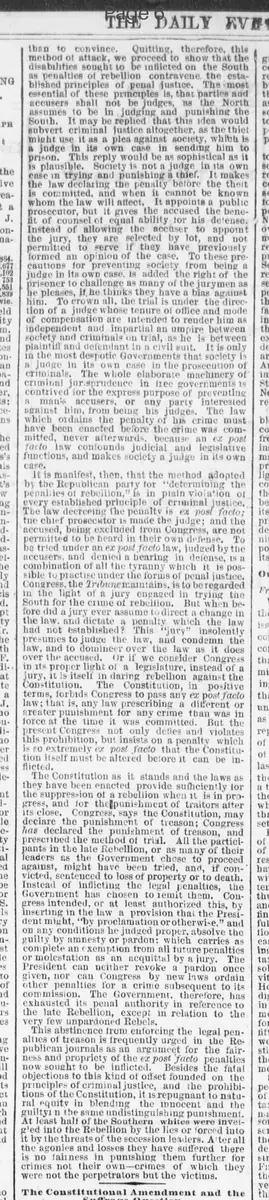
method of attack, we proceed to show that the
disabilities sought to be inflicted on the South
as penalties of rebellion contravene the esta-
blished principles of penal justice. The most
essential of these principles is, that parties and
accusers shall not be judges, as the North
assumes to be in judging and punishing the
South. It may be replied that this idea would
subvert criminal justice altogether, as the thief
might use it as a plea against society, which is
a judge in its own case in sending him to
prison. This reply would be as sophistical as it
is plausible. Society is not a judge in its own
case in trying and punishing a thief. It makes
the law declaring the penalty before the thief
is committed, and when it cannot be known
whom the law will affect. It appoints a public
prosecutor, but it gives the accused the bene-
fit of counsel of equal ability for his defense.
Instead of allowing the accuser to appoint
the jury, they are selected by lot, and not
permitted to serve if they have previously
formed an opinion of the case. To these pre-
cautions for preventing society from being a
judge in its own case, is added the right of the
prisoner to challenge as many of the jurymen as
he pleases, if he thinks they have a bias against
him. To crown all, the trial is under the direc-
tion of a judge whose tenure of office and mode
of compensation are intended to render him as
independent and impartial an umpire between
society and criminals on trial, as he is between
plaintiff and defendant in a civil suit. It is only
in the most despotic Governments that society is
a judge in its own case in the prosecution of
criminals. The whole elaborate machinery of
criminal jurisprudence in free governments is
contrived for the express purpose of preventing
a man's accusers, or any party interested
against him, from being his judges. The law
which ordains the penalty of his crime must
have been enacted before the crime was com-
mitted, never afterwards, because an ex post
facto law confounds judicial and legislative
functions, and makes society a judge in its own
case.
It is manifest, then, that the method adopted
by the Republican party for "determining the
penalties of rebellion," is in plain violation of
every established principle of criminal justice.
The law decreeing the penalty is ex post facto;
the chief prosecutor is made the judge; and the
accused, being excluded from Congress, are not
permitted to be heard in their own defense. To
be tried under an ex post facto law, judged by the
accusers, and denied a hearing in defense, is a
combination of all the tyranny which it is pos-
sible to practise under the forms of penal justice.
Congress, the Tribune maintains, is to be regarded
in the light of a jury engaged in trying the
South for the crime of rebellion. But when be-
fore did a jury ever assume to direct a change in
the law, and dictate a penalty which the law
had not established? This "jury" insolently
presumes to judge the law, and condemn the
law, and to domineer over the law as it does
over the accused. Or if we consider Congress
in its proper light of a legislature, instead of a
jury, it is itself in daring rebellion against the
Constitution. The Constitution, in positive
terms, forbids Congress to pass any ex post facto
law; that is, any law prescribing a different or
greater punishment for any crime than was in
force at the time it was committed. But the
present Congress not only defies and violates
this prohibition, but insists on a penalty which
is so extremely ex post facto that the Constitu-
tion itself must be altered before it can be in-
flicted.
The Constitution as it stands and the laws as
they have been enacted provide sufficiently for
the suppression of a rebellion when it is in pro-
gress, and for the punishment of traitors after
its close. Congress, says the Constitution, may
declare the punishment of treason; Congress
has declared the punishment of treason, and
prescribed the method of trial. All the partici-
pants in the late Rebellion, or as many of their
leaders as the Government chose to proceed
against, might have been tried, and, if con-
victed, sentenced to loss of property or to death.
Instead of inflicting the legal penalties, the
Government has chosen to remit them. Con-
gress intended, or at least authorized this, by
inserting in the law a provision that the Presi-
dent might, "by proclamation or otherwise," and
on any conditions he judged proper, absolve the
guilty by amnesty or pardon; which carries as
complete an exemption from all future penalties
or molestation as an acquittal by a jury. The
President can neither revoke a pardon once
given, nor can Congress by new laws ordain
other penalties for a crime subsequent to its
commission. The Government, therefore, has
exhausted its penal authority in reference to
the late Rebellion, except in relation to the
very few unpardoned Rebels.
This abstinence from enforcing the legal pen-
alties of treason is frequently urged in the Re-
publican journals as an argument for the fair-
ness and propriety of the ex post facto penalties
now sought to be inflicted. Besides the fatal
objections to this kind of offset founded on the
principles of criminal justice, and the prohibi-
tions of the Constitution, it is repugnant to natu-
ral equity in blending the innocent and the
guilty in the same undistinguishing punishment.
At least half of the Southern whites were invel-
ged into the Rebellion by the lies or forced into
it by the threats of the secession leaders. After all
the agonies and losses they have suffered there
is no fairness in punishing them further for
crimes not their own - crimes of which they
were not the perpetrators but the victims.
What sub-type of article is it?
What keywords are associated?
Where did it happen?
Domestic News Details
Primary Location
The South
Outcome
existing legal penalties for treason remitted via amnesty and pardon; proposed ex post facto penalties criticized as unconstitutional and unfair, blending innocent and guilty.
Event Details
Editorial argues that Republican party's method of imposing disabilities on the South as penalties for rebellion violates principles of penal justice, including no ex post facto laws, impartial judges, and right to defense; Congress acts as accuser and judge, excluding the accused; Constitution provides for treason punishment but authorizes presidential pardons, exhausting penal authority.