Thank you for visiting SNEWPapers!
Sign up free
Poem
November 26, 1850
Hillsdale Whig Standard
Hillsdale, Hillsdale County, Michigan
What is this article about?
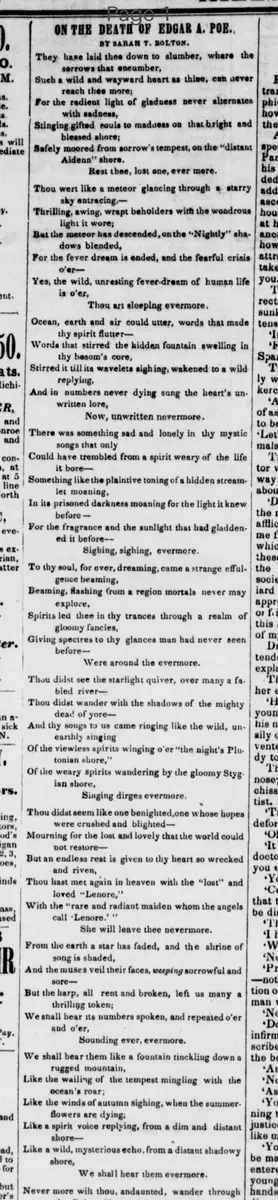
Elegy by Sarah T. Bolton on the death of Edgar A. Poe, portraying his life as a meteor of genius tormented by sorrow, now at rest in heaven with Lenore, echoing Poe's motifs like 'nevermore' and spectral visions.
Clipping
OCR Quality
95%
Excellent
Full Text
ON THE DEATH OF EDGAR A. POE.
BY SARAH T. BOLTON.
They have laid thee down to slumber, where the
sorrows that encumber,
Such a wild and wayward heart as thine, can never
reach thee more;
For the radiant light of gladness never alternates
with sadness,
Stinging gifted souls to madness on that bright and
blessed shore;
Safely moored from sorrow's tempest, on the "distant
Aidenn" shore.
Rest thee, lost one, ever more.
Thou wert like a meteor glancing through a starry
sky entrancing,
Thrilling, awing, wrapt beholders with the wondrous
light it wore;
But the meteor has descended, on the "Nightly" shadows blended
For the fever dream is ended, and the fearful crisis
o'er
Yes, the wild, unresting fever-dream of human life
is o'er,
Thou art sleeping evermore.
Ocean, earth and air could utter, words that made
thy spirit flutter-
Words that stirred the hidden fountain swelling in
thy bosom's core,
Stirred it till its wavelets sighing, wakened to a wild
replying,
And in numbers never dying sung the heart's unwritten lore,
Now, unwritten nevermore.
There was something sad and lonely in thy mystic
songs that only
Could have trembled from a spirit weary of the life
it bore-
Something like the plaintive toning of a hidden stream-
let moaning
In its prisoned darkness moaning for the light it knew
before-
For the fragrance and the sunlight that had gladdened
it before--
Sighing, sighing, evermore.
To thy soul, for ever, dreaming, came a strange effulgence beaming.
Beaming, flashing from a region mortals never may
explore,
Spirits led thee in thy trances through a realm of
gloomy fancies,
Giving spectres to thy glances man had never seen
before-
Were around the evermore.
Thou didst see the starlight quiver, over many a fabled river-
Thou didst wander with the shadows of the mighty
dead! of yore—
And thy songs to us came ringing like the wild, unearthly singing
Of the viewless spirits winging o'er "the night's Plutonian shore,"
Of the weary spirits wandering by the gloomy Stygian shore,
Singing dirges evermore
Thou didst seem like one benighted, one whose hopes
were crushed and blighted-
Mourning for the lost and lovely that the world could
not restore-
But an endless rest is given to thy heart so wrecked
and riven,
Thou hast met again in heaven with the "lost" and
loved "Lenore,"
With the "rare and radiant maiden whom the angels call Lenore."
She will leave thee nevermore.
From the earth a star has faded, and the shrine of
song is shaded,
And the muses veil their faces, weeping sorrowful and
sore--
But the harp, all rent and broken, left us many
thrilling token;
We shall hear its numbers spoken, and repeated o'er
and o'er,
Sounding ever, evermore.
We shall hear them like a fountain tinkling down a
rugged mountain,
Like the wailing of the tempest mingling with the
ocean's roar;
Like the winds of autumn sighing, when the summer
flowers are dying:
Like a spirit voice replying, from a dim and distant
shore
Like a wild, mysterious echo, from a distant shadowy
shore,
We shall hear them evermore.
Never more wilt thou, undaunted, wander through
"the Palace Haunted,"
Or the "cypress vales Titanic" which thy spirit did
explore-
Never heard the "Ghoul" king dwelling in the ancient steeple telling,
With a slow and solemn knelling, losses human
hearts deplore-
Telling "in a sort of Runic rhyme," the losses we deplore,
Tolling, tolling, evermore.
If a "living human being" ever had the gift of
"seeing"
The "grim and ghastly" countenance his "evil" Genius wore—
It was thee, "unhappy master, whom unmerciful
Disaster
Followed fast and followed faster, till " thy " songs
one burden bore,
Till the dirges of " thy " hope one melancholy burden bore,
Of never-nevermore."
Indianapolis, Nov. 1, 1849.
[Home Journal.
BY SARAH T. BOLTON.
They have laid thee down to slumber, where the
sorrows that encumber,
Such a wild and wayward heart as thine, can never
reach thee more;
For the radiant light of gladness never alternates
with sadness,
Stinging gifted souls to madness on that bright and
blessed shore;
Safely moored from sorrow's tempest, on the "distant
Aidenn" shore.
Rest thee, lost one, ever more.
Thou wert like a meteor glancing through a starry
sky entrancing,
Thrilling, awing, wrapt beholders with the wondrous
light it wore;
But the meteor has descended, on the "Nightly" shadows blended
For the fever dream is ended, and the fearful crisis
o'er
Yes, the wild, unresting fever-dream of human life
is o'er,
Thou art sleeping evermore.
Ocean, earth and air could utter, words that made
thy spirit flutter-
Words that stirred the hidden fountain swelling in
thy bosom's core,
Stirred it till its wavelets sighing, wakened to a wild
replying,
And in numbers never dying sung the heart's unwritten lore,
Now, unwritten nevermore.
There was something sad and lonely in thy mystic
songs that only
Could have trembled from a spirit weary of the life
it bore-
Something like the plaintive toning of a hidden stream-
let moaning
In its prisoned darkness moaning for the light it knew
before-
For the fragrance and the sunlight that had gladdened
it before--
Sighing, sighing, evermore.
To thy soul, for ever, dreaming, came a strange effulgence beaming.
Beaming, flashing from a region mortals never may
explore,
Spirits led thee in thy trances through a realm of
gloomy fancies,
Giving spectres to thy glances man had never seen
before-
Were around the evermore.
Thou didst see the starlight quiver, over many a fabled river-
Thou didst wander with the shadows of the mighty
dead! of yore—
And thy songs to us came ringing like the wild, unearthly singing
Of the viewless spirits winging o'er "the night's Plutonian shore,"
Of the weary spirits wandering by the gloomy Stygian shore,
Singing dirges evermore
Thou didst seem like one benighted, one whose hopes
were crushed and blighted-
Mourning for the lost and lovely that the world could
not restore-
But an endless rest is given to thy heart so wrecked
and riven,
Thou hast met again in heaven with the "lost" and
loved "Lenore,"
With the "rare and radiant maiden whom the angels call Lenore."
She will leave thee nevermore.
From the earth a star has faded, and the shrine of
song is shaded,
And the muses veil their faces, weeping sorrowful and
sore--
But the harp, all rent and broken, left us many
thrilling token;
We shall hear its numbers spoken, and repeated o'er
and o'er,
Sounding ever, evermore.
We shall hear them like a fountain tinkling down a
rugged mountain,
Like the wailing of the tempest mingling with the
ocean's roar;
Like the winds of autumn sighing, when the summer
flowers are dying:
Like a spirit voice replying, from a dim and distant
shore
Like a wild, mysterious echo, from a distant shadowy
shore,
We shall hear them evermore.
Never more wilt thou, undaunted, wander through
"the Palace Haunted,"
Or the "cypress vales Titanic" which thy spirit did
explore-
Never heard the "Ghoul" king dwelling in the ancient steeple telling,
With a slow and solemn knelling, losses human
hearts deplore-
Telling "in a sort of Runic rhyme," the losses we deplore,
Tolling, tolling, evermore.
If a "living human being" ever had the gift of
"seeing"
The "grim and ghastly" countenance his "evil" Genius wore—
It was thee, "unhappy master, whom unmerciful
Disaster
Followed fast and followed faster, till " thy " songs
one burden bore,
Till the dirges of " thy " hope one melancholy burden bore,
Of never-nevermore."
Indianapolis, Nov. 1, 1849.
[Home Journal.
What sub-type of article is it?
Elegy
Ode
What themes does it cover?
Death Mourning
What keywords are associated?
Edgar A Poe
Death Elegy
Poe Tribute
Nevermore
Lenore
Poetic Genius
Sorrow
Eternal Rest
What entities or persons were involved?
By Sarah T. Bolton.
Poem Details
Title
On The Death Of Edgar A. Poe.
Author
By Sarah T. Bolton.
Subject
On The Death Of Edgar A. Poe
Key Lines
Rest Thee, Lost One, Ever More.
Thou Art Sleeping Evermore.
Sighing, Sighing, Evermore.
Singing Dirges Evermore
Of Never Nevermore."