Thank you for visiting SNEWPapers!
Sign up free
Story
September 12, 1860
Democrat And Sentinel
Ebensburg, Cambria County, Pennsylvania
What is this article about?
Article from American Agriculturist provides practical advice on fattening pigs year-round, emphasizing keeping them in sties for manure production, feeding variety including garden refuse and cooked grains, and maintaining dry warm housing for efficient pork production. Includes example of low-cost pork making by a dairy farmer.
Clipping
OCR Quality
98%
Excellent
Full Text
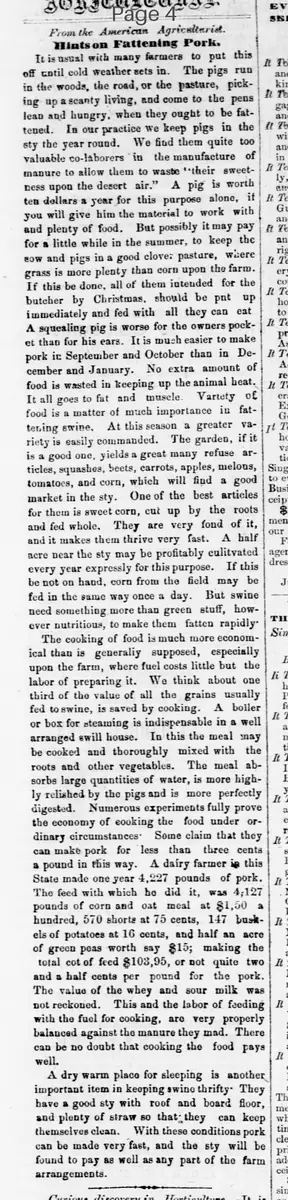
From the American Agriculturist.
Hints on Fattening Pork.
It is usual with many farmers to put this off until cold weather sets in. The pigs run in the woods, the road, or the pasture, picking up a scanty living, and come to the pens lean and hungry, when they ought to be fattened. In our practice we keep pigs in the sty the year round. We find them quite too valuable co-laborers in the manufacture of manure to allow them to waste 'their sweetness upon the desert air.' A pig is worth ten dollars a year for this purpose alone, if you will give him the material to work with and plenty of food. But possibly it may pay for a little while in the summer, to keep the sow and pigs in a good clover pasture, where grass is more plenty than corn upon the farm. If this be done, all of them intended for the butcher by Christmas, should be put up immediately and fed with all they can eat. A squealing pig is worse for the owners pocket than for his ears. It is much easier to make pork in September and October than in December and January. No extra amount of food is wasted in keeping up the animal beat. It all goes to fat and muscle. Variety of food is a matter of much importance in fattening swine. At this season a greater variety is easily commanded. The garden, if it is a good one, yields a great many refuse articles, squashes, beets, carrots, apples, melons, tomatoes, and corn, which will find a good market in the sty. One of the best articles for them is sweet corn, cut up by the roots and fed whole. They are very fond of it, and it makes them thrive very fast. A half acre near the sty may be profitably cultivated every year expressly for this purpose. If this be not on hand, corn from the field may be fed in the same way once a day. But swine need something more than green stuff, however nutritious, to make them fatten rapidly. The cooking of food is much more economical than is generally supposed, especially upon the farm, where fuel costs little but the labor of preparing it. We think about one third of the value of all the grains usually fed to swine, is saved by cooking. A boiler or box for steaming is indispensable in a well arranged swill house. In this the meal may be cooked and thoroughly mixed with the roots and other vegetables. The meal absorbs large quantities of water, is more highly relished by the pigs and is more perfectly digested. Numerous experiments fully prove the economy of cooking the food under ordinary circumstances. Some claim that they can make pork for less than three cents a pound in this way. A dairy farmer in this State made one year 4,227 pounds of pork. The feed with which he did it, was 4,127 pounds of corn and oat meal at $1.50 a hundred, 570 shorts at 75 cents, 147 bushels of potatoes at 16 cents, and half an acre of green peas worth say $15; making the total cost of feed $103.95, or not quite two and a half cents per pound for the pork. The value of the whey and sour milk was not reckoned. This and the labor of feeding with the fuel for cooking, are very properly balanced against the manure they made. There can be no doubt that cooking the food pays well.
A dry warm place for sleeping is another important item in keeping swine thrifty. They have a good sty with roof and board floor, and plenty of straw so that they can keep themselves clean. With these conditions pork can be made very fast, and the sty will be found to pay as well as any part of the farm arrangements.
Hints on Fattening Pork.
It is usual with many farmers to put this off until cold weather sets in. The pigs run in the woods, the road, or the pasture, picking up a scanty living, and come to the pens lean and hungry, when they ought to be fattened. In our practice we keep pigs in the sty the year round. We find them quite too valuable co-laborers in the manufacture of manure to allow them to waste 'their sweetness upon the desert air.' A pig is worth ten dollars a year for this purpose alone, if you will give him the material to work with and plenty of food. But possibly it may pay for a little while in the summer, to keep the sow and pigs in a good clover pasture, where grass is more plenty than corn upon the farm. If this be done, all of them intended for the butcher by Christmas, should be put up immediately and fed with all they can eat. A squealing pig is worse for the owners pocket than for his ears. It is much easier to make pork in September and October than in December and January. No extra amount of food is wasted in keeping up the animal beat. It all goes to fat and muscle. Variety of food is a matter of much importance in fattening swine. At this season a greater variety is easily commanded. The garden, if it is a good one, yields a great many refuse articles, squashes, beets, carrots, apples, melons, tomatoes, and corn, which will find a good market in the sty. One of the best articles for them is sweet corn, cut up by the roots and fed whole. They are very fond of it, and it makes them thrive very fast. A half acre near the sty may be profitably cultivated every year expressly for this purpose. If this be not on hand, corn from the field may be fed in the same way once a day. But swine need something more than green stuff, however nutritious, to make them fatten rapidly. The cooking of food is much more economical than is generally supposed, especially upon the farm, where fuel costs little but the labor of preparing it. We think about one third of the value of all the grains usually fed to swine, is saved by cooking. A boiler or box for steaming is indispensable in a well arranged swill house. In this the meal may be cooked and thoroughly mixed with the roots and other vegetables. The meal absorbs large quantities of water, is more highly relished by the pigs and is more perfectly digested. Numerous experiments fully prove the economy of cooking the food under ordinary circumstances. Some claim that they can make pork for less than three cents a pound in this way. A dairy farmer in this State made one year 4,227 pounds of pork. The feed with which he did it, was 4,127 pounds of corn and oat meal at $1.50 a hundred, 570 shorts at 75 cents, 147 bushels of potatoes at 16 cents, and half an acre of green peas worth say $15; making the total cost of feed $103.95, or not quite two and a half cents per pound for the pork. The value of the whey and sour milk was not reckoned. This and the labor of feeding with the fuel for cooking, are very properly balanced against the manure they made. There can be no doubt that cooking the food pays well.
A dry warm place for sleeping is another important item in keeping swine thrifty. They have a good sty with roof and board floor, and plenty of straw so that they can keep themselves clean. With these conditions pork can be made very fast, and the sty will be found to pay as well as any part of the farm arrangements.
What sub-type of article is it?
Agricultural Advice
Farming Guide
What keywords are associated?
Pork Fattening
Swine Management
Cooked Feed
Manure Production
Garden Refuse
Economic Pork
What entities or persons were involved?
Dairy Farmer In This State
Story Details
Key Persons
Dairy Farmer In This State
Story Details
Practical hints on year-round pig management: keep in sty for manure, feed variety from garden and cooked grains in fall for efficient fattening, example of low-cost pork production using corn, meal, potatoes, peas, whey; importance of dry warm housing.