Thank you for visiting SNEWPapers!
Sign up free
Editorial
October 19, 1852
The Daily Union
Washington, District Of Columbia
What is this article about?
Editorial criticizes General Scott's supporters for deceiving the public by portraying his military career as evidence of statesmanship, predicting defeat and self-reproach. Notes The Republic's selective printing of Scott's Auburn speech, omitting Seward's welcome.
Clipping
OCR Quality
98%
Excellent
Full Text
The Verdict upon Deception
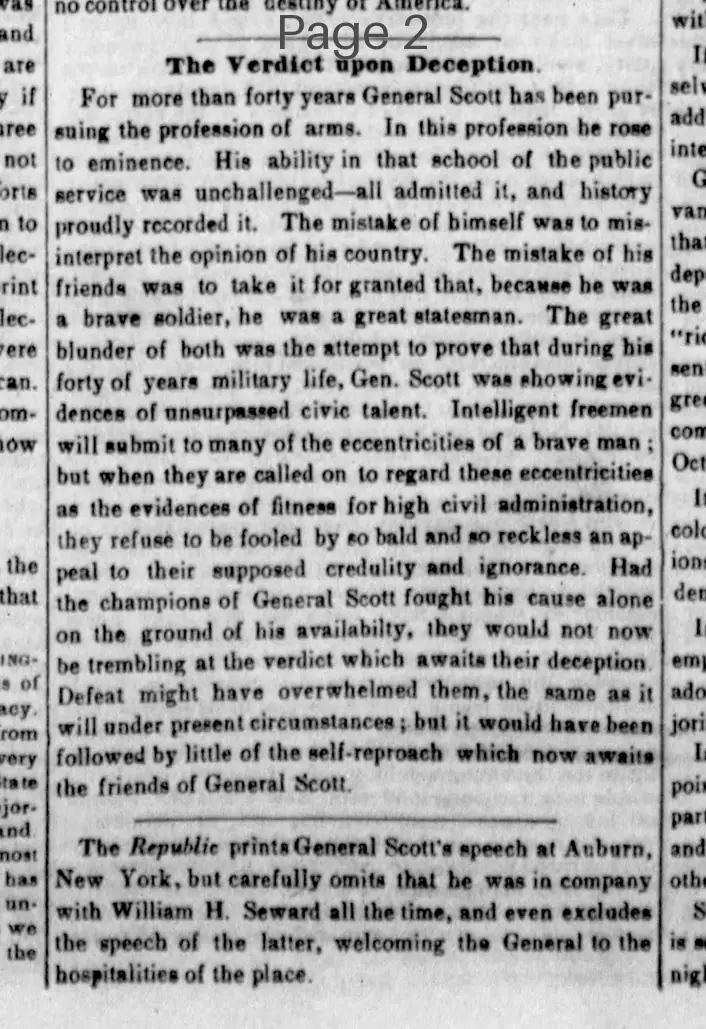
For more than forty years General Scott has been pursuing the profession of arms. In this profession he rose to eminence. His ability in that school of the public service was unchallenged-all admitted it, and history proudly recorded it. The mistake of himself was to misinterpret the opinion of his country. The mistake of his friends was to take it for granted that, because he was a brave soldier, he was a great statesman. The great blunder of both was the attempt to prove that during his forty years military life, Gen. Scott was showing evidences of unsurpassed civic talent. Intelligent freemen will submit to many of the eccentricities of a brave man: but when they are called on to regard these eccentricities as the evidences of fitness for high civil administration, they refuse to be fooled by so bald and so reckless an appeal to their supposed credulity and ignorance. Had the champions of General Scott fought his cause alone on the ground of his availability, they would not now be trembling at the verdict which awaits their deception. Defeat might have overwhelmed them, the same as it will under present circumstances; but it would have been followed by little of the self-reproach which now awaits the friends of General Scott.
The Republic prints General Scott's speech at Auburn, New York, but carefully omits that he was in company with William H. Seward all the time, and even excludes the speech of the latter, welcoming the General to the hospitalities of the place.
For more than forty years General Scott has been pursuing the profession of arms. In this profession he rose to eminence. His ability in that school of the public service was unchallenged-all admitted it, and history proudly recorded it. The mistake of himself was to misinterpret the opinion of his country. The mistake of his friends was to take it for granted that, because he was a brave soldier, he was a great statesman. The great blunder of both was the attempt to prove that during his forty years military life, Gen. Scott was showing evidences of unsurpassed civic talent. Intelligent freemen will submit to many of the eccentricities of a brave man: but when they are called on to regard these eccentricities as the evidences of fitness for high civil administration, they refuse to be fooled by so bald and so reckless an appeal to their supposed credulity and ignorance. Had the champions of General Scott fought his cause alone on the ground of his availability, they would not now be trembling at the verdict which awaits their deception. Defeat might have overwhelmed them, the same as it will under present circumstances; but it would have been followed by little of the self-reproach which now awaits the friends of General Scott.
The Republic prints General Scott's speech at Auburn, New York, but carefully omits that he was in company with William H. Seward all the time, and even excludes the speech of the latter, welcoming the General to the hospitalities of the place.
What sub-type of article is it?
Partisan Politics
What keywords are associated?
General Scott
Deception
Military Career
Statesmanship
Auburn Speech
William H Seward
Partisan Campaign
What entities or persons were involved?
General Scott
William H. Seward
The Republic
Editorial Details
Primary Topic
Criticism Of General Scott's Presidential Candidacy And Supporters' Deception
Stance / Tone
Critical Of Deception And Misrepresentation
Key Figures
General Scott
William H. Seward
The Republic
Key Arguments
General Scott Excelled In Military Profession But Misinterpreted Public Opinion On His Statesmanship
Friends Erred In Assuming Military Bravery Equates To Great Statesmanship
Blunder In Claiming Military Life Showed Civic Talent
Public Refuses To Be Fooled By Portraying Eccentricities As Fitness For Civil Administration
Better To Campaign On Availability Alone To Avoid Self Reproach In Defeat
The Republic Selectively Prints Scott's Auburn Speech, Omitting Seward's Welcome