Thank you for visiting SNEWPapers!
Sign up free
The Evansville Daily Journal
Evansville, Vanderburgh County, Indiana
What is this article about?
The steamer Central America sank in a gale on September 12, 1857, after departing Havana, due to engine failure and flooding. Women and children were evacuated to the brig Mariner; many passengers drowned, but 49 survivors were rescued by the bark Ellen near Norfolk.
Clipping
OCR Quality
Full Text
TO THE
EVANSVILLE DAILY JOURNAL
FURTHER PARTICULARS OF THE
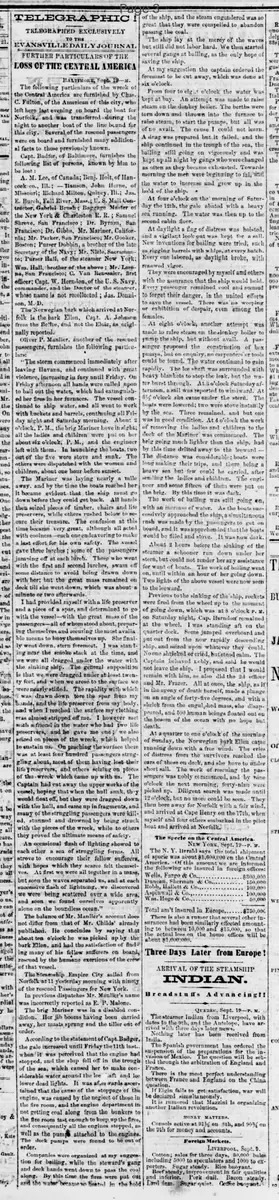
LOSS OF THE CENTRAL AMERICA
BALTIMORE, Sept. 19-M.
The following particulars of the wreck of the Central America are furnished by Chas. C. Fulton, of the American of this city, who left here last evening on board the boat for Norfolk, and was transferred during the night to another boat of the line bound for this city. Several of the rescued passengers were on board and furnished many additional facts to those previously known.
Capt. Badger, of Baltimore, furnishes the following list of persons, known by him to be lost:
A. M. Lee, of Canada; Benj. Holt, of Hancock co., Ill.; Nanson, John Herne, of Missouri; Richard Milton, Quincy, Ill.; Jas. E. Burch, Fall River, Mass.; U. S. Mail Contractor, Gabriel Brush; Baggage Master of the New York & Charleston R. R.; Samuel Shreve, San Francisco; Dr. Byrnes, San Francisco; Dr. Gibbs. Mr. Mariner, California; Mr. Parker, San Francisco; Mr. Gooker, Boston; Purser Dobbin, a brother of the late Secretary of the Navy; Mr. Niele, Sacramento; Purser Hall, of the steamer New York; Wm. Hall, brother of the above; Mr. Lerona, San Francisco; C. Van Rensselaer, first officer; Capt. W. Herndon, of the U. S. Navy commander, and the Doctor of the steamer, whose name is not recollected; Jas. Dennison, M.D.
The Norwegian bark which arrived at Norfolk is the bark Ellen, Capt. A. Johnson from the Breeze, and not the Eloise, as originally reported.
Oliver P. Manlier, another of the rescued passengers, furnishes the following particulars:
"The storm commenced immediately after leaving Havana, and continued with great violence, increasing in fury until Friday. On Friday afternoon all hands were called upon to bail out the water, which had extinguished her fires in her furnaces. The vessel continued to ship water, and all went to work with buckets and barrels, continuing all Friday night and Saturday morning. About 2 o'clock, P. M., the brig Mariner hove in sight; all the ladies and children were put on her about six o'clock P. M., and the engineer left with them. In launching the boats, two out of the five were stove and sunk. The others were dispatched with the women and children, about one hour before sunset.
The Mariner was lying nearly a mile away, and by the time the boats reached her it became evident that the ship must go down before they could get back. All hands then seized pieces of timber, chairs and life preservers, while others rushed below to secure their treasure. The confusion at this time became very great, although all acted with coolness-each one endeavoring to make a last effort for his own safety. The vessel gave three lurches; some of the passengers jumping off at each lurch. Those who went with the first and second lurches, swam off some distance to avoid being drawn down with her; but the great mass remained on deck till she went down, which was about a minute or two afterwards.
I had provided myself with a life preserver and a piece of a spar, and determined to go with the vessel-with the great mass of the passengers-all of whom stood about, preparing themselves and securing the most available means to buoy themselves up. She finally went down, stern foremost. I was standing near the smoke stack at the time, and we were all dragged under the water with the sinking ship. The general supposition is that we were dragged under at least twenty feet, and when we arose to the surface we were nearly stifled. The rapidity with which I was drawn down tore the spar from my hands, and the life preserver from my body, and when I reached the surface my clothing was almost stripped off me. I however met with a friend in the water who had two life preservers, and he gave me one; we also seized on pieces of the wreck, which helped to sustain us. On reaching the surface there was at least four hundred passengers struggling about, most of them having lost their life preservers, and others seizing on pieces of the wreck which came up with us. The Captain had cut away the upper works of the vessel, hoping that when the hull sunk, they would float off, but they were dragged down with the hull, and came up in fragments, and many of the struggling passengers were killed, stunned and drowned by being struck with the pieces of the wreck, while to others they proved the ultimate means of safety.
An occasional flash of lightning showed to each other a sea of struggling forms. All strove to encourage their fellow sufferers, with hopes which they scarce felt themselves. At first we were all together in a mass, but soon the waves separated us, and at each successive flash of lightning, we discovered we were being scattered over a wide area, and soon we found ourselves apparently alone on the boundless ocean."
The balance of Mr. Manlier's account does not differ from that of Mr. Childs' already published. He concludes by saying that about ten o'clock he was picked up by the bark Ellen, and had the satisfaction of finding many of his fellow sufferers on board, rescued by the humane exertions of the crew of that vessel.
The Steamship Empire City sailed from Norfolk at 11 yesterday morning with ninety of the rescued Passengers for New York.
In previous dispatches Mr. Manlier's name was incorrectly reported as E. P. Malone.
The brig Mariner was in a disabled condition. Her jib boom having been carried away, her masts sprung and the tiller out of order.
According to the statement of Capt. Badger, the gale increased until Friday the 11th inst. when it was perceived that the engine had stopped, and the ship fell off in the trough of the sea, which caused her to make considerable water around the lee aft and lee lower dead lights. It was afterwards ascertained that the cause of the stoppage of the engine, was caused by the neglect of those in the fire room, and the engine department in not getting coal along from the bunkers to the fire room fast enough to keep up the fires, and consequently all the engines stopped, as well as the pump attached to the engines. The deck pumps were found to be out of order.
Companies were organized at my suggestion for bailing, while the steward's gang and deck hands went down to pass the coal along. By this time the fires were put out and the water became so hot in the hold of the ship, and the steam engendered was so great that they were compelled to abandon passing the coal.
The ship lay at the mercy of the waves but still did not labor hard. We then started several gangs at bailing, as the only hope of saving the ship.
At my suggestion the captain ordered the foremast to be cut away, which was done at six o'clock.
From four to eight o'clock the water was kept at bay. An attempt was made to raise steam on the donkey boiler. The berths were torn down and thrown into the furnace to raise steam, to start the pumps, but all was of no avail. The cause I could not learn.
A drag was prepared but it failed, and the ship continued in the trough of the sea, the bailing still going on vigorously and was kept up all night by gangs who were changed as often as they became exhausted. Towards morning the men were beginning to fail and the water to increase and grow up in the hold of the ship.
At four o'clock on the morning of Saturday the 12th, the gale abated with a heavy sea running. The water was then up to the second cabin floor.
At daylight a flag of distress was hoisted, and a vigilant look out was kept for a sail. New inventions for bailing were tried: such as rigging barrels with whips, at every hatch. Every one labored, as daylight broke, with renewed vigor.
They were encouraged by myself and others with the assurance that the ship would hold. Every passenger remained cool and seemed to forget their danger, in the united efforts to save the vessel. There was no weeping or exhibition of despair, even among the females.
At eight o'clock, another attempt was made to raise steam on the donkey boiler to jump the ship, but without avail. A passenger proposed the construction of bucket pumps, but on enquiry, no carpenters or tools could be found. The water continued to gain rapidly. The deck was surrounded with heavy blankets to stop the leak, but the water burst through. At 2 o'clock Saturday afternoon, a sail was reported to windward. At 3 o'clock she swung under the stern. The boats were lowered; two were stove instantly by the sea. Three remained, and but one was in good condition. At 4 o'clock the work of removing the ladies and children to the deck of the Mariner was commenced. The brig going much lighter than the ship, had by this time drifted away to the leeward.
The distance was considerable: boats were long making their trips, and there being a heavy sea but few could be carried, after sending the ladies and children. The engineer and some fifteen of them were put on the brig. By this time it was dark.
The work of bailing was still going on, with an increase of water. As the boats successively approached the ship, a simultaneous rush was made by the passengers to get on board, and it was apprehended that the boats would be filled and stove. It was now dark.
About 2 hours before the sinking of the steamer a schooner run down under her stern, but could not render her any assistance for want of boats. The work of bailing went on, until within an hour of her going down.
Two lights of the above vessel were now seen to the leeward.
Previous to the sinking of the ship, rockets were fired from the wheel up to the moment of going down, which was at 8 o'clock P. M. on Saturday night. Capt. Herndon remained at the wheel. I was standing aft on the quarter deck. Some jumped overboard and put out from the now rapidly descending ship, and seized upon whatever they could. No one shrieked or cried, but stood calm. The Captain behaved nobly, and said he would not leave the ship. I proposed that I would remain with him, as also did the 2d officer and Mr. Frazer. All at once, the ship, as if in the agony of death herself, made a plunge on an angle of forty-five degrees, and with a shriek from the engulfed mass, she disappeared, and 500 human beings floated out on the bosom of the ocean with no hope but death.
At a quarter to one o'clock of the morning of Sunday, the Norwegian bark Ellen came running down with a free wind. The cries of distress from the survivors reached the ears of those on deck, and she hove to under short sail. The work of rescuing the passengers was nobly commenced, and by nine o'clock the next morning, forty-nine were picked up. Diligent search was made until 12 o'clock, but no more could be seen. They then bore away for Norfolk with a fair wind, and arrived at Cape Henry on the 17th, when myself and four others embarked in the pilot boat and arrived at Norfolk.
What sub-type of article is it?
What themes does it cover?
What keywords are associated?
What entities or persons were involved?
Where did it happen?
Story Details
Key Persons
Location
At Sea After Leaving Havana
Event Date
Friday The 11th Inst. To Saturday The 12th
Story Details
The steamer Central America encountered a violent storm, lost engine power due to water in furnaces, took on water despite bailing efforts, women and children transferred to brig Mariner, ship sank stern foremost with many passengers, survivors struggled in water and were rescued by Norwegian bark Ellen.