Thank you for visiting SNEWPapers!
Sign up free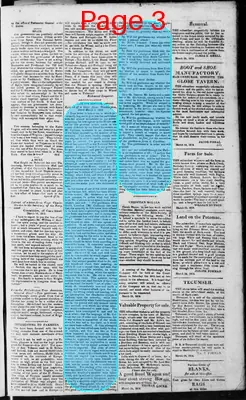
Martinsburgh Gazette
Martinsburg, Berkeley County, West Virginia
What is this article about?
In a heated U.S. House debate on the loan bill in early March 1814, Rep. Grosvenor accused Rep. Calhoun of making untrue statements about the minority's motives, sparking uproar and demands for retraction. After tense exchanges with the Speaker, Grosvenor clarified his words and continued his speech.
Clipping
OCR Quality
Full Text
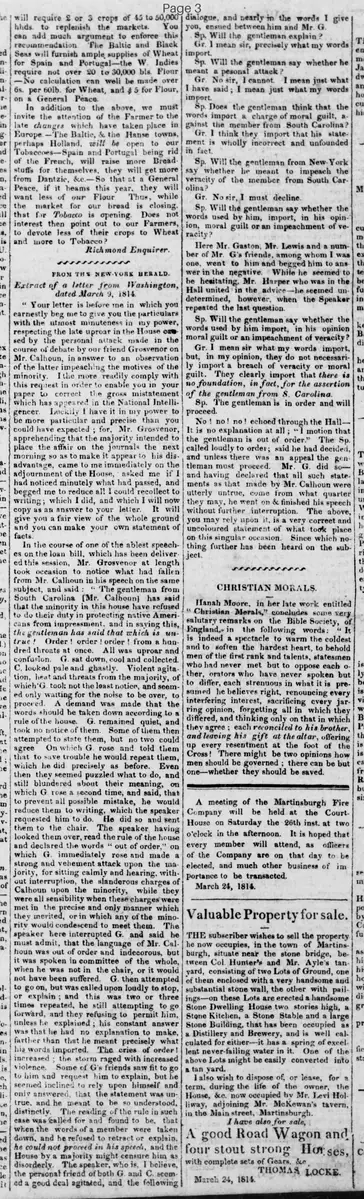
Extract of a letter from Washington,
dated March 9, 1814.
"Your letter is before me in which you earnestly beg me to give you the particulars with the utmost minuteness in my power, respecting the late uproar in the House caused by the personal attack made in the course of debate by our friend Grosvenor on Mr. Calhoun, in answer to an observation of the latter impeaching the motives of the minority. I the more readily comply with this request in order to enable you in your paper to correct the gross misstatement which has appeared in the National Intelligencer. Luckily I have it in my power to be more particular and precise than you could have expected: for, Mr. Grosvenor, apprehending that the majority intended to place the affair on the journals the next morning so as to make it appear to his disadvantage, came to me immediately on the adjournment of the House, asked me if I had noticed minutely what had passed, and begged me to reduce all I could recollect to writing; which I did, and which I will now copy as an answer to your letter. It will give you a fair view of the whole ground and you can make your own statement of facts.
In the course of one of the ablest speeches on the loan bill, which has been delivered this session, Mr. Grosvenor at length took occasion to notice what had fallen from Mr. Calhoun in his speech on the same subject, and said: "The gentleman from South Carolina [Mr. Calhoun] has said that the minority in this house have refused to do their duty in protecting native Americans from impressment, and in saying this, the gentleman has said that which is untrue!" Order! order! order! from a hundred throats at once. All was uproar and confusion. G. sat down, cool and collected. C. looked pale and ghastly. Violent agitation, heat and threats from the majority, of which G. took not the least notice, and seemed only waiting for the noise to be over, to proceed. A demand was made that the words should be taken down according to a rule of the house. G. remained quiet, and took no notice of them. Some of them then attempted to state them, but no two could agree. On which G. rose and told them that to save trouble he would repeat them, which he did precisely as before. Even then they seemed puzzled what to do, and still blundered about their meaning, on which G. rose a second time, and said, that to prevent all possible mistake, he would reduce them to writing, which the speaker requested him to do. He did so and sent them to the chair. The speaker having looked them over, read the rule of the house and declared the words "out of order," on which G. immediately rose and made a strong and vehement attack upon the majority, for sitting calmly and hearing, without interruption, the slanderous charges of Calhoun upon the minority, while they were all sensibility when these charges were met in the precise and only manner which they merited, or in which any of the minority would condescend to meet them. The speaker here interrupted G. and said he must admit, that the language of Mr. Calhoun was out of order and indecorous, but it was spoken in committee of the whole, when he was not in the chair, or it would not have been suffered. G. then attempted to go on, but was called upon loudly to stop, or explain; and this was two or three times repeated, he still attempting to go forward, and they refusing to permit him, unless he explained; his constant answer was that he had no explanation to make, farther than that he meant precisely what his words imported. The cries of order! increased; the storm raged with increased violence. Some of G's friends saw fit to go to him and request him to explain, but he seemed inclined to rely upon himself and only answered, that the statement was untrue, and he meant to be so understood, distinctly. The reading of the rule in such case was called for and found to be, that when the words of a member were taken down, and he refused to retract or explain, he could not proceed in his speech, and the House by a majority might censure him as disorderly. The speaker, who is, I believe, the personal friend of both G. and C. seemed a good deal agitated, and the following dialogue, and nearly in the words I give you, ensued between him and Mr. G.
Sp. Will the gentleman explain?
Gr. I mean sir, precisely what my words import.
Sp. Will the gentleman say whether he meant a personal attack?
Gr. No sir. I cannot. I mean just what I have said; I mean just what my words import.
Sp. Does the gentleman think that the words import a charge of moral guilt, against the member from South Carolina?
Gr. I think they import that his statement is wholly incorrect and unfounded in fact.
Sp. Will the gentleman from New-York say whether he meant to impeach the veracity of the member from South Carolina?
Gr. No sir. I must decline.
Sp. Will the gentleman say whether the words used by him, import, in his opinion, moral guilt or an impeachment of veracity?
Here Mr. Gaston, Mr. Lewis and a number of Mr. G's friends, among whom I was one, went to him and begged him to answer in the negative. While he seemed to be hesitating, Mr. Harper who was in the Hall united in the advice—he seemed undetermined, however, when the Speaker repeated the last question.
Sp. Will the gentleman say whether the words used by him import, in his opinion moral guilt or an impeachment of veracity?
Gr. I mean sir what my words import. but, in my opinion, they do not necessarily import a breach of veracity or moral guilt. They clearly import that there is no foundation, in fact, for the assertion of the gentleman from S. Carolina.
Sp. The gentleman is in order and will proceed.
No! no! no! echoed through the Hall—"It is no explanation at all;" "I motion that the gentleman is out of order." The Sp. called loudly to order; said he had decided, and unless there was an appeal the gentleman must proceed. Mr. G. did so—and having declared that all such statements as that made by Mr. Calhoun were utterly untrue, come from what quarter they may, he went on & finished his speech without further interruption. The above, you may rely upon it, is a very correct and uncoloured statement of what took place on this singular occasion. Since which nothing further has been heard on the subject."
What sub-type of article is it?
What keywords are associated?
What entities or persons were involved?
Where did it happen?
Domestic News Details
Primary Location
Washington
Event Date
March 1814
Key Persons
Outcome
grosvenor clarified his statement and completed his speech without further interruption; no formal censure occurred.
Event Details
During a House debate on the loan bill, Mr. Grosvenor accused Mr. Calhoun of making untrue statements about the minority's refusal to protect native Americans from impressment, leading to uproar, demands for the words to be taken down, and a tense dialogue with the Speaker over explanation and order. After clarification, Grosvenor proceeded.