Thank you for visiting SNEWPapers!
Sign up free
Lynchburg Virginian
Lynchburg, Virginia
What is this article about?
Whig meeting in Nelson County, Virginia, on November 27, 1842, adopts preamble and resolutions affirming Whig principles on sovereignty, currency, protectionism, and veto power; criticizes Democratic policies; nominates Henry Clay for president; appoints delegates to conventions.
Merged-components note: Continuation of the report on the Whig meeting in Nelson; text flows seamlessly from one component to the next.
Clipping
OCR Quality
Full Text
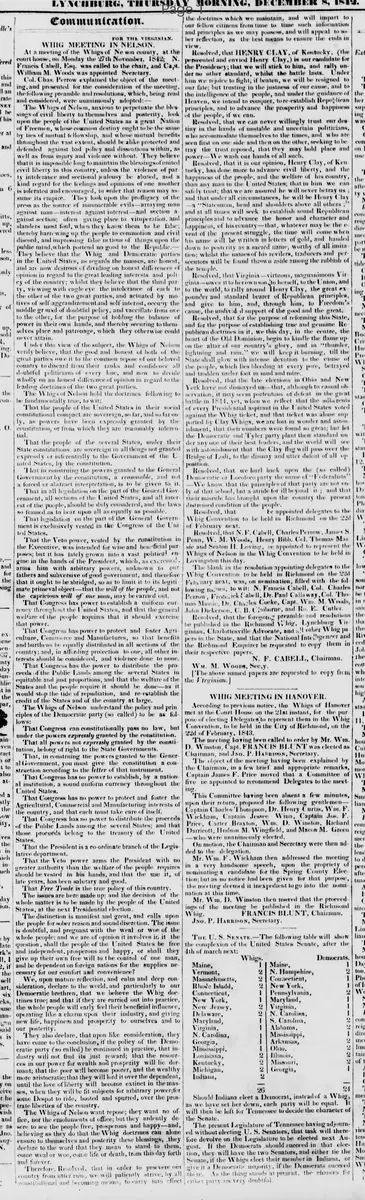
FOR THE VIRGINIAN.
WHIG MEETING IN NELSON.
At a meeting of the Whigs of Nelson county, at the court house, on Monday the 27th November, 1842; N. Francis Cabell, Esq. was called to the chair, and Capt. William M. Woods was appointed Secretary.
Col. Chas. Perrow explained the object of the meeting, and presented for the consideration of the meeting the following preamble and resolutions, which, being read and considered, were unanimously adopted:
The Whigs of Nelson, anxious to perpetuate the blessings of civil liberty to themselves and posterity, look upon the people of the United States as a great Nation of Freemen, whose common destiny ought to be the same by ties of mutual fellowship, and whose mutual benefits throughout the vast extent, should be alike protected and defended against bad policy and dissentions within, as well as from injury and violence without. They believe that it is impossible long to maintain the blessings of united civil liberty in this country, unless the violence of party intolerance and sectional jealousy be abated, and a kind regard for the feelings and opinions of one another is tolerated and encouraged, in order that reason may assume its empire. They look upon the profligacy of the press as the source of innumerable evils--arraying man against man--interest against interest--and section against section; often giving place to vituperation, and slanders most foul, when they know them to be false thereby harrowing up the people to commotion and civil discord, and impressing false notions of things upon the public mind, which portend no good to the Republic.
They believe that the Whig and Democratic parties in the United States, as regards the masses, are honest, and are now desirous of dividing on honest differences of opinion in regard to the great leading interests and policy of the country; whilst they believe that the third party, viewing with eagle eye the intolerance of each to the other of the two great parties, and actuated by motives of self aggrandizement and self-interest, occupy the middle ground of doubtful policy, and vacillate from one to the other, for the purpose of holding the balance of power in their own hands, and thereby securing to themselves place and patronage, which they otherwise could never attain.
Under this view of the subject, the Whigs of Nelson verily believe, that the good and honest of both of the great parties owe it to the common repose of our beloved country to discard from their ranks and confidence all doubtful politicians of every hue, and now to divide wholly on an honest difference of opinion in regard to the leading doctrines of the two great parties.
The Whigs of Nelson hold the doctrines following to be fundamentally true, to wit:
That the people of the United States in their social constitutional compact are sovereign, so far, and so far only, as powers have been expressly granted by the constitution, or from which they are reasonably inferred.
That the people of the several States, under their State constitutions, are sovereign in all things not granted expressly or inferentially to the Government of the United States, by the constitution.
That in construing the powers granted to the General Government by the constitution, a reasonable, and not a forced or abstract interpretation, is to be given to it.
That in all legislation on the part of the General Government, all sections of the United States, and all interest of the people, should be duly considered, and the laws so framed as to bear upon all as equally as possible.
That legislation on the part of the General Government is exclusively vested in the Congress of the United States.
That the Veto power, vested by the constitution in the Executive, was intended for wise and beneficial purposes; but it has lately grown into a vast political engine in the hands of the President, which, as exercised, arms him with arbitrary powers, unknown to our fathers and subversive of good government, and therefore that it ought to be abridged, so as to limit it to its legitimate primeval object--that the will of the people, and not the capricious will of one man, may be carried out.
That Congress has power to establish a uniform currency throughout the United States, and that the general welfare of the people requires that it should exercise that power.
That Congress has power to protect and foster Agriculture, Commerce and Manufactures, so that benefits and burthens be equally distributed in all sections of the country; and, in affording protection to one, all other interests should be considered, and violence done to none.
That Congress has the power to distribute the proceeds of the Public Lands among the several States in equitable and just proportions, and that the welfare of the States and the people require it should be done--as it would stop the tide of repudiation, and re-establish the credit of the States and of the country at large.
The Whigs of Nelson understand the policy and principles of the Democratic party (so called) to be as follows:
That Congress can constitutionally pass no law, but under the powers expressly granted by the constitution.
That all powers not expressly granted by the constitution, belong of right to the State Governments.
That, in construing the powers granted to the General Government, you must give the constitution a construction according to the letter of that instrument.
That Congress has no power to establish, by a national institution, a sound uniform currency throughout the United States.
That Congress has no power to protect and foster the Agricultural, Commercial and Manufacturing interests of the country, and that each must take care of itself.
That Congress has no power to distribute the proceeds of the Public Lands among the several States: and that those proceeds belong to the treasury of the United States.
That the President is a co-ordinate branch of the Legislative department.
That the Veto power arms the President with no greater authority than the welfare of the people requires should be vested in his hands, and that the use it, of late years, has been salutary and good.
That Free Trade is the true policy of this country.
The issues are here made up; and the decision of the whole matter is to be made by the people of the United States, at the next Presidential election.
The distinction is manifest and great, and calls upon the people for sober reason and sound discretion. The issue is doubtful, and pregnant with the weal or woe of the whole people; and we are of opinion it involves in it the question, shall the people of the United States be free and independent, prosperous and happy, or shall they give up their own free will to the control of one man, and be dependent on foreign nations for the supplies necessary for our comfort and convenience?
We, upon mature reflection, and calm and deep consideration, declare to the world, and particularly to our Democratic brethren, that we believe the Whig doctrines true; and that if they are carried out into practice, the whole people will early feel their beneficial influence, operating like a charm upon their industry, and giving new life, happiness and prosperity to ourselves and to our posterity.
They also declare, that upon like consideration, they have come to the conclusion, if the policy of the Democratic party (so called) be continued in practice, that industry will not find its just reward; that the resources in our power for wealth and prosperity will lie dormant; that the poor will become poorer, and the wealthy more aristocratic; that they will lord it over the dependent, until the love of liberty will become extinct in the masses, when they will be fit subjects for arbitrary power; for some Despot to ride, booted and spurred, over the prostrate liberties of the country.
The Whigs of Nelson want repose; they want no office, nor the emoluments of office; but they ardently desire to see the people free, prosperous and happy--and, believing as they do that the Whig doctrines can alone ensure to themselves and posterity these blessings, they declare to the world that they mean to stand to them, come weal or woe, come life or death, from this day forth and forever.
Therefore, Resolved, that in order to preserve our country from utter ruin, we will patiently strive, by all constitutional and becoming means, to carry into effect the doctrines which we maintain, and will impart to our fellow citizens from time to time such information and principles as we may possess, and will appeal to sober reflection, as the best means to ensure the ends in view.
Resolved, that HENRY CLAY, of Kentucky, (the persecuted and envied Henry Clay,) is our candidate for the Presidency: that we will stick to him, and rally under no other standard, whilst the battle lasts. Under him we rejoice to fight; if beaten, we will be resigned to our fate; but trusting in the justness of our cause, and to the intelligence of the people, and under the guidance of Heaven, we intend to conquer, to re-establish Republican principles, and to advance the prosperity and happiness of the people, if we can.
Resolved, that we can never willingly trust our destiny in the hands of unstable and uncertain politicians, who accommodate themselves to the times, and who are seen first on one side and then on the other, seeking to betray the trust reposed, that they may hold place and power--We wash our hands of all such.
Resolved, that it is our opinion, Henry Clay, of Kentucky, has done more to advance civil liberty, and the happiness of the people, and the welfare of his country, than any man in the United States; that in him we can safely trust; that we are assured he will never betray us: and that under all circumstances, he will be Henry Clay --a "Statesman, head and shoulders above all others;" and at all times will seek to establish sound Republican principles and to advance the honor and character and happiness, of his country--that, whatever may be the event of the present struggle, the time will come when his name will be written in letters of gold, and handed down to posterity as a sacred name, worthy of all imitation; whilst the names of his revilers, traducors and persecutors will be found thrown aside among the rubbish of the temple.
Resolved, that Virginia--virtuous, magnanimous Virginia--owes it to her own son, to herself, to the Union, and to the world, to rally around Henry Clay, the great expounder and standard bearer of Republican principles, and give to him, and, through him, to Freedom's cause, the undivided support of the good and the great.
Resolved, that for the purpose of reforming this State, and for the purpose of establishing true and genuine Republican doctrines in it, we this day, in the centre, the heart of the Old Dominion, begin to kindle the flame upon the altar of our country's glory, and in "thunder lightning and rain," we will keep it burning, till the State shall glow with intense devotion to the cause of the people, which lies bleeding at every pore, betrayed and trodden under foot in mud and mire.
Resolved, that the late elections in Ohio and New York have not dismayed us--that, although to casual observation, it may seem portentous of defeat in the great battle in 1844, yet, when we reflect that the adherents of every Presidential aspirant in the United States voted against the Whig ticket, and that ticket was alone supported by Clay Whigs, we are lost in wonder and astonishment, that their numbers were found so great; but let the Democrats and Tyler party plant their standard under any one of their best leaders, and the world will see with astonishment that the Clay flag will pass over the Bridge of Lodi, to the dismay and utter defeat of all opposition.
Resolved, that we hurl back upon the (so called) Democratic or Locofoco party the name of "Federalists" --We know that the principles of that party are not only of that school, but a stride for ill beyond it; and that their misrule has brought upon the country the present distressed condition of the people.
Resolved, that [blank] be appointed delegates to the Whig Convention to be held in Richmond on the 22d of February next.
Resolved, that N. F. Cabell, Charles Perrow, James S. Penn, W. M. Woods, Henry Bibb, Col. Thomas Massie and Seaton H. Loving, be appointed to represent the Whigs of Nelson in the Whig Convention to be held in Lovingston this day.
The blank in the resolution appointing delegates to the Whig Convention to be held in Richmond on the 22d February next, was, on nomination, filled with the following names, to wit: N. Francis Cabell, Col. Charles Perrow, Frederick Cabell, Dr. Paul Callaway, Col. Thomas Massie, Dr. Charles Cocke, Capt. Wm. M. Woods, John Dickerson, C. B. Cabell, and Ro. E. Cutler.
Resolved, that the foregoing preamble and resolutions be published in the Richmond Whig, Lynchburg Virginian, Charlottesville Advocate, and all other Whig papers in the State, and that the National Intelligencer and the Richmond Enquirer be requested to copy them in their respective papers.
N. F. CABELL, Chairman.
WM. M. WOODS, Sec'y.
[The above named papers are requested to copy from the Virginian.]
What sub-type of article is it?
What themes does it cover?
What keywords are associated?
What entities or persons were involved?
Where did it happen?
Story Details
Key Persons
Location
Nelson County, Virginia, Court House
Event Date
1842 11 27
Story Details
Whigs of Nelson County hold meeting, adopt preamble criticizing party intolerance and press profligacy, affirm Whig doctrines on constitutional sovereignty, veto power, currency, protectionism, and land distribution; contrast with Democratic principles; nominate Henry Clay for presidency; appoint delegates to conventions; resolve to promote Whig cause.