Thank you for visiting SNEWPapers!
Sign up free
Story
February 15, 1957
The Harlem News
Harlem, Blaine County, Montana
What is this article about?
Article explaining how to claim personal exemptions and dependents for 1956 federal income taxes, including rules for age, blindness, multiple support agreements, and child-care deductions, based on AICPA and IRS guidance.
Clipping
OCR Quality
95%
Excellent
Full Text
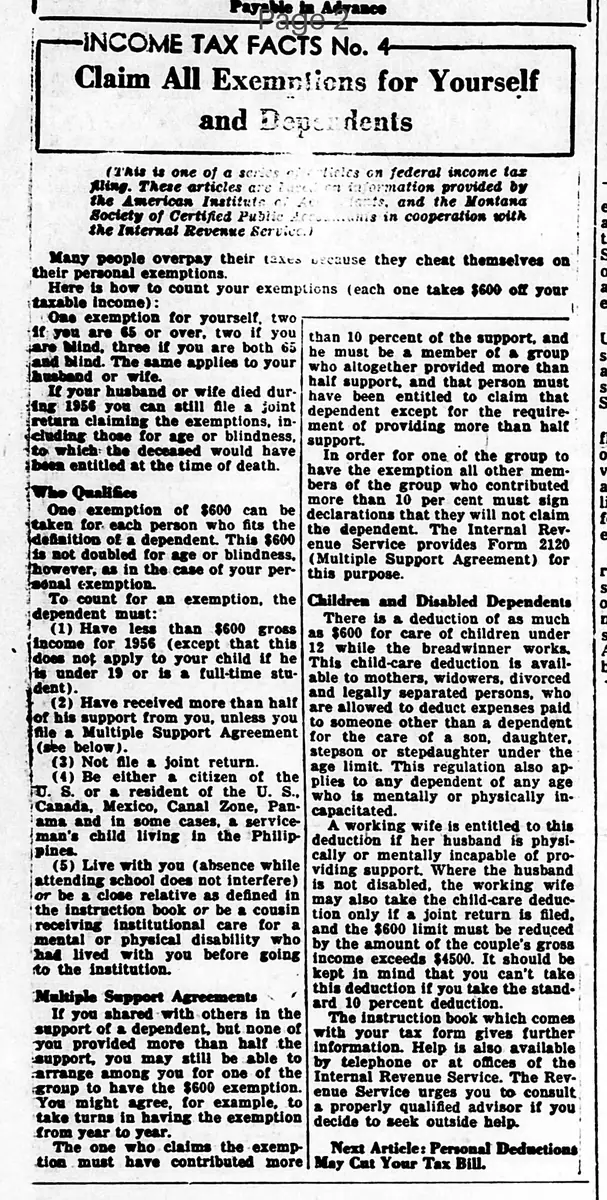
INCOME TAX FACTS No. 4
Claim All Exemptions for Yourself and Dependents
(This is one of a series of articles on federal income tax filing. These articles are in formation provided by the American Institute of CPAs, and the Montana Society of Certified Public Accountants in cooperation with the Internal Revenue Service.)
Many people overpay their taxes because they cheat themselves on their personal exemptions.
Here is how to count your exemptions (each one takes $600 off your taxable income):
If you are 65 or over, two if you are blind, three if you are both 65 and blind. The same applies to your husband or wife.
If your husband or wife died during 1956 you can still file a joint return claiming the exemptions, including those for age or blindness, to which the deceased would have been entitled at the time of death.
Who Qualifies
One exemption of $600 can be taken for each person who fits the definition of a dependent. This $600 is not doubled for age or blindness, however, as in the case of your personal exemption.
To count for an exemption, the dependent must:
(1) Have less than $600 gross income for 1956 (except that this does not apply to your child if he is under 19 or is a full-time student).
(2) Have received more than half of his support from you, unless you file a Multiple Support Agreement (See below).
(3) Not file a joint return.
(4) Be either a citizen of the U. S. or a resident of the U. S., Canada, Mexico, Canal Zone, Panama and in some cases, a service man's child living in the Philippines.
(5) Live with you (absence while attending school does not interfere) or be a close relative as defined in the instruction book or be a cousin receiving institutional care for a mental or physical disability who had lived with you before going to the institution.
Multiple Support Agreements
If you shared with others in the support of a dependent, but none of you provided more than half the support, you may still be able to arrange among you for one of the group to have the $600 exemption.
You might agree, for example, to take turns in having the exemption from year to year.
The one who claims the exemption must have contributed more than 10 percent of the support, and he must be a member of a group who altogether provided more than half support, and that person must have been entitled to claim that dependent except for the requirement of providing more than half support.
In order for one of the group to have the exemption all other members of the group who contributed more than 10 per cent must sign declarations that they will not claim the dependent. The Internal Revenue Service provides Form 2120 (Multiple Support Agreement) for this purpose.
Children and Disabled Dependents
There is a deduction of as much as $600 for care of children under 12 while the breadwinner works.
This child-care deduction is available to mothers, widowers, divorced and legally separated persons, who are allowed to deduct expenses paid to someone other than a dependent for the care of a son, daughter, stepson or stepdaughter under the age limit. This regulation also applies to any dependent of any age who is mentally or physically incapacitated.
A working wife is entitled to this deduction if her husband is physically or mentally incapable of providing support. Where the husband is not disabled, the working wife may also take the child-care deduction only if a joint return is filed, and the $600 limit must be reduced by the amount of the couple's gross income exceeds $4500. It should be kept in mind that you can't take this deduction if you take the standard 10 percent deduction.
The instruction book which comes with your tax form gives further information. Help is also available by telephone or at offices of the Internal Revenue Service. The Revenue Service urges you to consult a properly qualified advisor if you decide to seek outside help.
Next Article: Personal Deductions May Cut Your Tax Bill.
Claim All Exemptions for Yourself and Dependents
(This is one of a series of articles on federal income tax filing. These articles are in formation provided by the American Institute of CPAs, and the Montana Society of Certified Public Accountants in cooperation with the Internal Revenue Service.)
Many people overpay their taxes because they cheat themselves on their personal exemptions.
Here is how to count your exemptions (each one takes $600 off your taxable income):
If you are 65 or over, two if you are blind, three if you are both 65 and blind. The same applies to your husband or wife.
If your husband or wife died during 1956 you can still file a joint return claiming the exemptions, including those for age or blindness, to which the deceased would have been entitled at the time of death.
Who Qualifies
One exemption of $600 can be taken for each person who fits the definition of a dependent. This $600 is not doubled for age or blindness, however, as in the case of your personal exemption.
To count for an exemption, the dependent must:
(1) Have less than $600 gross income for 1956 (except that this does not apply to your child if he is under 19 or is a full-time student).
(2) Have received more than half of his support from you, unless you file a Multiple Support Agreement (See below).
(3) Not file a joint return.
(4) Be either a citizen of the U. S. or a resident of the U. S., Canada, Mexico, Canal Zone, Panama and in some cases, a service man's child living in the Philippines.
(5) Live with you (absence while attending school does not interfere) or be a close relative as defined in the instruction book or be a cousin receiving institutional care for a mental or physical disability who had lived with you before going to the institution.
Multiple Support Agreements
If you shared with others in the support of a dependent, but none of you provided more than half the support, you may still be able to arrange among you for one of the group to have the $600 exemption.
You might agree, for example, to take turns in having the exemption from year to year.
The one who claims the exemption must have contributed more than 10 percent of the support, and he must be a member of a group who altogether provided more than half support, and that person must have been entitled to claim that dependent except for the requirement of providing more than half support.
In order for one of the group to have the exemption all other members of the group who contributed more than 10 per cent must sign declarations that they will not claim the dependent. The Internal Revenue Service provides Form 2120 (Multiple Support Agreement) for this purpose.
Children and Disabled Dependents
There is a deduction of as much as $600 for care of children under 12 while the breadwinner works.
This child-care deduction is available to mothers, widowers, divorced and legally separated persons, who are allowed to deduct expenses paid to someone other than a dependent for the care of a son, daughter, stepson or stepdaughter under the age limit. This regulation also applies to any dependent of any age who is mentally or physically incapacitated.
A working wife is entitled to this deduction if her husband is physically or mentally incapable of providing support. Where the husband is not disabled, the working wife may also take the child-care deduction only if a joint return is filed, and the $600 limit must be reduced by the amount of the couple's gross income exceeds $4500. It should be kept in mind that you can't take this deduction if you take the standard 10 percent deduction.
The instruction book which comes with your tax form gives further information. Help is also available by telephone or at offices of the Internal Revenue Service. The Revenue Service urges you to consult a properly qualified advisor if you decide to seek outside help.
Next Article: Personal Deductions May Cut Your Tax Bill.
What sub-type of article is it?
Tax Advice
Informational Guide
What keywords are associated?
Income Tax
Exemptions
Dependents
Multiple Support
Child Care Deduction
1956 Tax Year
Where did it happen?
United States
Story Details
Location
United States
Event Date
1956
Story Details
Explains claiming personal exemptions ($600 each) for self, spouse, age (65+), blindness; dependent qualifications including income limits, support, residency; multiple support agreements via Form 2120; child-care deductions up to $600 for working parents or disabled dependents, with restrictions.