Thank you for visiting SNEWPapers!
Sign up free
Virginia Argus
Richmond, Virginia
What is this article about?
Preliminary proceedings of Gen. Wilkinson's court martial in Troy on Jan. 16: court rejected special judge advocate M.V. Bueren's appointment, assigned army judge advocate E.A. Bancker to prosecute; Wilkinson pleaded not guilty. Reported in Albany Argus, Jan. 20.
Clipping
OCR Quality
Full Text
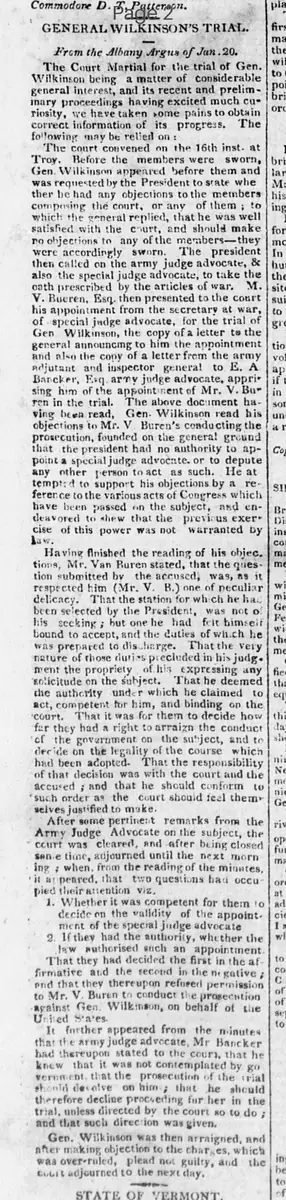
From the Albany Argus of Jan. 20.
The Court Martial for the trial of Gen. Wilkinson being a matter of considerable general interest, and its recent and preliminary proceedings having excited much curiosity, we have taken some pains to obtain correct information of its progress. The following may be relied on:
The court convened on the 16th inst. at Troy. Before the members were sworn, Gen. Wilkinson appeared before them and was requested by the President to state whether he had any objections to the members composing the court, or any of them; to which the general replied, that he was well satisfied with the court, and should make no objections to any of the members—they were accordingly sworn. The president then called on the army judge advocate, & also the special judge advocate, to take the oath prescribed by the articles of war. M. V. Bueren, Esq. then presented to the court his appointment from the secretary at war, of special judge advocate, for the trial of Gen. Wilkinson, the copy of a letter to the general announcing to him the appointment and also the copy of a letter from the army adjutant and inspector general to E. A. Bancker, Esq. army judge advocate, apprising him of the appointment of Mr. V. Bueren in the trial. The above documents having been read. Gen. Wilkinson read his objections to Mr. V. Buren's conducting the prosecution, founded on the general ground that the president had no authority to appoint a special judge advocate, or to depute any other person to act as such. He attempted to support his objections by a reference to the various acts of Congress which have been passed on the subject, and endeavored to shew that the previous exercise of this power was not warranted by law.
Having finished the reading of his objections. Mr. Van Buren stated, that the question submitted by the accused, was, as it respected him (Mr. V. B.) one of peculiar delicacy. That the station for which he had been selected by the President, was not of his seeking: but one he had felt himself bound to accept, and the duties of which he was prepared to discharge. That the very nature of those duties precluded in his judgment the propriety of his expressing any solicitude on the subject. That he deemed the authority under which he claimed to act, competent for him, and binding on the court. That it was for them to decide how far they had a right to arraign the conduct of the government on the subject, and to decide on the legality of the course which had been adopted. That the responsibility of that decision was with the court and the accused; and that he should conform to such order as the court should feel themselves justified to make.
After some pertinent remarks from the Army Judge Advocate on the subject, the court was cleared, and after being closed some time, adjourned until the next morning: when, from the reading of the minutes, it appeared, that two questions had occupied their attention viz.
1. Whether it was competent for them to decide on the validity of the appointment of the special judge advocate
2. If they had the authority, whether the law authorised such an appointment.
That they had decided the first in the affirmative and the second in the negative; and that they thereupon refused permission to Mr. V. Buren to conduct the prosecution against Gen. Wilkinson, on behalf of the United States.
It further appeared from the minutes that the army judge advocate, Mr. Bancker had thereupon stated to the court, that he knew that it was not contemplated by government, that the prosecution of the trial should devolve on him; that he should therefore decline proceeding further in the trial, unless directed by the court so to do; and that such direction was given.
Gen. Wilkinson was then arraigned, and after making objection to the charges, which was over-ruled, plead not guilty, and the court adjourned to the next day.
What sub-type of article is it?
What keywords are associated?
What entities or persons were involved?
Where did it happen?
Domestic News Details
Primary Location
Troy
Event Date
16th Inst.
Key Persons
Outcome
the court rejected the appointment of the special judge advocate, mr. v. buren, and directed the army judge advocate, mr. bancker, to conduct the prosecution. gen. wilkinson pleaded not guilty after his objections to the charges were overruled.
Event Details
The court martial convened on the 16th inst. at Troy. Gen. Wilkinson approved the court members. Documents regarding the special judge advocate appointment were presented. Gen. Wilkinson objected to Mr. V. Bueren's role, arguing lack of authority. Mr. Van Buren responded deferring to the court. After deliberation, the court ruled it had authority to decide but that the law did not authorize the appointment, refusing Mr. V. Buren permission to prosecute. Mr. Bancker was directed to proceed. Gen. Wilkinson was arraigned, objected to charges (overruled), and pleaded not guilty.