Thank you for visiting SNEWPapers!
Sign up free
The Pacific Commercial Advertiser
Honolulu, Honolulu County, Hawaii
What is this article about?
US Professor Elliott warns of seal extermination in Bering Sea, rejects 'mare clausum' claim as incompatible with international law, and urges regulated closed season. Amid US-British dispute, English officials cite US precedents against sea sovereignty claims, hoping for acceptance of Lord Salisbury's offer.
Clipping
OCR Quality
Full Text
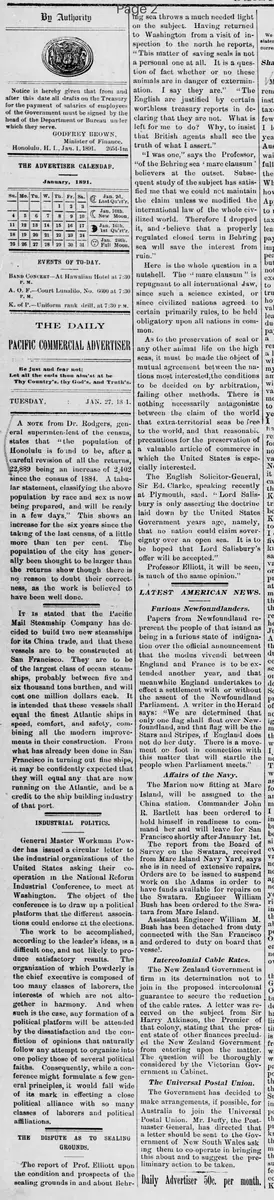
The report of Prof. Elliott upon the condition and prospects of the sealing grounds in and about Behring sea throws a much needed light on the subject. Having returned to Washington from a visit of inspection to the north he reports, "This matter of saving seals is not a personal one at all. It is a question of fact whether or no these animals are in danger of extermination. I say they are." "The English are justified by certain worthless treasury reports in declaring that they are not. What is left for me to do? Why, to insist that British agents shall see the truth of what I assert."
"I was one," says the Professor, "of the Behring sea 'mare clausum' believers at the outset. Subsequent study of the subject has satisfied me that we could not maintain the claim unless we modified the international law of the whole civilized world. Therefore I dropped it, and believe that a properly regulated closed term in Behring sea will save the interest from ruin."
Here is the whole question in a nutshell. The "mare clausum" is repugnant to all international law, since such a science existed, or since civilized nations agreed to certain primary rules, to be held obligatory upon all nations in common.
As to the preservation of seal or any other animal life on the high seas, it must be made the object of mutual agreement between the nations most interested, the conditions to be decided on by arbitration, failing other methods. There is nothing necessarily antagonistic between the claim of the world that extra-territorial seas be free to the world, and that reasonable precautions for the preservation of a valuable article of commerce in which the United States is especially interested.
The English Solicitor-General, Sir Ed. Clarke, speaking recently at Plymouth, said. "Lord Salisbury is only asserting the doctrine laid down by the United States Government years ago, namely, that no nation could claim sovereignty over an open sea."
It is to be hoped that Lord Salisbury's offer will be accepted."
Professor Elliott, it will be seen, is much of the same opinion.
What sub-type of article is it?
What keywords are associated?
What entities or persons were involved?
Where did it happen?
Foreign News Details
Primary Location
Behring Sea
Key Persons
Outcome
hope that lord salisbury's offer will be accepted; professor elliott believes seals are in danger of extermination and advocates for a properly regulated closed term in behring sea to save the interest from ruin.
Event Details
Prof. Elliott reports after inspection that seals in Behring sea are in danger of extermination, contradicting English treasury reports. He initially supported 'mare clausum' but now believes it cannot be maintained without modifying international law and suggests a regulated closed term instead. The dispute involves claims of sovereignty over open seas, with English Solicitor-General Sir Ed. Clarke noting Lord Salisbury asserts the doctrine that no nation can claim sovereignty over an open sea, as laid down by the United States Government years ago. Preservation of seal life on high seas requires mutual agreement between interested nations, decided by arbitration if needed.