Thank you for visiting SNEWPapers!
Sign up free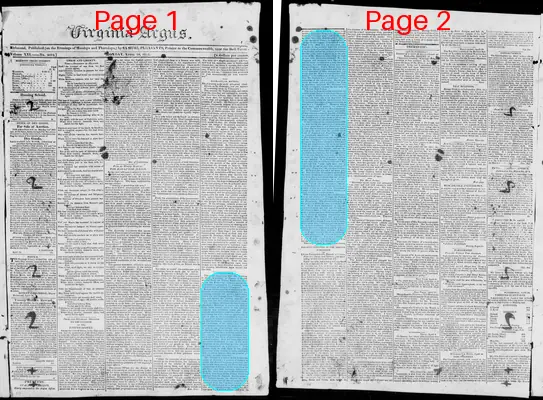
Virginia Argus
Richmond, Virginia
What is this article about?
Editorial defends Albert Gallatin against accusations of being a foreigner unfit for a diplomatic mission to Russia, compares him favorably to Alexander Hamilton (also a foreigner), and critiques deep-seated American prejudices against French immigrants versus favoritism toward English ones in politics and society.
Merged-components note: Continuation of editorial on foreigners and prejudices against Gallatin across pages.
Clippings
1 of 2
OCR Quality
Full Text
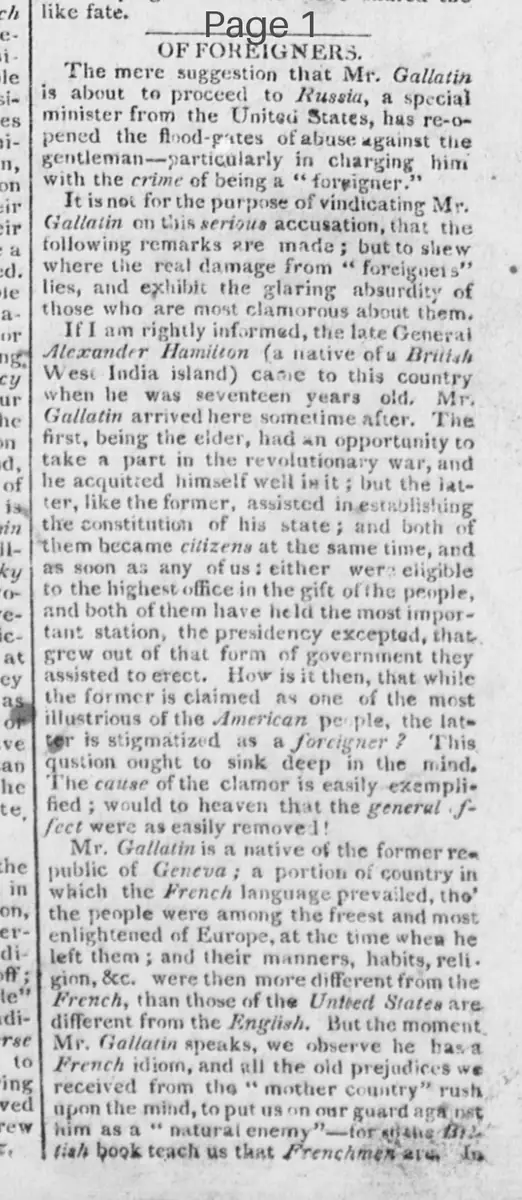
The mere suggestion that Mr. Gallatin is about to proceed to Russia, a special minister from the United States, has re-opened the flood-gates of abuse against the gentleman—particularly in charging him with the crime of being a "foreigner."
It is not for the purpose of vindicating Mr. Gallatin on this serious accusation, that the following remarks are made; but to shew where the real damage from "foreigners" lies, and exhibit the glaring absurdity of those who are most clamorous about them.
If I am rightly informed, the late General Alexander Hamilton (a native of a British West India island) came to this country when he was seventeen years old. Mr. Gallatin arrived here sometime after. The first, being the elder, had an opportunity to take a part in the revolutionary war, and he acquitted himself well in it; but the latter, like the former, assisted in establishing the constitution of his state; and both of them became citizens at the same time, and as soon as any of us: either were eligible to the highest office in the gift of the people, and both of them have held the most important station, the presidency excepted, that grew out of that form of government they assisted to erect. How is it then, that while the former is claimed as one of the most illustrious of the American people, the latter is stigmatized as a foreigner? This question ought to sink deep in the mind.
The cause of the clamor is easily exemplified: would to heaven that the general effect were as easily removed!
Mr. Gallatin is a native of the former republic of Geneva; a portion of country in which the French language prevailed, tho' the people were among the freest and most enlightened of Europe, at the time when he left them; and their manners, habits, religion, &c. were then more different from the French, than those of the United States are different from the English. But the moment Mr. Gallatin speaks, we observe he has a French idiom, and all the old prejudices we received from the "mother Country" rush upon the mind, to put us on our guard against him as a "natural enemy"—for such the fish book teach us that Frenchmen are. In
Despite ourselves, we think he must have an interest separate from ours: and, the epithets that offend us, "French dog," and all the hostile epithets that John Bull delights to bestow on the people of France, is immediately on the tip of our tongues, to be hurled at him. Such is the effect of a vile education, that engrafts on the youthful mind (for political views) a body of prejudices that reason combats weakly, and never, perhaps, eradicates.
Did the same caution guard us, in the presence of Mr. Hamilton, even while we were at war with his native country? No: his language and manners were like our own, and his many services with a long residence among us, had divested us of the idea of his being a foreigner. Every liberal man who has made himself acquainted with the political character of these eminent men, will admit, that Mr. H. was a more decided "federalist," in the estimation of the federalists, than Mr. Gallatin is a "republican," in the estimation of the republicans. Hence generally proceeds party asperity; but none in opposition supposed Mr. Hamilton less honest or capable because he was born in the British West Indies.
The fact is, from education and habit, we readily admit that an Englishman has a sort of a right to dabble in our politics, though he has only been one week imported; but we constantly refuse the same courtesy to a Frenchman, his tongue always reminding us that he is a "foreigner." Hamilton was a great man; and it matters not where he was born. The mind of a Kamchatkdale and a "Lunnuner" are equally susceptible of improvement—equally capable of leading the possessor to a good life; and the merit lies with him who makes the most advantage of the opportunities afforded to polish it.
If we examine all the circumstances of life we may behold the operations of these prejudices against France and Frenchmen in a greater degree than most persons apprehend—and at the same time the predilection in favor of England and Englishmen will be as completely manifested. Look at the coffee-houses in our commercial cities. Who are the foreigners that frequent them and mingle in the political discussion of the day? They are Englishmen: but we do not know them for certainty as such—we wonder at their eulogiums upon royalty, and are surprised at the contempt they express for our republican institutions; but it is so common that we pass them by, even now, as the enjoyment of that liberty of speech to which we are entitled. If a Frenchman were to speak thus, who would bear with him? We would ask him "what right have you to ridicule the president and libel congress?" and say, "If you don't like the country leave it. We'll send for you when we want you," &c. This disparity of treatment arises from the force of education as above referred to, and from the circumstance that we always know a Frenchman—born to be a French man? If every native Englishman had these words, "I AM An EnglishMan," branded on his forehead, we should not be so repulsive of him as we are of a Frenchman, though now at war with Great Britain; so deeply rooted are our prejudices.
Who are the foreigners that chiefly interfere in our elections? Though the French are numerous in the middle states, they are not Frenchmen. The French seldom go to the polls; or, if they do, merely vote and retire. With much experience in election matters, I never saw but one Frenchman distribute tickets or take an active part in such concerns but have often been surrounded by shoals of opposing Englishmen and Scotchmen. My country had given them the right to do so, and I never disputed the practice of it; though I may have thought, sometimes, they "overstept the modesty" of their condition. Let every man examine his own experience and he will see the force of these plain remarks. I knew many Englishmen in 1798-9 who discharged their mechanics, &c. because they would not vote as ordered. This was a matter of course in some parts of the union. Was the like ever done by a Frenchman?
This subject shall be resumed hereafter.
What sub-type of article is it?
What keywords are associated?
What entities or persons were involved?
Editorial Details
Primary Topic
Defense Of Foreigners In American Politics, Especially Against Anti French Prejudice
Stance / Tone
Critical Of Prejudices Favoring English Over French Immigrants; Supportive Of Gallatin's Qualifications
Key Figures
Key Arguments