Thank you for visiting SNEWPapers!
Sign up free
The New Hampshire Gazette And General Advertiser
Portsmouth, Rockingham County, New Hampshire
What is this article about?
A Swedish officer, Benzenstierna, plotted to burn the Russian squadron in Copenhagen harbor using the ship Alexander, bribing its Irish captain O'Brien. The scheme involved tarring the vessel and preparing incendiaries, but was betrayed by O'Brien's acquaintance Taaffe, leading to the arrest of Benzenstierna, O'Brien, and accomplice Shields.
Clipping
OCR Quality
Full Text
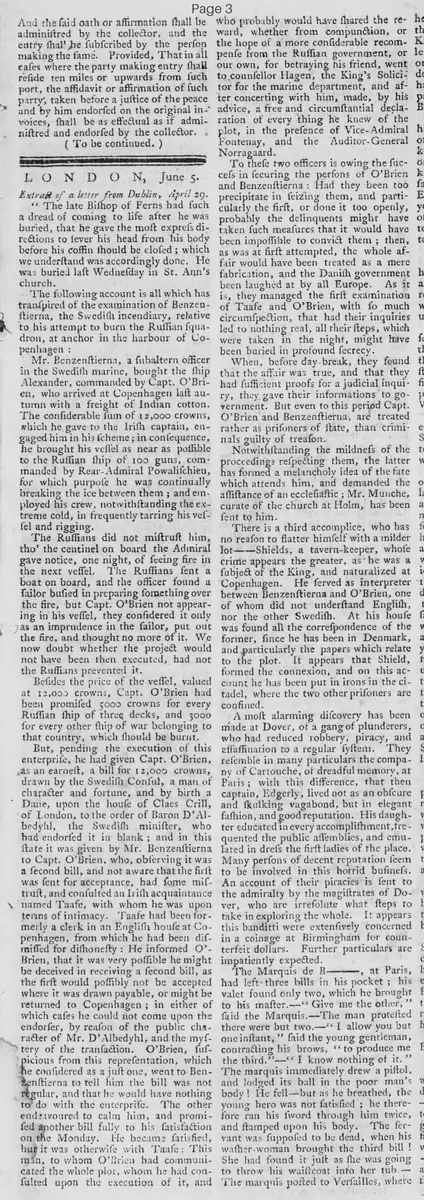
Mr. Benzenstierna, a subaltern officer in the Swedish marine, bought the ship Alexander, commanded by Capt. O'Brien, who arrived at Copenhagen last autumn with a freight of Indian cotton. The considerable sum of 12,000 crowns, which he gave to the Irish captain, engaged him in his scheme; in consequence, he brought his vessel as near as possible to the Russian ship of 100 guns, commanded by Rear-Admiral Powalischieu, for which purpose he was continually breaking the ice between them; and employed his crew, notwithstanding the extreme cold, in frequently tarring his vessel and rigging.
The Russians did not mistrust him, tho' the sentinel on board the Admiral gave notice, one night, of seeing fire in the next vessel. The Russians sent a boat on board, and the officer found a sailor busied in preparing something over the fire, but Capt. O'Brien not appearing in his vessel, they considered it only as an imprudence in the sailor, put out the fire, and thought no more of it. We now doubt whether the project would not have been then executed, had not the Russians prevented it.
Besides the price of the vessel, valued at 12,000 crowns, Capt. O'Brien had been promised 5000 crowns for every Russian ship of three decks, and 3000 for every other ship of war belonging to that country, which should be burnt. But, pending the execution of this enterprise, he had given Capt. O'Brien, as an earnest, a bill for 12,000 crowns, drawn by the Swedish Consul, a man of character and fortune, and by birth a Dane, upon the house of Claes Grill, of London, to the order of Baron D'Albedyhl, the Swedish minister, who had endorsed it in blank: and in this state it was given by Mr. Benzenstierna to Capt. O'Brien, who, observing it was a second bill, and not aware that the first was sent for acceptance, had some mistrust, and consulted an Irish acquaintance named Taaffe, with whom he was upon terms of intimacy. Taaffe had been formerly a clerk in an English house at Copenhagen, from which he had been dismissed for dishonesty: He informed O'Brien, that it was very possible he might be deceived in receiving a second bill, as the first would possibly not be accepted where it was drawn payable, or might be returned to Copenhagen; in either of which cases he could not come upon the endorser, by reason of the public character of Mr. D'Albedyhl, and the mystery of the transaction. O'Brien, suspicious from this representation, which he considered as a just one, went to Benzenstierna to tell him the bill was not regular, and that he would have nothing to do with the enterprise. The other endeavoured to calm him, and promised another bill fully to his satisfaction on the Monday. He became satisfied, but it was otherwise with Taaffe: This man, to whom O'Brien had communicated the whole plot, whom he had consulted upon the execution of it, and who probably would have shared the reward, whether from compunction, or the hope of a more considerable recompense from the Russian government, or our own, for betraying his friend, went to counsellor Hagen, the King's Solicitor for the marine department, and after concerting with him, made, by his advice, a free and circumstantial declaration of every thing he knew of the plot, in the presence of Vice-Admiral Fontenay, and the Auditor-General Norragaard.
To these two officers is owing the success in securing the persons of O'Brien and Benzenstierna: Had they been too precipitate in seizing them, and particularly the first, or done it too openly, probably the delinquents might have taken such measures that it would have been impossible to convict them; then, as was at first attempted, the whole affair would have been treated as a mere fabrication, and the Danish government been laughed at by all Europe. As it is, they managed the first examination of Taaffe and O'Brien, with so much circumspection, that had their inquiries led to nothing real, all their steps, which were taken in the night, might have been buried in profound secrecy.
When, before day-break, they found that the affair was true, and that they had sufficient proofs for a judicial inquiry, they gave their informations to government. But even to this period Capt. O'Brien and Benzenstierna, are treated rather as prisoners of state, than criminals guilty of treason.
Notwithstanding the mildness of the proceedings respecting them, the latter has formed a melancholy idea of the fate which attends him, and demanded the assistance of an ecclesiastic: Mr. Munche, curate of the church at Holm, has been sent to him.
There is a third accomplice, who has no reason to flatter himself with a milder lot---Shields, a tavern-keeper, whose crime appears the greater, as he was a subject of the King, and naturalized at Copenhagen. He served as interpreter between Benzenstierna and O'Brien, one of whom did not understand English, nor the other Swedish. At his house was found all the correspondence of the former, since he has been in Denmark, and particularly the papers which relate to the plot. It appears that Shields formed the connexion, and on this account he has been put in irons in the citadel, where the two other prisoners are confined.
What sub-type of article is it?
What keywords are associated?
What entities or persons were involved?
Where did it happen?
Foreign News Details
Primary Location
Copenhagen
Key Persons
Outcome
plot foiled by betrayal from taaffe; benzenstierna, o'brien, and shields arrested and confined; no ships burned or casualties reported.
Event Details
Swedish marine officer Benzenstierna purchased the ship Alexander from Irish Capt. O'Brien to position near Russian squadron in Copenhagen harbor, intending to burn them using incendiaries prepared by tarring and rigging in cold weather. Russians noticed fire once but dismissed it. O'Brien was promised rewards per ship burned and given a bill as earnest, but grew suspicious after consulting Taaffe, who betrayed the plot to Danish authorities. Careful investigation led to arrests without alerting suspects initially; prisoners treated as state prisoners.