Thank you for visiting SNEWPapers!
Sign up free
The New York Journal, And Daily Patriotic Register
New York, New York County, New York
What is this article about?
Historical anecdote about Erasmus visiting Sir Thomas More in England, debating transubstantiation, borrowing his horse which strays, and replying with a witty Latin poem punning on the doctrine when accused of theft. Mr. Collins later translates it into English.
Clipping
OCR Quality
Full Text
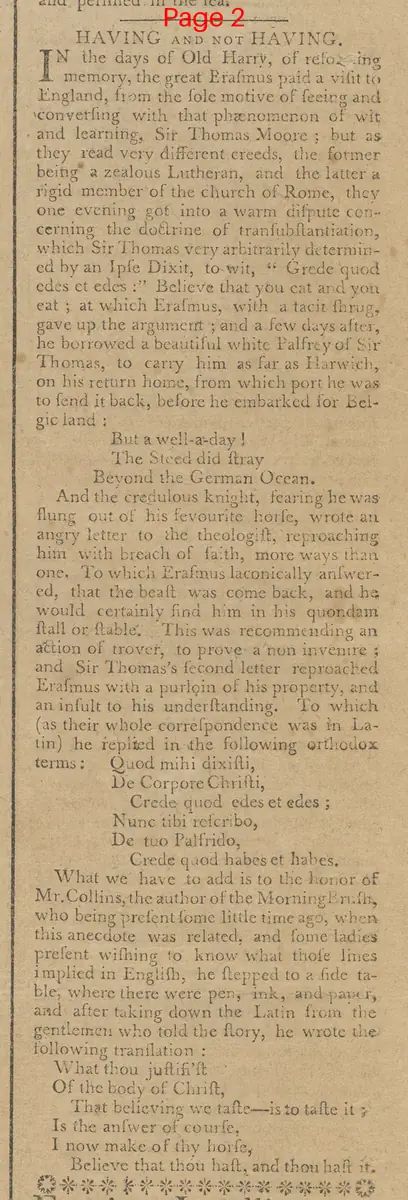
IN the days of Old Harry, of blessed memory, the great Erasmus paid a visit to England, from the sole motive of seeing and conversing with that phenomenon of wit , and learning, Sir Thomas More ; but as they read very different creeds, the former being a zealous Lutheran, and the latter a rigid member of the church of Rome, they one evening got into a warm dispute concerning the doctrine of transubstantiation, which Sir Thomas very arbitrarily determined by an Ipse Dixit, to wit, " Crede quod edis et edis :" Believe that you eat and you eat ; at which Erasmus, with a tacit shrug, gave up the argument ; and a few days after, he borrowed a beautiful white Palfrey of Sir Thomas, to carry him as far as Harwich, on his return home, from which port he was to send it back, before he embarked for Belgic land :
But a well-a-day!
The Steed did stray
Beyond the German Ocean.
And the credulous knight, fearing he was flung out of his favourite horse, wrote an angry letter to the theologian, reproaching him with breach of faith, more ways than one. To which Erasmus laconically answered, that the beast was come back, and he would certainly find him in his quondam stall or stable. This was recommending an action of trover. to prove a non invenire ; and Sir Thomas's second letter reproached Erasmus with a purloin of his property, and an insult to his understanding. To which (as their whole correspondence was in Latin) he replied in the following orthodox terms:
Quod mihi dixisti,
De Corpore Christi,
Crede quod edis et edis ;
Nunc tibi rescribo,
De tuo Palfrido,
Crede quod habes et habes.
What thou justifi'st
Of the body of Christ,
That believing we taste-is to taste it ;
Is the answer of course.
I now make of thy horse.
Believe that thou hast. and thou hast it.
What we have to add is to the honor of Mr. Collins, the author of the Morning Post, who being present some little time ago, when this anecdote was related, and some ladies present wishing to know what those lines implied in English, he stepped to a side table, where there were pen, ink, and paper, and after taking down the Latin from the gentlemen who told the story, he wrote the following translation :
What sub-type of article is it?
What keywords are associated?
What entities or persons were involved?
Where did it happen?
Filler Details
Topic
Witty Latin Poem By Erasmus On Borrowed Horse And Transubstantiation
Location
England, Harwich
Key Persons
Event Details
Erasmus visits Sir Thomas More in England, debates transubstantiation, borrows his white palfrey to Harwich but it strays. More accuses theft; Erasmus replies with punning Latin poem: 'Crede quod habes et habes' (Believe that you have and you have). Mr. Collins translates it into English.