Thank you for visiting SNEWPapers!
Sign up free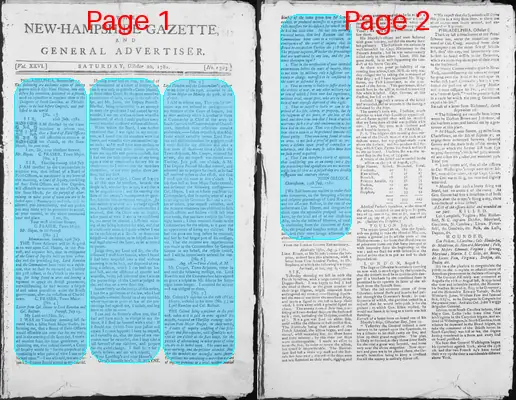
The New Hampshire Gazette And General Advertiser
Portsmouth, Exeter, Rockingham County, New Hampshire
What is this article about?
Authentic copies of papers from Col. Isaac Hayne, delivered before his execution, detailing his irregular trial by British authorities in Charleston for taking up arms after accepting protection, including notifications, his defense letter, legal opinion, and temporary respites granted.
Merged-components note: Continuation of the narrative about Col. Isaac Hayne's trial and execution across pages 1 and 2; original labels were 'story' and 'domestic_news', merged into 'story' as it is a full narrative article.
Clippings
1 of 2
OCR Quality
Full Text
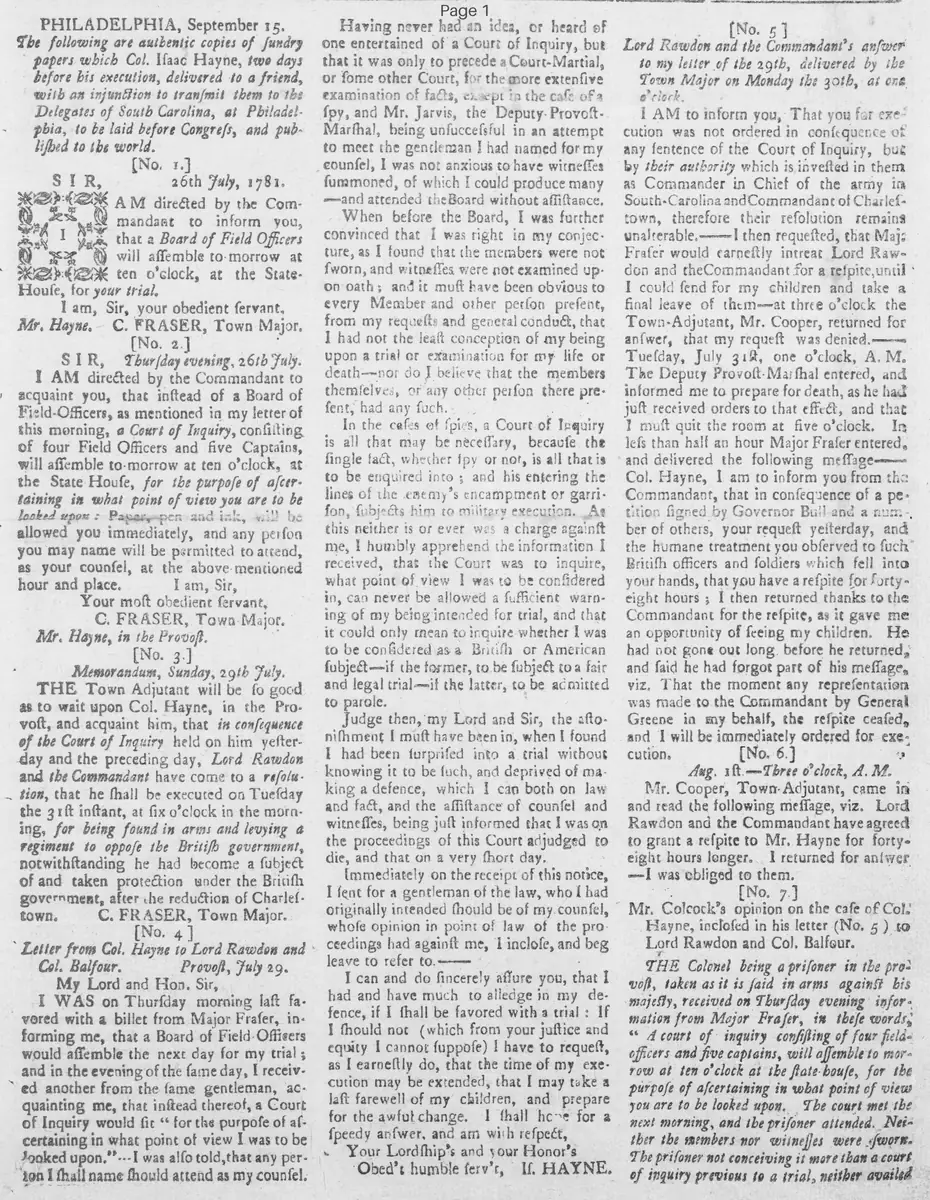
The following are authentic copies of sundry papers which Col. Isaac Hayne, two days before his execution, delivered to a friend, with an injunction to transmit them to the Delegates of South Carolina, at Philadelphia, to be laid before Congress, and published to the world.
[No. 1.]
SIR,
26th July, 1781.
As directed by the Commandant to inform you, that a Board of Field Officers will assemble to-morrow at ten o'clock, at the State-House, for your trial.
I am, Sir, your obedient servant,
Mr. Hayne.
C. FRASER, Town Major.
[No. 2.]
SIR, Thursday evening, 26th July.
I AM directed by the Commandant to acquaint you, that instead of a Board of Field-Officers, as mentioned in my letter of this morning, a Court of Inquiry, consisting of four Field Officers and five Captains, will assemble to-morrow at ten o'clock, at the State House, for the purpose of ascertaining in what point of view you are to be looked upon. Paper, pen and ink will be allowed you immediately, and any person you may name will be permitted to attend as your counsel, at the above-mentioned hour and place.
I am, Sir,
Your most obedient servant,
C. FRASER, Town Major.
Mr. Hayne, in the Provost.
[No. 3.]
Memorandum, Sunday, 29th July
THE Town Adjutant will be so good as to wait upon Col. Hayne, in the Provost, and acquaint him, that in consequence of the Court of Inquiry held on him yesterday and the preceding day, Lord Rawdon and the Commandant have come to a resolution, that he shall be executed on Tuesday the 31st instant, at six o'clock in the morning, for being found in arms and levying a regiment to oppose the British government, notwithstanding he had become a subject of and taken protection under the British government, after the reduction of Charleston.
C. FRASER, Town Major.
[No. 4]
Letter from Col. Hayne to Lord Rawdon and Col. Balfour.
Provost, July 29.
My Lord and Hon. Sir,
I WAS on Thursday morning last favored with a billet from Major Fraser, informing me, that a Board of Field Officers would assemble the next day for my trial: and in the evening of the same day, I received another from the same gentleman, acquainting me, that instead thereof, a Court of Inquiry would sit for the purpose of ascertaining in what point of view I was to be looked upon... I was also told, that any person I shall name should attend as my counsel.
Having never had an idea, or heard of one entertained of a Court of Inquiry, but that it was only to precede a Court-Martial, or some other Court, for the more extensive examination of facts, except in the case of a spy, and Mr. Jarvis, the Deputy-Provost-Marshal, being unsuccessful in an attempt to meet the gentleman I had named for my counsel, I was not anxious to have witnesses summoned, of which I could produce many --and attended the Board without assistance.
When before the Board, I was further convinced that I was right in my conjecture, as I found that the members were not sworn, and witnesses were not examined upon oath; and it must have been obvious to every Member and other person present, from my requests and general conduct, that I had not the least conception of my being upon a trial or examination for my life or death--nor do I believe that the members themselves, or any other person there present, had any such.
In the cases of spies, a Court of Inquiry is all that may be necessary, because the single fact, whether spy or not, is all that is to be enquired into; and his entering the lines of the enemy's encampment or garrison, subjects him to military execution. As this neither is or ever was a charge against me, I humbly apprehend the information I received, that the Court was to inquire, what point of view I was to be considered in, can never be allowed a sufficient warning of my being intended for trial, and that it could only mean to inquire whether I was to be considered as a British or American subject--if the former, to be subject to a fair and legal trial--if the latter, to be admitted to parole.
Judge then, my Lord and Sir, the astonishment I must have been in, when I found I had been surprised into a trial without knowing it to be such, and deprived of making a defence, which I can both on law and fact, and the assistance of counsel and witnesses, being just informed that I was on the proceedings of this Court adjudged to die, and that on a very short day.
Immediately on the receipt of this notice, I sent for a gentleman of the law, who I had originally intended should be of my counsel, whose opinion in point of law of the proceedings had against me, I inclose, and beg leave to refer to.
I can and do sincerely assure you, that I had and have much to allege in my defence, if I shall be favored with a trial: If I should not (which from your justice and equity I cannot suppose) I have to request, as I earnestly do, that the time of my execution may be extended, that I may take a last farewell of my children, and prepare for the awful change. I shall here for a speedy answer, and am with respect,
Your Lordship's and your Honor's
Obed't humble serv't,
I. HAYNE.
[No. 5]
Lord Rawdon and the Commandant's answer to my letter of the 29th, delivered by the Town Major on Monday the 30th, at one o'clock.
I AM to inform you, That your execution was not ordered in consequence of any sentence of the Court of Inquiry, but by their authority which is invested in them as Commander in Chief of the army in South-Carolina and Commandant of Charleston, therefore their resolution remains unalterable. I then requested, that Major Fraser would earnestly intreat Lord Rawdon and the Commandant for a respite, until I could send for my children and take a final leave of them--at three o'clock the Town-Adjutant, Mr. Cooper, returned for answer, that my request was denied.
Tuesday, July 31st, one o'clock, A. M.
The Deputy Provost-Marshal entered, and informed me to prepare for death, as he had just received orders to that effect, and that I must quit the room at five o'clock.
In less than half an hour Major Fraser entered, and delivered the following message--
Col. Hayne, I am to inform you from the Commandant, that in consequence of a petition signed by Governor Bull and a number of others, your request yesterday, and the humane treatment you observed to such British officers and soldiers which fell into your hands, that you have a respite for forty-eight hours; I then returned thanks to the Commandant for the respite, as it gave me an opportunity of seeing my children. He had not gone out long, before he returned, and said he had forgot part of his message, viz. That the moment any representation was made to the Commandant by General Greene in my behalf, the respite ceased, and I will be immediately ordered for execution.
[No. 6.]
Mr. Cooper, Town-Adjutant, came in Aug. 1st.--Three o'clock, A.M. and read the following message, viz. Lord Rawdon and the Commandant have agreed to grant a respite to Mr. Hayne for forty-eight hours longer. I returned for answer --I was obliged to them.
[No. 7.]
Mr. Colcock's opinion on the case of Col. Hayne, enclosed in his letter (No. 5) to Lord Rawdon and Col. Balfour.
THE Colonel being a prisoner in the provost, taken as it is said in arms against his majesty, received on Thursday evening information from Major Fraser, in these words:
A court of inquiry consisting of four field-officers and five captains, will assemble to-morrow at ten o'clock at the state-house, for the purpose of ascertaining in what point of view you are to be looked upon. The court met the next morning, and the prisoner attended. Neither the members nor witnesses were sworn. The prisoner not conceiving it more than a court of inquiry previous to a trial, neither availed
Himself of the leave given him for having counsel, or produced witnesses to a great many facts necessary for his defense, for which indeed he had but little time. He has this morning received notice that Lord Rawdon and the Commandant have come to a resolution, in consequence of the court of inquiry, that he should be executed on Tuesday the 21st instant. The prisoner inquires, whether the proceedings had are warranted by any law, and the sentence thereupon legal?
1. That in the notification of your intended examination before the court of inquiry, there is not even by military rule a sufficient certainty or charge expressed to be considered by the court or defended by you.
2. That no enemy is liable to suffer death by the articles of war, or any other military rule or law of which I have ever had cognizance, without trial, except spies, who are by the article of war expressly deprived of that right.
3. That no subject is liable or can be deprived of his life, liberty, or property, but by the judgment of his peers, or the law of the land; and there is no law that I know of which warrants such a trial and condemnation as has been had in this case. That it is a fixed rule in law that a man is to be presumed innocent till found guilty. That even being found or taken in arms, is not such a proof of guilt as prevents a defense upon proof of compulsion or otherwise, and that many so taken have been on such proof acquitted.
4. That I am therefore clearly of opinion, that considering you as an enemy (not a spy) the proceedings had against you are not warranted by law, & that as a subject they are directly repugnant and contrary thereto.
JOHN COLCOCK.
Charleston, 29th July, 1781.
We shall leave our readers to make their own comments on the foregoing arbitrary and despotic proceedings of Lord Rawdon, and his associate Balfour, in the case of the unfortunate Col. Hayne, and congratulate them upon the agreeable prospect we now have, by the kind aid of our illustrious Ally, under the smiles of Heaven, of totally eradicating from the continent of America, the proud and haughty troops of Britain, and their more savage adherents, the abandoned Tories.
What sub-type of article is it?
What themes does it cover?
What keywords are associated?
What entities or persons were involved?
Where did it happen?
Story Details
Key Persons
Location
Charleston, South Carolina
Event Date
July 1781
Story Details
Col. Hayne, after taking British protection, is captured in arms, subjected to a Court of Inquiry instead of a proper trial, sentenced to execution without due process, appeals for defense and respite to see his children, receives temporary 48-hour respites amid petitions, but faces arbitrary British authority.