Thank you for visiting SNEWPapers!
Sign up free
Litchfield Enquirer
Litchfield, Litchfield County, Connecticut
What is this article about?
Extract from Dr. Beecher's lectures on skepticism arguing that liberty's conquest is easy but preservation requires enlightened patriots and Christianity, citing historical examples from France, Greece, and America to show Christianity's role in sustaining civil liberty against despotism.
Clipping
OCR Quality
Full Text
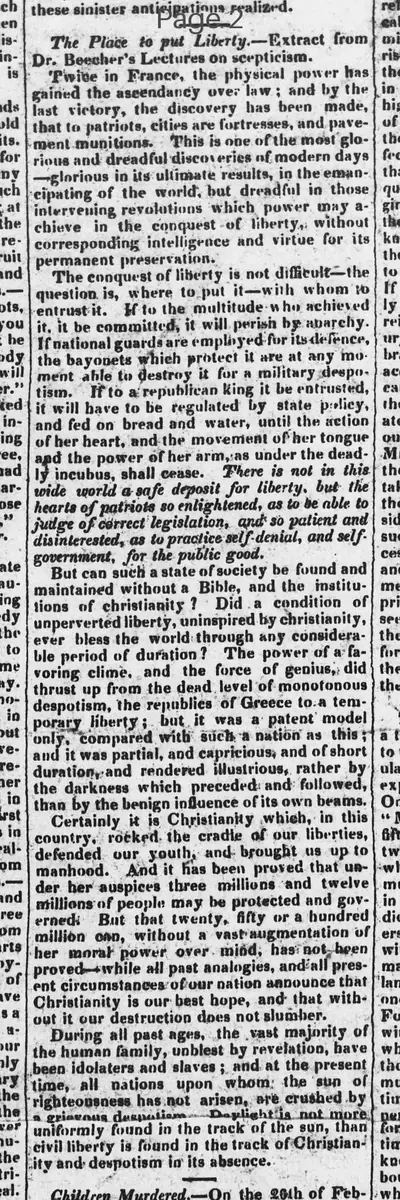
Twice in France, the physical power has gained the ascendancy over law; and by the last victory, the discovery has been made, that to patriots, cities are fortresses, and pavement munitions. This is one of the most glorious and dreadful discoveries of modern days—glorious in its ultimate results, in the emancipating of the world, but dreadful in those intervening revolutions which power may achieve in the conquest of liberty, without corresponding intelligence and virtue for its permanent preservation.
The conquest of liberty is not difficult—the question is, where to put it—with whom to entrust it. If to the multitude who achieved it, it be committed, it will perish by anarchy. If national guards are employed for its defence, the bayonets which protect it are at any moment able to destroy it for a military despotism. If to a republican king it be entrusted, it will have to be regulated by state policy, and fed on bread and water, until the action of her heart, and the movement of her tongue and the power of her arm, as under the deadly incubus, shall cease. There is not in this wide world a safe deposit for liberty, but the hearts of patriots so enlightened, as to be able to judge of correct legislation, and so patient and disinterested, as to practice self-denial, and self-government, for the public good.
But can such a state of society be found and maintained without a Bible, and the institutions of Christianity? Did a condition of unperverted liberty, uninspired by Christianity, ever bless the world through any considerable period of duration? The power of a favoring clime, and the force of genius, did thrust up from the dead level of monotonous despotism, the republics of Greece to a temporary liberty; but it was a patent model only, compared with such a nation as this; and it was partial, and capricious, and of short duration, and rendered illustrious, rather by the darkness which preceded and followed, than by the benign influence of its own beams.
Certainly it is Christianity which, in this country, rocked the cradle of our liberties, defended our youth, and brought us up to manhood. And it has been proved that under her auspices three millions and twelve millions of people may be protected and governed: But that twenty, fifty or a hundred million can, without a vast augmentation of her moral power over mind, has not been proved—while all past analogies, and all present circumstances of our nation announce that Christianity is our best hope, and that without it our destruction does not slumber.
During all past ages, the vast majority of the human family, unblest by revelation, have been idolaters and slaves; and at the present time, all nations upon whom the sun of righteousness has not arisen, are crushed by a grievous despotism. Daylight is not more uniformly found in the track of the sun, than civil liberty is found in the track of Christianity and despotism in its absence.
What sub-type of article is it?
What themes does it cover?
What keywords are associated?
What entities or persons were involved?
Where did it happen?
Story Details
Key Persons
Location
France, Greece, America
Event Date
Modern Days, Past Ages, Present Time
Story Details
Dr. Beecher argues that while conquering liberty is straightforward, entrusting it safely requires enlightened, virtuous patriots guided by Christianity, as historical examples from France's revolutions, Greece's temporary republics, and America's growth under Christian influence demonstrate liberty's dependence on religious moral power to avoid anarchy or despotism.