Thank you for visiting SNEWPapers!
Sign up free
Literary
July 13, 1869
Event 1 of 2
Orleans Independent Standard
Irasburg, Barton, Orleans County, Vermont
What is this article about?
A poem by Henry Kirke White on solitude and loneliness in nature, followed by an excerpt from Henry Ward Beecher's sermon critiquing superficial self-denial and advocating true moral sacrifice in daily interactions.
Clipping
OCR Quality
95%
Excellent
Full Text
This is Event 1 of 2. The full text below covers all events in this component.
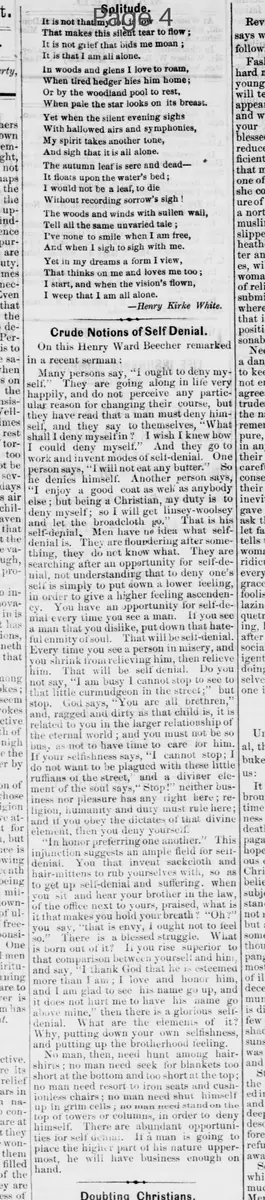
That makes this silent tear to flow:
It is not grief that bids me moan;
It is that I am all alone.
In woods and glens I love to roam,
When tired hedger hies him home;
Or by the woodland pool to rest,
When pale the star looks on its breast.
Yet when the silent evening sighs
With hallowed airs and symphonies,
My spirit takes another tone,
And sigh that it is all alone.
The autumn leaf is sere and dead—
It floats upon the water's bed;
I would not be a leaf, to die
Without recording sorrow's sigh!
The woods and winds with sullen wail,
Tell all the same unvaried tale;
I've none to smile when I am free,
And when I sigh to sigh with me.
Yet in my dreams a form I view,
That thinks on me and loves me too;
I start, and when the vision's flown,
I weep that I am all alone.
—Henry Kirke White.
Crude Notions of Self Denial.
On this Henry Ward Beecher remarked in a recent sermon:
Many persons say, 'I ought to deny myself.' They are going along in life very happily, and do not perceive any particular reason for changing their course, but they have read that a man must deny himself, and they say to themselves, 'What shall I deny myself in? I wish I knew how I could deny myself.' And they go to work and invent modes of self-denial. One person says, 'I will not eat any butter.' So he denies himself. Another person says, 'I enjoy a good coat as well as anybody else; but being a Christian, my duty is to deny myself; so I will get linsey-woolsey and let the broadcloth go.' That is his self-denial. Men have no idea what self-denial is. They are floundering after something, they do not know what. They are searching after an opportunity for self-denial, not understanding that to deny one's self is simply to put down a lower feeling, in order to give a higher feeling ascendency. You have an opportunity for self-denial every time you see a man. If you see a man that you dislike, put down that hateful enmity of soul. That will be self-denial. Every time you see a person in misery, and you shrink from relieving him, then relieve him. That will be self denial. Do you not say, 'I am busy I cannot stop to see to that little curmudgeon in the street;' but stop. God says, 'You are all brethren,' and, ragged and dirty as that child is, it is related to you in the larger relationship of the eternal world; and you must not be so busy, as not to have time to care for him. If your selfishness says, 'I cannot stop; I do not want to be plagued with these little ruffians of the street,' and a diviner element of the soul says, 'Stop!' neither business nor pleasure has any right here; religion, humanity and duty must rule here; and if you obey the dictates of that divine element, then you deny yourself.
'In honor preferring one another.' This injunction suggests an ample field for self-denial. You that invent sackcloth and hair-mittens to rub yourselves with, so as to get up self-denial and suffering, when you sit and hear your brother in the law, of the office next to yours, praised, what is it that makes you hold your breath? 'Oh?' you say, 'that is envy, I ought not to feel so.' There is a blessed struggle. What is born out of it? If you rise superior to that comparison between yourself and him and say, I thank God that he is esteemed more than I am, I love and honor him, and I am glad to see his name go up, and it does not hurt me to have his name go above mine,' then there is a glorious self-denial. What are the elements of it? Why, putting down your own selfishness, and putting up the brotherhood feeling.
No man, then, need hunt among hair-shirts; no man need seek for blankets too short at the bottom and too short at the top; no man need resort to iron seats and cushionless chairs; no man need shut himself up in grim cells, no man need stand on the top of towers or columns, in order to deny himself. There are abundant opportunities for self-denial. If a man is going to place the higher part of his nature uppermost, he will have business enough on hand.
It is not grief that bids me moan;
It is that I am all alone.
In woods and glens I love to roam,
When tired hedger hies him home;
Or by the woodland pool to rest,
When pale the star looks on its breast.
Yet when the silent evening sighs
With hallowed airs and symphonies,
My spirit takes another tone,
And sigh that it is all alone.
The autumn leaf is sere and dead—
It floats upon the water's bed;
I would not be a leaf, to die
Without recording sorrow's sigh!
The woods and winds with sullen wail,
Tell all the same unvaried tale;
I've none to smile when I am free,
And when I sigh to sigh with me.
Yet in my dreams a form I view,
That thinks on me and loves me too;
I start, and when the vision's flown,
I weep that I am all alone.
—Henry Kirke White.
Crude Notions of Self Denial.
On this Henry Ward Beecher remarked in a recent sermon:
Many persons say, 'I ought to deny myself.' They are going along in life very happily, and do not perceive any particular reason for changing their course, but they have read that a man must deny himself, and they say to themselves, 'What shall I deny myself in? I wish I knew how I could deny myself.' And they go to work and invent modes of self-denial. One person says, 'I will not eat any butter.' So he denies himself. Another person says, 'I enjoy a good coat as well as anybody else; but being a Christian, my duty is to deny myself; so I will get linsey-woolsey and let the broadcloth go.' That is his self-denial. Men have no idea what self-denial is. They are floundering after something, they do not know what. They are searching after an opportunity for self-denial, not understanding that to deny one's self is simply to put down a lower feeling, in order to give a higher feeling ascendency. You have an opportunity for self-denial every time you see a man. If you see a man that you dislike, put down that hateful enmity of soul. That will be self-denial. Every time you see a person in misery, and you shrink from relieving him, then relieve him. That will be self denial. Do you not say, 'I am busy I cannot stop to see to that little curmudgeon in the street;' but stop. God says, 'You are all brethren,' and, ragged and dirty as that child is, it is related to you in the larger relationship of the eternal world; and you must not be so busy, as not to have time to care for him. If your selfishness says, 'I cannot stop; I do not want to be plagued with these little ruffians of the street,' and a diviner element of the soul says, 'Stop!' neither business nor pleasure has any right here; religion, humanity and duty must rule here; and if you obey the dictates of that divine element, then you deny yourself.
'In honor preferring one another.' This injunction suggests an ample field for self-denial. You that invent sackcloth and hair-mittens to rub yourselves with, so as to get up self-denial and suffering, when you sit and hear your brother in the law, of the office next to yours, praised, what is it that makes you hold your breath? 'Oh?' you say, 'that is envy, I ought not to feel so.' There is a blessed struggle. What is born out of it? If you rise superior to that comparison between yourself and him and say, I thank God that he is esteemed more than I am, I love and honor him, and I am glad to see his name go up, and it does not hurt me to have his name go above mine,' then there is a glorious self-denial. What are the elements of it? Why, putting down your own selfishness, and putting up the brotherhood feeling.
No man, then, need hunt among hair-shirts; no man need seek for blankets too short at the bottom and too short at the top; no man need resort to iron seats and cushionless chairs; no man need shut himself up in grim cells, no man need stand on the top of towers or columns, in order to deny himself. There are abundant opportunities for self-denial. If a man is going to place the higher part of his nature uppermost, he will have business enough on hand.
What sub-type of article is it?
Poem
Soliloquy
What themes does it cover?
Nature
Death Mortality
Friendship
What keywords are associated?
Solitude
Loneliness
Nature
Dreams
Autumn Leaf
What entities or persons were involved?
Henry Kirke White
Literary Details
Author
Henry Kirke White
Key Lines
It Is Not Grief That Bids Me Moan;
It Is That I Am All Alone.
Yet In My Dreams A Form I View,
That Thinks On Me And Loves Me Too;
I Weep That I Am All Alone.