Thank you for visiting SNEWPapers!
Sign up free
Richmond Enquirer
Richmond, Richmond County, Virginia
What is this article about?
James M. Garnett submits his valedictory lecture to the pupils of Elm-Wood school in Essex County, Va., for publication in the Enquirer. The lecture urges young women to reflect on their moral, religious, and intellectual growth, warns of life's uncertainties, and cites examples of accomplished historical women like Lady Jane Grey and Elizabeth Smith to inspire virtue and learning.
Merged-components note: This is a single continuous letter to the editor on education, spanning pages 1-2; text flows directly (ends mid-sentence on first, continues on second); original labels 'letter_to_editor' and 'literary' merged under 'letter_to_editor' as dominant content.
Clippings
1 of 2
OCR Quality
Full Text
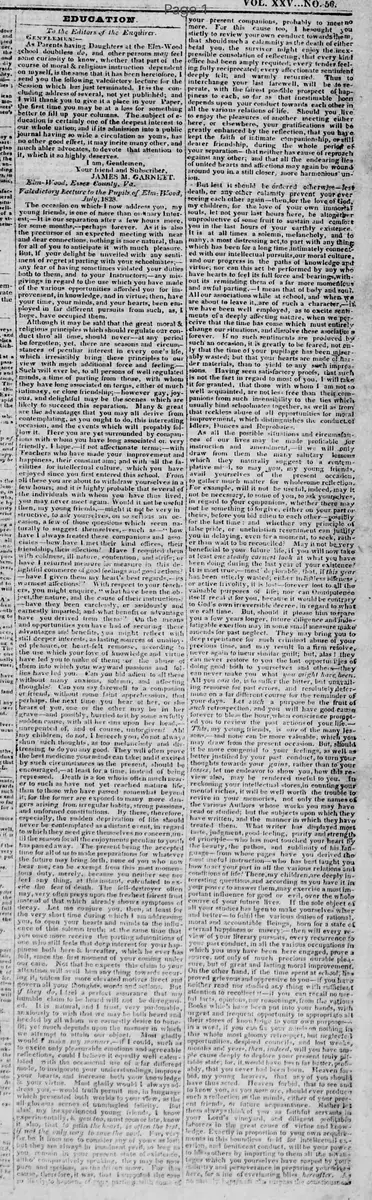
To the Editors of the Enquirer.
GENTLEMEN:—
As Parents having Daughters at the Elm-Wood school doubtless do, and other persons may feel some curiosity to know, whether that part of the course of moral & religious instruction dependent on myself, is the same that it has been heretofore, I send you the following valedictory lecture for the Session which has just terminated. It is the concluding address of several, not yet published; and I will thank you to give it a place in your Paper, the first time you may be at a loss for something better to fill up your columns. The subject of education is certainly one of the deepest interest to our whole nation; and if its admission into a public journal having so wide a circulation as yours, has no other good effect, it may incite many other, and much abler advocates, to devote that attention to it, which it so highly deserves.
I am, Gentlemen,
Your friend and Subscriber,
JAMES M. GARNETT.
Elm-Wood, Essex County, Va.
Valedictory Lecture to the Pupils. of Elm-Wood,
July, 1828.
The occasion on which I now address you, my young friends, is one of more than ordinary interest;—It is our separation after a few hours more, for some months,—perhaps forever. As it is also the precursor of an expected meeting with near and dear connections, nothing is more natural, than for all of you to anticipate it with much pleasure. But, If your delight be unalloyed with any sentiment of regret at parting with your schoolmates;— any fear of having sometimes violated your duties both to them, and to your Instructors;—any misgivings in regard to the use which you have made of the various opportunities afforded you for improvement, in knowledge, and in virtue; then, have your time, your minds, and your hearts, been employed in far different pursuits from such, as, I hope, have occupied them.
Although it may be said that the great moral & religious principles which should regulate our conduct thro' all time, should never—at any period be forgotten; yet, there are seasons and circumstances of peculiar interest in every one's life, which irresistibly bring these principles to our view with much additional force and feeling.— Such will ever be, to all persons of well regulated minds, a time of parting from those, with whom they have long associated on terms, either of much intimacy, or close friendship;—however gay, joyous, and delightful may be the scenes which are likely to succeed this separation. Many & great are the advantages that you may all derive from contemplating, as you ought to do, this interesting occasion, and the events which will probably follow it. Here you are yet surrounded by companions with whom you have long associated on very friendly. I hope,—if not affectionate terms;—with Teachers who have made your improvement and happiness, their constant aim; and with all the facilities for intellectual culture, which you have enjoyed since you first entered this school. From all these you are about to withdraw yourselves in a few hours; and it is highly probable that several of the individuals with whom you have thus lived, you may never meet again. Would it not be useful then, my young friends,—might it not be very instructive, to ask yourselves, on so serious an occasion, a few of those questions which seem naturally to suggest themselves,—such as—"how have I always treated these companions and associates—how have I met their kind offices, their friendship, their affection? Have I requited them with coldness, ill-nature, contention, and strife; or have I returned measure for measure in this delightful commerce of good feelings and good actions? -have I given them my heart's best regards, -its warmest affections?" With respect to your teachers, you might enquire, "what have been the object, the nature, and the cause of their instructions? --have they been carelessly, or assiduously and earnestly imparted; and—what benefit or advantage have you derived from them:" On the means and opportunities you have had of securing these advantages and benefits, you might reflect with still deeper interests, as lasting sources of unalloyed pleasure, or heart-felt remorse, according to the use which your love of knowledge and virtue have led you to make of them; or the abuse of them into which your wayward passions and follies have led you. Can you bid adieu to all these without many anxious, solemn, and affecting thoughts? Can you say farewell to a companion or friend, without some faint apprehension, that perhaps, the next time you hear of her, or she hears of you, one or the other may be in her grave—and possibly, hurried to it by some awfully sudden cause, with all her sins upon her head,—unrepented of, and of course, unforgiven? Ah! my children, do not, I beseech you, do not always shun 'such thoughts, as too melancholy and distressing to do you any good. They will often prove the best medicine your minds can take; and if excited by such circumstances as the present, should be encouraged,—at least for a time, instead of being repressed. Death is a foe who is often much nearer to such as have not yet reached mature life, than to those who have passed somewhat beyond it; for the former are exposed to many more dangers arising from irregular habits, strong passions, and unformed constitutions. By these, therefore, especially, the sudden deprivation of life should never be contemplated as a distant event, in regard to which they need give themselves no concern, until the season for all the enjoyments peculiar to youth has passed away. The present being the accepted time for all of us to make preparations for whatever the future may bring forth, none of you who now hear me, can be exempt from this most momentous duty, merely, because you neither see nor feel any thing, at this instant, calculated to excite the fear of death. The fell-destroyer often nay, very often preys upon the freshest fairest fruit instead of that which already shows symptoms of decay. Let me conjure you, then, at least for the very short time during which I am addressing you, to open your hearts and minds to the influence of this solemn truth; at the same time that you once more receive the parting admonitions of one who still feels that deep interest for your happiness both here & hereafter, which he ever has felt, since the first moment of your coming under our care. Not that he expects this claim to your attention will avail him any thing towards securing it, unless far more elevated motives direct and govern all your thoughts, words and actions. But if they do, I feel a perfect assurance that my humble claim to be heard will not be disregarded. It is natural, end I trust, very pardonable, anxiously to wish that we may be both heard and heeded by all whom we earnestly desire to benefit, yet much depends upon the manner in which we attempt to attain our object. Most gladly would I make my manner,—if I could, such as to excite only pleasurable emotions and agreeable reflections, could I believe it equally well calculated with the occasional use of a far different mode, to invigorate your understandings, improve your hearts, and increase both your knowledge & your virtue. Most gladly would I always address you,—would truth permit me, in language which presented both worlds to your view, as the all glorious scenes of unmingled felicity. But alas. my inexperienced young friends, I know experimentally, &. you too, must soon or late, know it also, that to pain the heart, is often the best, if not the only way to save the soul. For be it from me to consider any of yours as lost but they are always in imminent peril, so long as you remain in your present state of existence, altho comparatively speaking, they may be now pure and spotless, as the dew on snow. For this cause, therefore, it was, that I supposed the case so likely to happen. more parting your -present companions, probably to meet no more. For this cause too, I besought you strictly to review your own conduct towards them, that should such a calamity as the death of either befall you, the survivor might enjoy the inexpressible consolation of reflecting. that every kind office had been amply requited; every tender feeling fully reciprocated; every affectionate sentiment deeply felt; and warmly returned. Thus to interchange your last farewell, will be to separate, with the fairest possible prospect of happiness to each, so far as that inestimable boon depends upon your conduct towards each other in all the various relations of life. Should you live to enjoy the pleasures of another meeting either here, or elsewhere, your gratifications will be greatly enhanced by the reflection, that you have kept the faith of intimate companionship, or still dearer friendship, during the whole period of your separation—that neither has cause of reproach against any other; and that all the endearments of united hearts and affections may again be wound around you in a still closer, more harmonious union.
But lest it should be ordered otherwise -lest death, or any other calamity prevent your ever seeing each other again—then, for the love of God, my children, for the love of your own immortal souls, let not your last hours here, be altogether unproductive of some fruit to sustain and comfort you in the last hours of your earthly existence.
It is at all times a solemn, melancholy, and to many, a most distressing act, to part with any thing which has been for a long time, intimately connected with our intellectual pursuits, our moral culture, and our progress in the paths of knowledge and virtue; nor can this act be performed by any who have hearts to feel its full force and bearings, without its reminding them of a far more momentous and awful parting,—I mean that of body and soul. All our associations while at school, and when we are about to leave it, are of such a character, in which we have been well employed, as to excite sentiments of a deeply affecting nature, when we perceive that the time has come which must entirely change our situations, and dissolve these associations forever. If no such sentiments are produced by such an occasion, it is greatly to be feared, not only that the time of your pupilage has been miserably wasted; but that your hearts are made of harder materials, than to yield to any such impressions. Having seen satisfactory proofs, that such is not the fact in regard to most of you, I will take it for granted, that those with whom I am not so well acquainted, are not less free than their companions from such insensibility to the ties which usually bind schoolmates together, as well as from that reckless abuse of all opportunities for moral improvement, which distinguishes the conduct of Idlers, Dunces and Reprobates.
As all the possible situations and circumstances of our lives may be made profitable for instruction and amendment,—if we will only draw from them the many salutary lessons which they naturally suggest to a contemplative mind, so may you, my young friends, avail yourselves of the present occasion, to gather much matter for wholesome reflection.
For example, will it not be useful, indeed, may it not be necessary, to some of you, to ask yourselves, in regard to your companions, whether there may not be something to forgive, either on your part or theirs, before you bid adieu to each other—possibly for the last time : and whether any principle of false pride, or unchristian resentment can justify you in delaying, even for a moment, to seek, rather than wait to be reconciled? May it not be very beneficial to your future life, if you will now take at least one steady earnest look at what you have been doing during the last year of your existence? It is most true,—most deplorable, that, if this year has been utterly wasted; either in listless idleness, or active frivolity, it is lost—forever lost to all the valuable purposes of life; nor can Omnipotence itself recall it for you, because it would be contrary to God's own irreversible decree, in regard to what we call time. But, should it please him to spare you a few years longer, future diligence and indefatigable exertion may in some small measure make amends for past neglect. They may bring you to deep repentance for such criminal abuse of your precious time, and may result in a firm resolve, never again to incur similar guilt; but, alas! they can never restore to you the lost opportunities of doing good both to yourselves and others—they can never make you what you ought have been. All you can do, is to suffer the bitter, but unavailing remorse for past errors, and resolutely determine on a far different course for the remainder of your days. Let such a purpose be the fruit of such retrospection, and you will have good cause forever to bless the hour, when conscience prompted you to review the past actions of your life.— Thus, my young friends, is one of the many lessons—and none can be more valuable, which you may draw from the present occasion. But, should it be more congenial to your feelings, as well as better justified by your past conduct, to turn your thoughts towards your gains, rather than to your losses, let me endeavor to show you, how this review also, may be rendered useful to you. In reckoning your intellectual stores, in counting your mental riches, it will be well worth the trouble to revive in your memories, not only the names of the various Authors whose works you may have read or studied; but the subjects upon which they have written, and the manner in which they have treated them. What writer has displayed most taste, judgment, good-feeling, purity and strength of principle—who has most touched your heart by the beauty, the pathos, and sublimity of his language—from whose pages have you derived the most useful instruction—who has best taught you how to act your part in all the various relations and conditions of life? These, my children, are deeply interesting questions, and according as you have it in your power to answer them, may exercise a most important influence for good or evil, over the whole course of your future lives. If the sole object of all your studies has been to make yourselves wiser and better—to fulfil the various duties of rational, moral and accountable Beings, born for a state of eternal happiness or misery;—then will every review of your literary pursuits, every recurrence to your past conduct, in all the various occupations in which you may have been here engaged, prove a source, not only of much precious durable pleasure, but of great and lasting moral improvement. On the other hand, if the time spent at school, has proved grievous and oppressive to you—if you have neither read nor studied any thing with sufficient attention to recollect it—if you can recall no useful facts, opinions, nor reasonings, from the various Books which have been put into your hands, with urgent and frequent opportunities to appropriate all their stores of knowledge to your own purposes in a word, if you can fix your minds on nothing in this whole most gloomy retrospect, but neglected opportunities, despised counsel, and lost weeks, months and years, then, indeed, will you have ample cause deeply to deplore your present truly pitiable state; for, it would have been far better, probably, that you never had been born. Heaven forbid, my young hearers, that any of you should have thus acted. Heaven forbid, that to see and to know you, as you now are, should ever produce such a reflection in the minds, either of your present friend, or future acquaintance. Rather let them always think of you as faithful servants in your Lord's vineyard, and diligent profitable laborers in the great cause of virtue and knowledge. Exactly in proportion to your own acquirements in this boundless field for intellectual exertion, and beneficent conduct, will be your power to bless others by imparting to them all the advantages which you yourselves have reaped by your industry and perseverance in preparing yourselves here, for a life of everlasting bliss hereafter. As no starting apprehension less the contagiousness
of having, by God's help, effectually trained those whom we most love, in the paths of knowledge and virtue; of having stored their minds with those inestimable treasures of science and literature; and fed their souls with the bread of life; so no earthly object should bear any comparison in real value or importance with the attainment of the means and the power to accomplish this all-glorious, Heaven-commanded purpose. To learn ourselves, that we may aid in teaching others the true road both to temporal good, and eternal felicity, is the great end of our existence on Earth; and we shall all lose or gain happiness, exactly in proportion as we neglect, or fulfill, this great practical duty. No excuse of weariness in well-doing; no subterfuge of ignorance and difficulty; no plea of powerful temptations to selfish indulgences—no alleged want of opportunity, will avail anything, at the last day of awful account, when it shall be demanded of us—'where are the talents confided to you;—what have you done with them?—in what respect have they benefited either yourselves or others by their application?'—Alas! my thoughtless, unreflecting hearers, can nothing assure you that such questions will certainly be propounded to you at some time or other;—possibly within the next 24 hours; and that too, before a tribunal where true answers must be given; and where, endless, indescribable punishment will as surely follow your failure to have used these talents for all the purposes to which they should have been applied, as that death follows life? Oh! how shall I persuade you, if still incredulous, of this most momentous truth? Have you yet received it into your hearts, or must I say of you, 'if ye believe not this, neither would ye believe, though one rose from the dead' to proclaim it to you?
Having endeavored to show you, not only how you might profitably refresh your minds with the recollection of your acquirements in science and literature, but how to apply such reminiscences to salutary ends; let me add one caution, lest you estimate your gains more highly than they deserve. You will effectually guard against this danger, if you will only call to mind some few of the many celebrated, illustrious women whose names adorn the pages of history; and who have most distinguished themselves for literary and scientific acquirement. Take, for example, Lady Jane Grey,—Maria Gactana Agnesi, and Elizabeth Smith, and then compare their acquisitions with your own. Of the first it is recorded,—'that she discovered an early propensity to all kinds of good literature; and having a fine genius, improved under the tuition of a Mr. Elmer, she made a most surprising progress in the languages, arts and sciences. She understood perfectly, both kinds of Philosophy, and could express herself very properly,—at least in the Latin and Greek tongues. She was also well versed in Hebrew, Chaldee, Arabic, French and Italian—played well on instrumental music, wrote a curious hand, and was excellent at her needle.'—The same writer tells us, that she accompanied her musical instruments with a voice exquisitely sweet in itself, assisted by all the graces that art could bestow. 'It is further added,—'that her most excellent and amiable qualities had rendered her dear to all who had the happiness to know her. For simplicity of manners, purity of heart, and extensive learning she was hardly ever equalled in any age or country.' And yet, all 'this she became at the early age of 18, when she was beheaded by that ruthless, blood-thirsty tyrant, the English Queen Mary.'—Her magnanimity ' (says the Historian) 'in this dreadful catastrophe, was astonishing. Immediately before her execution, she addressed herself to the weeping multitude with amazing composure and coherency;—and died in charity with that wretched World, which she had so much reason to execrate.'
Maria Gactana Agnesi was an Italian Lady so celebrated for her great merit, and her many virtues, that she was made mathematical Professor in the University of Bologna by Benedict the 14th. She died about 1770, aged 52, universally respected; and her analytical Institutions have been translated both into French and English.
In regard to the character of Miss Elizabeth Smith, I have been so struck,—so deeply impressed with its very uncommon excellence, that I cannot refrain from giving you several extracts from her life by Mrs. Bowdler, in the hope of tempting you to buy the Book as soon as possible. There is no Biography in our language from the perusal of which I verily believe you could derive half the benefit. In the letter containing an account of her death, at the early age of 29, Mrs. Bowdler thus addresses Dr. Munssen of Altona:
'The lovely young creature on whose account I first applied to you, had been for above a year, gradually declining, and on the 7th of August, 1806, she resigned her pure spirit to the God who gave it. Her character was so extraordinary, and she was so very dear to me, that I hope, you will forgive my dwelling a little longer on my irreparable loss. Her person and manners were extremely pleasing, with a pensive softness of countenance that indicated deep reflection; but her extreme timidity concealed the most extraordinary talents that ever fell under my observation. With scarcely any assistance, she taught herself the French, Italian, Spanish, German, Latin, Greek and Hebrew Languages. She had no inconsiderable knowledge of Arabic & Persic. She was well acquainted with Geometry, Algebra, and other branches of Mathematics. She was a very fine Musician. She drew landscapes from nature—extremely well, and was a mistress of perspective. She showed an early taste for Poetry, of which some specimens remain; but I believe she destroyed most of the effusions of her youthful muse, when an acquaintance with your great Poet Klopstock, and still more, when the sublime compositions of the Hebrew Bards, gave a different turn to her thoughts. With all these acquirements, she was perfectly feminine in her dispositions; elegant, modest, gentle and affectionate, nothing was neglected which a woman ought to know; no duty was omitted, which her situation in life required her to perform. But, the part of her character on which I dwell with the greatest satisfaction, is that exalted piety, which seemed always to raise her above this World; and taught her, at sixteen years of age, to resign its riches and its pleasures, almost without regret, and to support with dignity a very unexpected change of situation. For some years before her death, the Holy Scripture was her principal study, and she translated from the Hebrew the whole Book of Job. &c. &c.—How far she succeeded in this attempt, I am not qualified to judge: but the benefit which she herself derived from these studies, must be evident to those who witnessed the patience and resignation with which she supported a long and painful illness,—the sweet attention which she always showed to the feelings of her parents and friends,—and the heavenly composure with which she looked forward to the awful change which has now removed her to a World, where (as one of her friends observes, her gentle, pure, and enlightened spirit will find itself more at home, than in this land of shadows.)
The following is the Doctor's reply to this affecting letter:
'Let me heartily sympathise with you, dear Madam, in your sorrow. The loss you have suffered is great, is irrevocable in this World. The account you gave me of the extraordinary character of your late angelic friend, has filled my breast with admiration and awe. I have read your letter with tears. So many accomplishments, natural and moral,—so much of science, erudition, and eminence of rare talents, combined with grace, with gentleness, and all the virtues that adorn the female mind! it is wonderful, and cannot be enough admired. Great, indeed, must have been your happiness in the possession of this treasure.—Alas! the gentle spirit that moved her tender limbs, is now divested of its mortal garment, and gone to join its kindred Angels!'
'But, I think her happy in this our period; or, what can be more fortunate on earth, than to fall into the hands of the virtuous; and free from contact of a corrupted race, to make her passage over our unlucky planet, pure and immaculate, and with the robe of innocence appear before her Creator? To taste all the sweets of science and art, and having satisfied all honest desires, remove from the feast of life with gratitude? Tis a consummation devoutly to be wished.'
In a letter of the Rev. Dr. Randolph to her Mother, persuading her to furnish materials for her life, he thus writes:—'But the plant you had the happiness to rear in the moral garden of life, (tho' alas! of short duration) exhibited such a luxuriant flourishing, and a vigour so far exceeding the ordinary growth of intellect, that it seems a duty you owe to Society, to mark the several points and stages of its advancement to such early maturity.'
'I see you start at the proposal I am about to make: but the papers now before me, not only serve to increase my admiration of your beloved child, but convince me, the more I read them, that she who is gone, ought to live in universal remembrance; that over such a grave grief should not be dumb; and that the World, deprived by her death of one of its brightest ornaments, has a claim to every memorial of her exalted worth and talents, to show the unthinking crowd what may be done, and to hold forth an example of what has been done, even in so short a space of time, by fulfilling the duties of a christian life, and the purposes of rational existence.'
'Every page I unfold, fills me with fresh astonishment, and when I recollect the evidence of your Daughter's attainments, within the short period of her earthly existence; when I combine the graces of person, and the elegance of accomplishments, with her more noble and higher distinctions of intellect, I seem to lose sight of what once adorned society, and to be tracing a form of ideal perfection.'
'Over every thing she touches, she seems to spread a new charm; and whether she furnishes materials from her own capacious mind, or draws them from the stores of others, there is a choice & arrangement, which evinces the soundest judgment, as well as the sweetest imagination. Her feelings are exquisite, but never romantic; and in the flight of her most excursive fancy, she keeps within the bounds of truth and taste.—In all that she invents or describes, nothing is overcharged or unnatural. Her pen, like her pencil, places every object in the most pleasing point of view; and the delicacy of her thoughts is even heightened by the purity,—I may say piety, of the expressions in which they are conveyed. In her various translations from the German, and other languages, most of which I have compared with the different Authors, she never mistakes or weakens the spirit of the original Klopstock under her management, talks English as well as his native tongue; and the warmest of his admirers would rejoice to hear the facility and precision with which she has taught their favorite Poet and Philosopher to converse among us.—Of her Hebrew versions, of which I would not allow myself to be a competent Judge, I can now speak in the strongest terms of praise, from the testimony of some of our best Hebrew Scholars, to whom the Book of Job has been more particularly submitted.'
To the foregoing admirable eulogium I will add only one more, and this is from the pen of Mrs. E. Hamilton of Edinburgh:
'It was not on a first acquaintance that Miss Smith's extraordinary qualities were to be appreciated. She did not emit those brilliant flashes which dazzle the imagination; and so superior were the native graces of her mind to the ornaments which embellished it, that acquirements, which in others would have been admired as astonishing, were in her, sometimes almost unobserved. To those who had been accustomed to contemplate the possessor of genius or learning raised upon the pedestal of vanity, and extorting the homage of applause from all beholders, the simplicity, to which all ostentatious display was abhorrent, would have appeared as a defect, and therefore it is not surprising that her merit should have been sometimes overlooked. But whoever compared it with a higher standard, than that of the world, must have been sensible of its near approach to perfection; and while they bestowed on her character the admiration so justly due, they would be led to reflect with gratitude that the model on which all her virtues were founded, is within the reach of all who with equal sincerity endeavour to mould themselves to its likeness.'
Now, let me entreat you, my young friends, not to shrink from the comparison which I have recommended, of your own acquirements with those of the admirable women just described, and especially of the last, whose character I most earnestly exhort and entreat you, always to keep before you, as the very perfection of female loveliness, and excellence. Although such comparison will certainly repress all vanity, it should also encourage hope, by the consideration that what has been done by individuals of your own sex, may be done again; and consequently, that none need despair who feel conscious both of the desire and the power to acquire knowledge. It is not necessary that you should be able accurately to measure this power:—its existence, and the steady, earnest inclination to apply—to exercise it, is all of which you need be certain. Not that I would have any of my present hearers calculate on becoming Lady Jane Greys, Maria Agnesis, or Elizabeth Smiths; for there may be too much, as well as too little use made of books. Not only their kinds, but the extent to which they should be studied, ought to depend on the respective ages at which you begin really to study, and the future circumstances of life in which you are likely to be placed. Many of you will probably have to spend the greater part of your time in the discharge of those active domestic duties which preclude the opportunities for much reading; and be it ever remembered, that however strong may be your inclination for books, the call of those necessary duties must be preferred and first obeyed. Again, the very late period at which some of you have commenced study, and the very short time which is usually allowed in this country at least, for female education, would render utterly unattainable such acquirements as were made by the celebrated ladies just mentioned, even if you had talents and genius far surpassing what you really possess. But thus far all of you may go with absolute certainty of considerable success. You may diligently employ every moment not devoted to other necessary duties, in adding continually to your stock of intellectual treasure; and numerous instances might be adduced by way of encouragement, of self-taught scholars, who under the greatest disadvantages of poverty, ill-health, want of books and of leisure, have attained a degree of eminence in all useful and ornamental knowledge, entirely incredible to the lazy, stupid, and worthless sons and daughters of wilful ignorance. None in the present times,—still less can you, my young hearers, plead the want of opportunity to gain much useful learning; for you have been sedulously placed in the way of it by those who are most interested in your welfare and happiness. Neglect this and you incur the double guilt of not seeking, and at the same time rejecting this great and easily attainable good. Easy it certainly is, compared with the difficulty of the acquisition in former times; for not only are schools and books greatly multiplied, but among the latter are to be found numerous and excellent works on the various branches of human learning, now become so cheap, as to be accessible to almost every body. Truly may it now be said, that all who thirst for the waters of eternal life—all who would draw from the perennial fountains of eternal truth—all who would restore their souls to the God who gave them, adorned with every intellectual treasure which they are capable of acquiring, 'may draw near & be filled.' The present are times full, indeed, of wonder;—pregnant with instruction both moral & political; & abounding with causes of infinite gratitude to God, who has destined us to live in them, & to enjoy—if we will, all the innumerable blessings by which we are surrounded, and which seem to be multiplied beyond all computation from special use. Science and Virtue, Religion and morality are travelling together, hand in hand, over the face of the great waters, to the remotest regions of the habitable Earth, & bearing with them to destitute mortals,—not only the treasures of their united knowledge, but the glad tidings of the blessed Gospel, as the sure the all effectual means,—if once received, of eradicating vice and ignorance from the human heart, and restoring our fallen race to a state of eternal happiness. Would to God, my children, that you could feel these inestimable privileges and blessings as you ought to do. Then would you no longer require to be admonished by any human voice;—no longer to be advised by any mortal friend;—no longer to listen to anything, but 'the spirit of your father which is in Heaven,'—inspiring and animating all your thoughts, words and actions; and at last leading you safely, thro' all the dangers and sufferings of life, to your final abode among the Angels of bliss in his own everlasting kingdom.
Before I conclude, there are a few other reflections naturally suggested by the present occasion, to which I must beg your patient attention.
You all certainly expect in a few days, again to embrace the relatives and friends from whom you have been so long separated. With equal certainty too, you probably anticipate that the meeting will be a joyous one on both sides. But have you never asked yourselves, whether you deserve that it should be so? Have no doubts nor fears ever crossed your minds, lest these friends and relatives should have cause to receive you with less warmth of affection than formerly? Or, are you fully confident that the pleasure of merely seeing you once more, will be too great to admit of any abatement from the apprehension of your having entirely neglected all their parting advice when you came here; and disregarded every means of improvement which have been so continually proffered to your acceptance? Do you think it possible that those dear connexions,—especially your parents, (if you have any,) can be so unconcerned for your welfare,—so regardless of your conduct,—so little anxious about your principles, as to feel for you the same love and affection, should you yourselves be utterly negligent & reckless on all these points, that they would do, were you always endeavouring to prove your attachment to them by the earnestness of your zeal in pursuit of knowledge: by your exemplary deportment in other families than you own; & by the purity of your lives and conversation?
Dear children, it is utterly impossible, whatever you may think of their kindness to your faults; their readiness to forgive all against which they cannot shut their eyes, and the invincible strength of their love. There is that heaven-implanted principle in every good Parent's heart,—forming a part of its very essence, and expiring only with the last throb of mortal existence, which keeps them tremblingly alive to all that concerns their children, and so unceasingly anxious for their welfare and happiness, as to make their characters and conduct the all-absorbing object of their constant solicitude. Exactly in proportion then, as you are careless and culpable,—perverse, and vicious, will be the pain you will inflict on your dearest connexions, and the anguish with which you will wring their bosoms, as soon as they become sensible how far you have deviated from the paths of rectitude;—if indeed, so great a misfortune has befallen any of you. Much sincere joy may be felt and expressed when you first meet; but be not deceived; it must inevitably be of short duration, to be succeeded by yet deeper misery and woe, should your return to them soon evince, that you have gained nothing by your long absence, but unamiable tempers, rude manners, bad habits, and still worse principles. I will hope and believe that no such event will happen to either of you; but still, you may derive no small benefit from dwelling awhile, upon the danger to which you are all exposed of realizing so great a calamity, should you continue to indulge in any bad feelings or practices whatever. I know well that very few things are harder, than to convince you of this danger; or altho' as real as life itself, it is visible only to those who are undergoing, or have already undergone the pangs of self-condemnation for sins committed; and have repeatedly experienced in their own cases, the infirmity of our nature,—the instability of all human resolves,—and the insecurity of all human virtue. These are matters on which few —if any of you, I fear, have ever bestowed enough serious reflection to be aware that I place before you nothing but the plain, sober, solemn truth, when I urge you so often to be continually on your guard, (however unexceptionable your present feelings and conduct may be,) against the approaches of immorality and vice: because the various disguises which they assume are always adapted to the situations and characters of their intended victims, who are never beyond the reach of temptation until death itself excludes its assaults. To you who have been brought up by tender, affectionate parents or very near connexions, with all the solicitude and anxiety of parental love;—who have been nurtured and cherished with unremitted care; and who have been so supremely fortunate, as seldom or never to have been exposed to the influence of very bad example, vice and immorality will never appear in any form but to excite either disgust or alarm. They will often steal upon your ear in notes as soft and sweet as the melody of the Æolian Harp; they will delight your eyes with colours glowing and lovely, as those of the rainbow; and will charm your imagination with eloquence as seductive as the syren's song. But beware,—for heaven's sake beware of their first approaches. Your good friend conscience,—which is but another name for the voice of God, is ever on the watch for your happiness, and will never fail to give you timely warning of every danger, provided you will always keep your ears open to her soul-saving intimation. All you will have to do, is to obey her dictates promptly and implicitly,—praying to God without ceasing, that her heavenly light may never be withheld. Whenever she says—'hear not—see not—taste not—touch not,'—shun the prohibited object, no matter what it may be, as you would flee from the gulf of destruction, if it suddenly yawned at your feet.
Bear yet a little longer, I beseech you, with my admonitory, farewell cautions; since all of them are for your own ultimate benefit. All lead to one momentous point—the continual and useful occupation of your whole time, and the awful peril which unceasingly hangs—like the sword of Damocles, suspended by a single hair,—over the heads of all who dare to neglect it. As every hour may be your last, you should ever consider the present, as the only one of which you can make sure. In the language of the eloquent Bishop Heber, you may always say with the most perfect truth, in regard to time:
'One hour remains,—there is but one,
But many a shriek, and many a tear,
Through endless years the guilt must moan,
Of moments lost and wasted here.'
Most sincerely do I wish you a happy meeting with your relatives and friends; but to render the pleasures experienced by both parties lasting, no other course of conduct on your part can possibly answer, but such as I have recommended; and hence my great solicitude to prevail on you to follow my advice. Reflect now, maturely and deeply, on all that you may have thought, said, or done, since you were last at home, with a view to avoid what was wrong, and to pursue, with renovated ardor, all that was right. Do this, as far as you are able, and meet the dearest objects of your affection when, and where you may, all will be peace within; and without—you will have the fairest prospects which this world affords of lasting happiness; for you will have done all that duty requires and religion enjoins to secure it. You will have acted well your parts, so far as you had means and opportunities;—you will have studied earnestly and sincerely, 'to gain the prize of your high calling.' by a life of faith and holiness; and assuredly. 'God will reward you seven-fold into your bosoms.' Do this, and the sight of home will be as cheering to your hearts, as delightful to your eyes. Your return will be accompanied by no doubts or misgivings in regard to the kind of reception which awaits you; for you will be greeted by all with unalloyed pleasure. The cordial gratulation of intimate acquaintance;—the warm embrace of early, much attached friends;—the still deeper affection of near and dear relatives, will all be your own. Should there be parents among them, you may realize one of the sweetest, —the purest of all earthly enjoyments,—that of a justly beloved child once more pressed to the parental bosom, after a long absence spent in constant—earnest—persevering endeavors, to render herself still more worthy of that affection which none but parents can feel;—of that happiness which none but such children are capable of reciprocating.
And now, my dear young friends, nothing remains but to bid you farewell. Should we live to meet at another time, rest assured that I shall feel the same interest in your welfare, that I do at this moment. But, if we are never to see each other again, on this side of the grave, then let my blessing accompany you wherever you go. Once more farewell, and may your heavenly Father continue to pour upon you all, the choicest gifts of his mercy and his love.
What sub-type of article is it?
What themes does it cover?
What keywords are associated?
What entities or persons were involved?
Letter to Editor Details
Author
James M. Garnett
Recipient
To The Editors Of The Enquirer
Main Argument
james m. garnett submits a valedictory lecture delivered to elm-wood school pupils in july 1828, emphasizing moral and religious reflection on their education, urging them to value time, pursue virtue, and emulate accomplished women to prepare for eternal happiness.
Notable Details