Thank you for visiting SNEWPapers!
Sign up free
Story
May 24, 1853
The Camden Weekly Journal
Camden, Kershaw County, South Carolina
What is this article about?
Report of Dr. Slade's lecture in Boston on horse anatomy, focusing on teeth development to determine age, from birth to old age, including periods of tooth eruption, wear patterns, and warnings about deceptive practices by horse dealers.
Clipping
OCR Quality
95%
Excellent
Full Text
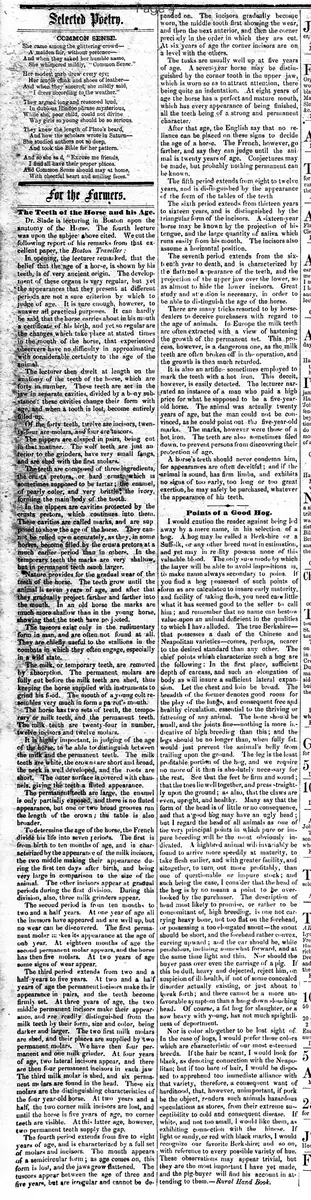
For the Farmers.
The Teeth of the Horse and his Age.
Dr. Slade is lecturing in Boston upon the anatomy of the Horse. The fourth lecture was upon the subject above cited. We cut the following report of his remarks from that excellent paper, the Boston Traveller:
In opening, the lecturer remarked, that the belief that the age of a horse, is shown by his teeth, is of very ancient origin. The development of these organs is very regular, but yet the appearances that they present at different periods are not a sure criterion by which to judge of age. It is sure enough, however, to answer at practical purposes. It can hardly be said that the horse carries about in his mouth a certificate of his birth, and yet so regular are the changes which take place at stated times in the mouth of the horse, that experienced observers have no difficulty in approximating with considerable certainty to the age of the animal.
The lecturer then dwelt at length on the anatomy of the teeth of the horse, which are forty in number. These teeth are set in the jaw in separate cavities, divided by a bony substance: these cavities change their form with age, and when a tooth is lost, become entirely filled up.
Of the forty teeth, twelve are incisors, twenty-four are molars, and four are tusks. The nippers are clasped in pairs, being cut in that manner. The wolf teeth are just anterior to the grinders, have very small fangs, and are shed with the first molars.
The teeth are composed of three ingredients, the crusta petrosa, or hard crust, which is sometimes supposed to be tartar; the enamel, of pearly color, and very brittle, the ivory, forming the main body of the tooth.
In the nippers are cavities protected by the crusta petrosa, which continues into them. These cavities are called marks, and are supposed to show the age of the horse. They cannot be relied upon accurately, as they, in some horses, become filled by the crusta petrosa at a much earlier period than in others. In the temporary teeth the marks are very shallow, but in permanent teeth much larger.
Nature provides for the gradual wear of the teeth of the horse. The teeth grow until the animal is seven years of age, and after that they gradually project farther and farther into the mouth. In an old horse the marks are much more shallow than in the young horse, showing that the teeth have projected.
The tusks exist only in the rudimentary form in man, and are often not found at all They are chiefly useful to the stallions in the combats in which they often engage, especially in a wild state.
The milk, or temporary teeth, are removed by absorption. The permanent molars are fully cut before the milk teeth are shed, thus keeping the horse supplied with instruments to grind his food. The mouth of a young colt resembles very much in form a parrot's mouth.
The horse has two sets of teeth, the temporary or milk teeth, and the permanent teeth. The milk-teeth are twenty-four in number, twelve incisors and twelve molars.
It is highly important, in judging of the age of the horse, to be able to distinguish between the milk and the permanent teeth. The milk teeth are white, the crowns are short and broad, the neck is well developed, and the roots are short. The outer surface is covered with channels, giving the teeth a fluted appearance.
The permanent teeth are large, the enamel is only partially exposed, and there is no fluted appearance, but one or two broad grooves run the length of the crown; the table is also broader.
To determine the age of the horse, the French divide his life into seven periods. The first is from birth to ten months of age, and is characterized by the appearance of the milk incisors, the two middle making their appearance during the first ten days after birth, and being very large in comparison to the size of the animal. The other incisors appear at gradual periods during the first division. During this division, also, three milk grinders appear.
The second period is from ten months to two and a half years. At one year of age all the incisors have appeared and are well up, but no wear can be discovered. The first permanent molar makes its appearance at the age of one year. At eighteen months of age the second permanent molar appears, and the horse has then five molars. At two years of age some signs of wear appear.
The third period extends from two and a half years to five years. At two and a half years of age the permanent incisors make their appearance in pairs, and the teeth become final set. At three years of age, the two middle permanent incisors make their appearance, and are readily distinguished from the milk teeth by their form, size and color, being darker and larger. The two first milk molars are shed, and their places are supplied by two permanent molars. We have then our permanent and one milk grinder. At four years of age, two lateral incisors appear, and there are then four permanent incisors in each jaw The third milk molar is shed, and six permanent molars are found in the head. These six molars are the distinguishing characteristics of the four year-old horse. At two years and a half, the two corner milk incisors are lost, and until the horse is five years of age, no corner teeth are visible. At this latter age, however, two permanent teeth supply the gap.
The fourth period extends from five to eight years of age, and is characterized by a full set of molars and incisors. The mouth appears of a semicircular form; as age comes on, this form is lost, and the jaws grow flattened. The tusks appear between the age of three and five years, but are irregular and cannot be depended on. The incisors gradually become worn, the middle tooth first showing the wear, and then the next anterior, and then the corner precisely in the order in which they are cut. At six years of age the corner incisors are on a level with the others The tusks are usually well up at five years of age. A seven-year horse may be distinguished by the corner tooth in the upper jaw, which is worn so as to attract attention, there being quite an indentation. At eight years of age the horse has a perfect and mature mouth, which has every appearance of being finished, all the teeth being of a strong and permanent character.
After that age, the English say that no reliance can be placed on these signs to decide the age of a horse. The French, however, go further, and say they can judge until the animal is twenty years of age. Conjectures may be made, but probably nothing permanent can be known.
The fifth period extends from eight to twelve years, and is distinguished by the appearance of the form of the tables of the teeth The sixth period extends from thirteen years to sixteen years, and is distinguished by the triangular form of the incisors. A sixteen-year horse may be known by the projection of his tongue, and the large quantity of saliva which runs easily from his mouth. The incisors also assume a horizontal position.
The seventh period extends from the sixteenth year to death, and is characterized by the flattened appearance of the teeth, and the projection of the upper jaw over the lower, so as to almost to hide the lower incisors. Great study and attention is necessary, in order to be able to distinguish the age of the horse.
There are many tricks resorted to by horse-dealers to deceive purchasers with regard to the age of animals. In Europe the milk teeth are often extracted with a view of hastening the growth of the permanent set. This process, however, is a dangerous one, as the milk teeth are often broken off in the operation, and the growth is then much retarded.
It is also an artifice sometimes employed to mark the teeth with a hot iron. This deceit, however, is easily detected. The lecturer narrated an instance of a man who paid a high price for what he supposed to be a five-year-old horse. The animal was actually twenty years of age, but the man could not be convinced, as he could point out the five-year-old marks. The marks, however were those of a hot iron. The teeth are also sometimes filed down, to prevent persons from discovering their protection of age.
A horse's teeth should never condemn him, for appearances are often deceitful; and if the animal is sound, has firm limbs, and exhibits no signs of too early, too long or too great exertion, he may safely be purchased, whatever the appearance of his teeth.
The Teeth of the Horse and his Age.
Dr. Slade is lecturing in Boston upon the anatomy of the Horse. The fourth lecture was upon the subject above cited. We cut the following report of his remarks from that excellent paper, the Boston Traveller:
In opening, the lecturer remarked, that the belief that the age of a horse, is shown by his teeth, is of very ancient origin. The development of these organs is very regular, but yet the appearances that they present at different periods are not a sure criterion by which to judge of age. It is sure enough, however, to answer at practical purposes. It can hardly be said that the horse carries about in his mouth a certificate of his birth, and yet so regular are the changes which take place at stated times in the mouth of the horse, that experienced observers have no difficulty in approximating with considerable certainty to the age of the animal.
The lecturer then dwelt at length on the anatomy of the teeth of the horse, which are forty in number. These teeth are set in the jaw in separate cavities, divided by a bony substance: these cavities change their form with age, and when a tooth is lost, become entirely filled up.
Of the forty teeth, twelve are incisors, twenty-four are molars, and four are tusks. The nippers are clasped in pairs, being cut in that manner. The wolf teeth are just anterior to the grinders, have very small fangs, and are shed with the first molars.
The teeth are composed of three ingredients, the crusta petrosa, or hard crust, which is sometimes supposed to be tartar; the enamel, of pearly color, and very brittle, the ivory, forming the main body of the tooth.
In the nippers are cavities protected by the crusta petrosa, which continues into them. These cavities are called marks, and are supposed to show the age of the horse. They cannot be relied upon accurately, as they, in some horses, become filled by the crusta petrosa at a much earlier period than in others. In the temporary teeth the marks are very shallow, but in permanent teeth much larger.
Nature provides for the gradual wear of the teeth of the horse. The teeth grow until the animal is seven years of age, and after that they gradually project farther and farther into the mouth. In an old horse the marks are much more shallow than in the young horse, showing that the teeth have projected.
The tusks exist only in the rudimentary form in man, and are often not found at all They are chiefly useful to the stallions in the combats in which they often engage, especially in a wild state.
The milk, or temporary teeth, are removed by absorption. The permanent molars are fully cut before the milk teeth are shed, thus keeping the horse supplied with instruments to grind his food. The mouth of a young colt resembles very much in form a parrot's mouth.
The horse has two sets of teeth, the temporary or milk teeth, and the permanent teeth. The milk-teeth are twenty-four in number, twelve incisors and twelve molars.
It is highly important, in judging of the age of the horse, to be able to distinguish between the milk and the permanent teeth. The milk teeth are white, the crowns are short and broad, the neck is well developed, and the roots are short. The outer surface is covered with channels, giving the teeth a fluted appearance.
The permanent teeth are large, the enamel is only partially exposed, and there is no fluted appearance, but one or two broad grooves run the length of the crown; the table is also broader.
To determine the age of the horse, the French divide his life into seven periods. The first is from birth to ten months of age, and is characterized by the appearance of the milk incisors, the two middle making their appearance during the first ten days after birth, and being very large in comparison to the size of the animal. The other incisors appear at gradual periods during the first division. During this division, also, three milk grinders appear.
The second period is from ten months to two and a half years. At one year of age all the incisors have appeared and are well up, but no wear can be discovered. The first permanent molar makes its appearance at the age of one year. At eighteen months of age the second permanent molar appears, and the horse has then five molars. At two years of age some signs of wear appear.
The third period extends from two and a half years to five years. At two and a half years of age the permanent incisors make their appearance in pairs, and the teeth become final set. At three years of age, the two middle permanent incisors make their appearance, and are readily distinguished from the milk teeth by their form, size and color, being darker and larger. The two first milk molars are shed, and their places are supplied by two permanent molars. We have then our permanent and one milk grinder. At four years of age, two lateral incisors appear, and there are then four permanent incisors in each jaw The third milk molar is shed, and six permanent molars are found in the head. These six molars are the distinguishing characteristics of the four year-old horse. At two years and a half, the two corner milk incisors are lost, and until the horse is five years of age, no corner teeth are visible. At this latter age, however, two permanent teeth supply the gap.
The fourth period extends from five to eight years of age, and is characterized by a full set of molars and incisors. The mouth appears of a semicircular form; as age comes on, this form is lost, and the jaws grow flattened. The tusks appear between the age of three and five years, but are irregular and cannot be depended on. The incisors gradually become worn, the middle tooth first showing the wear, and then the next anterior, and then the corner precisely in the order in which they are cut. At six years of age the corner incisors are on a level with the others The tusks are usually well up at five years of age. A seven-year horse may be distinguished by the corner tooth in the upper jaw, which is worn so as to attract attention, there being quite an indentation. At eight years of age the horse has a perfect and mature mouth, which has every appearance of being finished, all the teeth being of a strong and permanent character.
After that age, the English say that no reliance can be placed on these signs to decide the age of a horse. The French, however, go further, and say they can judge until the animal is twenty years of age. Conjectures may be made, but probably nothing permanent can be known.
The fifth period extends from eight to twelve years, and is distinguished by the appearance of the form of the tables of the teeth The sixth period extends from thirteen years to sixteen years, and is distinguished by the triangular form of the incisors. A sixteen-year horse may be known by the projection of his tongue, and the large quantity of saliva which runs easily from his mouth. The incisors also assume a horizontal position.
The seventh period extends from the sixteenth year to death, and is characterized by the flattened appearance of the teeth, and the projection of the upper jaw over the lower, so as to almost to hide the lower incisors. Great study and attention is necessary, in order to be able to distinguish the age of the horse.
There are many tricks resorted to by horse-dealers to deceive purchasers with regard to the age of animals. In Europe the milk teeth are often extracted with a view of hastening the growth of the permanent set. This process, however, is a dangerous one, as the milk teeth are often broken off in the operation, and the growth is then much retarded.
It is also an artifice sometimes employed to mark the teeth with a hot iron. This deceit, however, is easily detected. The lecturer narrated an instance of a man who paid a high price for what he supposed to be a five-year-old horse. The animal was actually twenty years of age, but the man could not be convinced, as he could point out the five-year-old marks. The marks, however were those of a hot iron. The teeth are also sometimes filed down, to prevent persons from discovering their protection of age.
A horse's teeth should never condemn him, for appearances are often deceitful; and if the animal is sound, has firm limbs, and exhibits no signs of too early, too long or too great exertion, he may safely be purchased, whatever the appearance of his teeth.
What sub-type of article is it?
Curiosity
Animal Story
Medical Curiosity
What themes does it cover?
Deception
Moral Virtue
What keywords are associated?
Horse Teeth
Age Determination
Anatomy Lecture
Deceptive Practices
Milk Teeth
Permanent Teeth
Horse Age Periods
What entities or persons were involved?
Dr. Slade
Where did it happen?
Boston
Story Details
Key Persons
Dr. Slade
Location
Boston
Story Details
Dr. Slade lectures on horse teeth anatomy and age determination through seven periods of development, distinguishing milk and permanent teeth, wear patterns, and warns of deceptive practices like extracting milk teeth or using hot irons to fake age.