Thank you for visiting SNEWPapers!
Sign up free
Editorial
April 5, 1853
The Sumter Banner
Sumter, Sumter County, South Carolina
What is this article about?
The New York Mirror responds to a letter from advertiser T.S. Berry, an abolitionist, by reaffirming that abolitionists cannot be gentlemen. It defines abolitionism as treasonous and disruptive, criticizing figures like Frederick Douglass and Horace Greeley for slandering national heroes.
Clipping
OCR Quality
95%
Excellent
Full Text
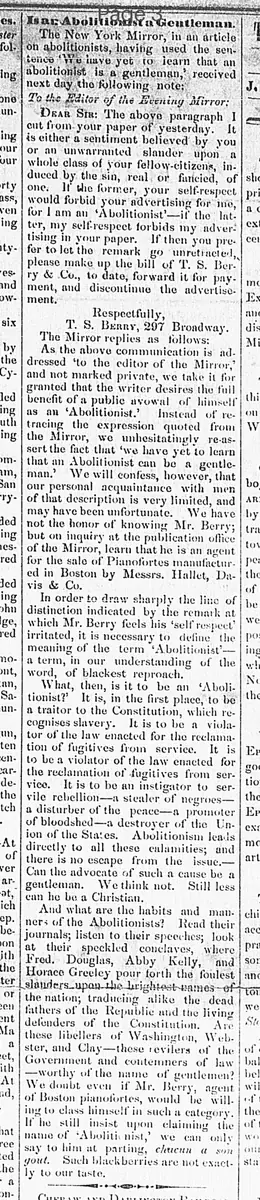
An Abolitionist a Gentleman.
The New York Mirror, in an article on abolitionists, having used the sentence "We have yet to learn that an abolitionist is a gentleman," received next day the following note.
To the Editor of the Evening Mirror:
Dear Sir: The above paragraph I cut from your paper of yesterday. It is either a sentiment believed by you or an unwarranted slander upon a whole class of your fellow-citizens, induced by the sin, real or fancied, of one. If the former, your self-respect would forbid your advertising for me, for I am an Abolitionist'—if the latter, my self-respect forbids my advertising in your paper. If then you prefer to let the remark go unretracted, please make up the bill of T. S. Berry & Co., to date, forward it for payment, and discontinue the advertisement.
Respectfully,
T. S. BERRY, 297 Broadway.
The Mirror replies as follows:
As the above communication is addressed to the editor of the Mirror, and not marked private, we take it for granted that the writer desires the full benefit of a public avowal of himself as an 'Abolitionist.' Instead of retracting the expression quoted from the Mirror, we unhesitatingly re-assert the fact that 'we have yet to learn that an Abolitionist can be a gentleman.' We will confess, however, that our personal acquaintance with men of that description is very limited, and may have been unfortunate. We have not the honor of knowing Mr. Berry; but on inquiry at the publication office of the Mirror, learn that he is an agent for the sale of Pianofortes manufactured in Boston by Messrs. Hallet, Davis & Co.
In order to draw sharply the line of distinction indicated by the remark at which Mr. Berry feels his 'self respect irritated, it is necessary to define the meaning of the term Abolitionist'—a term, in our understanding of the word, of blackest reproach.
What, then, is it to be an Abolitionist? It is, in the first place, to be a traitor to the Constitution, which recognizes slavery. It is to be a violator of the law enacted for the reclamation of fugitives from service. It is to be a violator of the law enacted for the reclamation of fugitives from service. It is to be an instigator to servile rebellion—a stealer of negroes—a disturber of the peace—a promoter of bloodshed—a destroyer of the Union of the States. Abolitionism leads directly to all these calamities; and there is no escape from the issue.
Can the advocate of such a cause be a gentleman? We think not. Still less can he be a Christian.
And what are the habits and manners of the Abolitionists? Read their journals: listen to their speeches: look at their speckled conclaves, where Fred. Douglass, Abby Kelly, and Horace Greeley pour forth the foulest slanders upon the brightest names of the nation; traducing alike the dead fathers of the Republic and the living defenders of the Constitution. Are these libellers of Washington, Webster, and Clay—these revilers of the Government and contemners of law—worthy of the name of gentlemen?
We doubt even if Mr. Berry, agent of Boston pianofortes, would be willing to class himself in such a category. If he still insist upon claiming the name of 'Abolitionist,' we can only say to him at parting, chacun a son gout. Such black berries are not exactly to our taste.
The New York Mirror, in an article on abolitionists, having used the sentence "We have yet to learn that an abolitionist is a gentleman," received next day the following note.
To the Editor of the Evening Mirror:
Dear Sir: The above paragraph I cut from your paper of yesterday. It is either a sentiment believed by you or an unwarranted slander upon a whole class of your fellow-citizens, induced by the sin, real or fancied, of one. If the former, your self-respect would forbid your advertising for me, for I am an Abolitionist'—if the latter, my self-respect forbids my advertising in your paper. If then you prefer to let the remark go unretracted, please make up the bill of T. S. Berry & Co., to date, forward it for payment, and discontinue the advertisement.
Respectfully,
T. S. BERRY, 297 Broadway.
The Mirror replies as follows:
As the above communication is addressed to the editor of the Mirror, and not marked private, we take it for granted that the writer desires the full benefit of a public avowal of himself as an 'Abolitionist.' Instead of retracting the expression quoted from the Mirror, we unhesitatingly re-assert the fact that 'we have yet to learn that an Abolitionist can be a gentleman.' We will confess, however, that our personal acquaintance with men of that description is very limited, and may have been unfortunate. We have not the honor of knowing Mr. Berry; but on inquiry at the publication office of the Mirror, learn that he is an agent for the sale of Pianofortes manufactured in Boston by Messrs. Hallet, Davis & Co.
In order to draw sharply the line of distinction indicated by the remark at which Mr. Berry feels his 'self respect irritated, it is necessary to define the meaning of the term Abolitionist'—a term, in our understanding of the word, of blackest reproach.
What, then, is it to be an Abolitionist? It is, in the first place, to be a traitor to the Constitution, which recognizes slavery. It is to be a violator of the law enacted for the reclamation of fugitives from service. It is to be a violator of the law enacted for the reclamation of fugitives from service. It is to be an instigator to servile rebellion—a stealer of negroes—a disturber of the peace—a promoter of bloodshed—a destroyer of the Union of the States. Abolitionism leads directly to all these calamities; and there is no escape from the issue.
Can the advocate of such a cause be a gentleman? We think not. Still less can he be a Christian.
And what are the habits and manners of the Abolitionists? Read their journals: listen to their speeches: look at their speckled conclaves, where Fred. Douglass, Abby Kelly, and Horace Greeley pour forth the foulest slanders upon the brightest names of the nation; traducing alike the dead fathers of the Republic and the living defenders of the Constitution. Are these libellers of Washington, Webster, and Clay—these revilers of the Government and contemners of law—worthy of the name of gentlemen?
We doubt even if Mr. Berry, agent of Boston pianofortes, would be willing to class himself in such a category. If he still insist upon claiming the name of 'Abolitionist,' we can only say to him at parting, chacun a son gout. Such black berries are not exactly to our taste.
What sub-type of article is it?
Slavery Abolition
Moral Or Religious
Partisan Politics
What keywords are associated?
Abolitionist
Gentleman
Slavery
Constitution
Fugitive Slaves
Union
Slander
New York Mirror
What entities or persons were involved?
T. S. Berry
New York Mirror
Fred. Douglass
Abby Kelly
Horace Greeley
Washington
Webster
Clay
Hallet, Davis & Co.
Editorial Details
Primary Topic
Abolitionists Cannot Be Gentlemen
Stance / Tone
Strongly Anti Abolitionist And Derogatory
Key Figures
T. S. Berry
New York Mirror
Fred. Douglass
Abby Kelly
Horace Greeley
Washington
Webster
Clay
Hallet, Davis & Co.
Key Arguments
Abolitionist Is A Traitor To The Constitution Which Recognizes Slavery.
Abolitionist Violates Laws For Reclaiming Fugitive Slaves.
Abolitionism Instigates Servile Rebellion, Steals Negroes, Disturbs Peace, Promotes Bloodshed, Destroys The Union.
Advocates Of Abolitionism Cannot Be Gentlemen Or Christians.
Abolitionists Slander National Figures Like Washington, Webster, And Clay In Their Journals, Speeches, And Meetings.