Thank you for visiting SNEWPapers!
Sign up free
The Evening Telegraph
Philadelphia, Philadelphia County, Pennsylvania
What is this article about?
Rev. Dr. Bellows recounts General Sherman's moral courage in San Francisco during the Vigilance Committee era. As chief marshal at a crowded July 4th theater event, he learned the building was settling and at risk of collapse but maintained calm to prevent panic, allowing safe dispersal and averting disaster.
Clipping
OCR Quality
Full Text
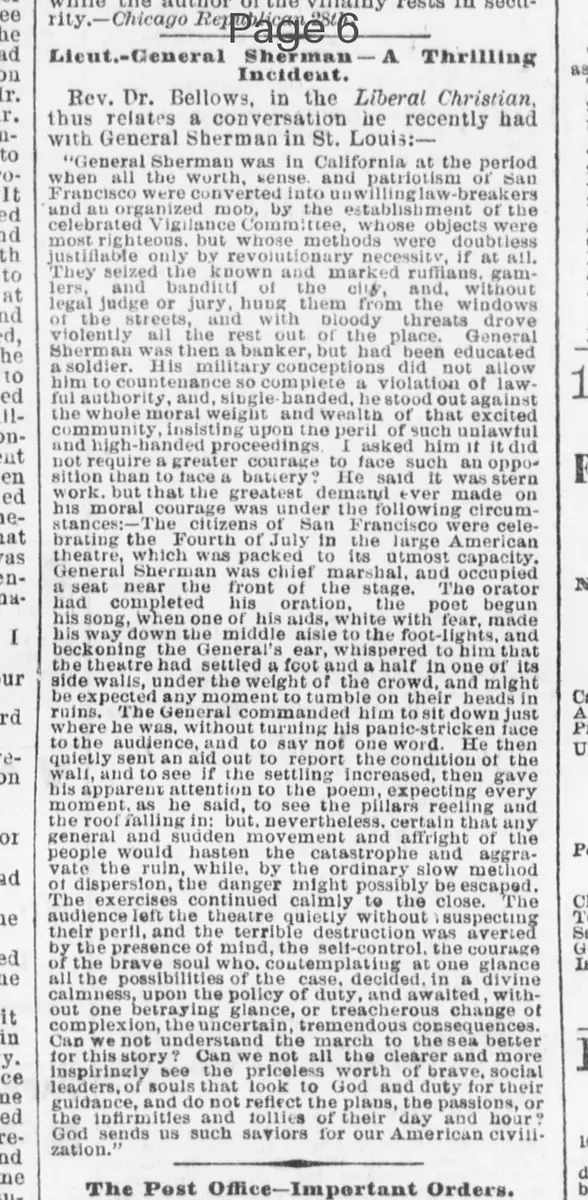
Rev. Dr. Bellows, in the Liberal Christian, thus relates a conversation he recently had with General Sherman in St. Louis:--
"General Sherman was in California at the period when all the worth, sense and patriotism of San Francisco were converted into unwilling law-breakers and an organized mob, by the establishment of the celebrated Vigilance Committee, whose objects were most righteous, but whose methods were doubtless justifiable only by revolutionary necessity, if at all. They seized the known and marked ruffians, gamblers, and bandits of the city, and, without legal judge or jury, hung them from the windows of the streets, and with bloody threats drove violently all the rest out of the place. General Sherman was then a banker, but had been educated a soldier. His military conceptions did not allow him to countenance so complete a violation of lawful authority, and, single handed, he stood out against the whole moral weight and wealth of that excited community, insisting upon the peril of such unlawful and high-handed proceedings. I asked him if it did not require a greater courage to face such an opposition than to face a battery? He said it was stern work, but that the greatest demand ever made on his moral courage was under the following circumstances:--The citizens of San Francisco were celebrating the Fourth of July in the large American theatre, which was packed to its utmost capacity. General Sherman was chief marshal, and occupied a seat near the front of the stage. The orator had completed his oration, the poet begun his song, when one of his aids, white with fear, made his way down the middle aisle to the foot-lights, and beckoning the General's ear, whispered to him that the theatre had settled a foot and a half in one of its side walls, under the weight of the crowd, and might be expected any moment to tumble on their heads in ruins. The General commanded him to sit down just where he was, without turning his panic-stricken face to the audience, and to say not one word. He then quietly sent an aid out to report the condition of the wall, and to see if the settling increased, then gave his apparent attention to the poem, expecting every moment, as he said, to see the pillars reeling and the roof falling in; but, nevertheless, certain that any general and sudden movement and affright of the people would hasten the catastrophe and aggravate the ruin, while, by the ordinary slow method of dispersion, the danger might possibly be escaped. The exercises continued calmly to the close. The audience left the theatre quietly without suspecting their peril, and the terrible destruction was averted by the presence of mind, the self-control, the courage of the brave soul who, contemplating at one glance all the possibilities of the case, decided, in a divine calmness, upon the policy of duty, and awaited, without one betraying glance, or treacherous change of complexion, the uncertain, tremendous consequences.
Can we not understand the march to the sea better for this story? Can we not all the clearer and more inspiringly see the priceless worth of brave, social leaders, of souls that look to God and duty for their guidance, and do not reflect the plans, the passions, or the infirmities and follies of their day and hour? God sends us such saviors for our American civilization."
What sub-type of article is it?
What themes does it cover?
What keywords are associated?
What entities or persons were involved?
Where did it happen?
Story Details
Key Persons
Location
San Francisco, American Theatre
Event Date
Fourth Of July, During The Vigilance Committee Period
Story Details
General Sherman, chief marshal at a packed July 4th theater in San Francisco, learns from an aid that the building is settling and risks collapse but instructs silence to avoid panic, monitors the situation calmly, and ensures the audience disperses orderly, averting disaster through self-control and presence of mind.