Thank you for visiting SNEWPapers!
Sign up free
Constitutional Whig
Richmond, Virginia
What is this article about?
Detailed proceedings of the Virginia House of Delegates from December 23 to 28, 1825, covering reports, resolutions on military lands and audits, election contests, petitions on tolls and livestock, bills on courts, pensions, divorces, and debates on adjournments and committee referrals.
Clipping
OCR Quality
Full Text
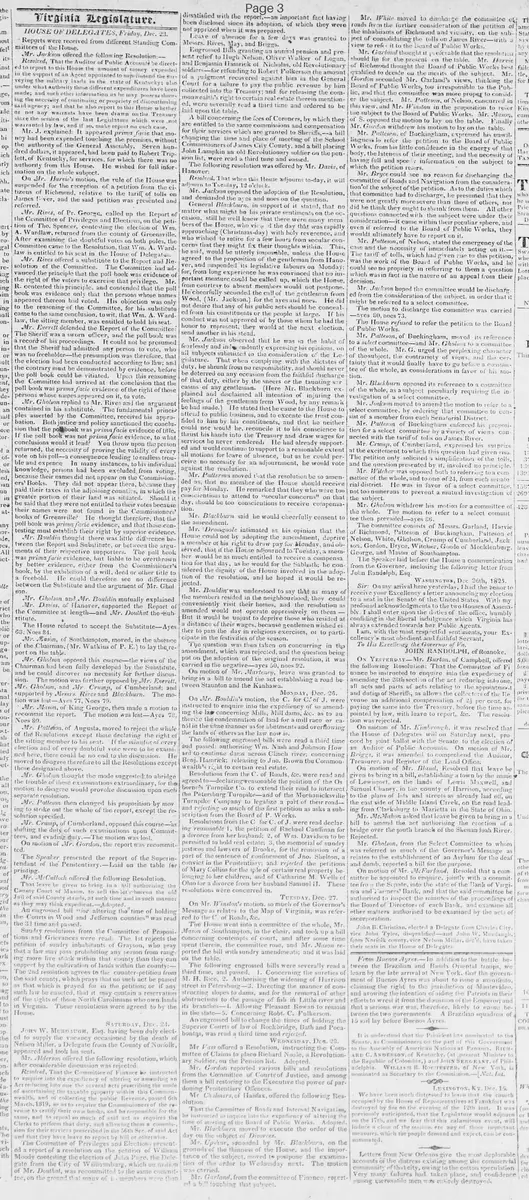
HOUSE OF DELEGATES, Friday, Dec. 23.
Reports were received from different Standing Committees of the House.
Mr. Jackson offered the following Resolution:--
Resolved, That the Auditor of Public Accounts be directed to report to this House the amount of money expended in the support of an Agent appointed to superintend the surveying the military lands in the state of Kentucky: also under what authority those different expenditures have been made; and such other information as he may possess showing the necessity of continuing or propriety of discontinuing said agency; and that he also report to this House whether or not any warrants have been drawn on the Treasury since the session of the last Legislature which were not warranted by law, and if so, make report on each case.
Mr. J. explained: It appeared prima facie that money had been expended touching the premises, without the authority of the General Assembly. Seven hundred dollars, it appeared, had been paid to Robert Triplett, of Kentucky, for services, for which there was no authority from this House. He wished for full information on the whole subject.
On Mr. Harvie's motion, the rule of the House was suspended for the reception of a petition from the citizens of Richmond, relative to the tariff of tolls on James river, and the said petition was presented and referred.
Mr. Rives, of Pr. George, called up the Report of the Committee of Privileges and Elections, on the petition of Tho. Spencer, contesting the election of Wm. A. Wardlaw, returned from the county of Greensville.
After examining the doubtful votes on both polls, the Committee came to the Resolution, that Wm. A. Wardlaw is entitled to his seat in the House of Delegates.
Mr. Rives offered a substitute to the Report and Resolution of the Committee. The Committee had advanced the principle that the poll book was evidence of the right of the voters to exercise that privilege. Mr. R. contested this principle, and contended that the poll book was evidence only that the persons whose names appeared thereon had voted. His objection was only to the reasoning of the Committee, for his substitute came to the same conclusion, towit, that Wm. A. Wardlaw, the sitting member, was entitled to hold his seat.
Mr. Everett defended the Report of the Committee: The Sheriff was a sworn officer, and the poll book was a record of his proceedings. It could not be presumed that the Sheriff had admitted any person to vote, who was no freeholder--the presumption was therefore, that the election had been conducted according to law: and the contrary must be demonstrated by evidence, before the poll book could be vitiated. Upon this reasoning the Committee had arrived at the conclusion that the poll book was prima facie evidence of the right of those persons whose names appeared on it, to vote.
Mr. Gholson replied to Mr. Rives and the argument contained in his substitute. The fundamental principles asserted by the Committee, received his approbation. Both justice and policy sanctioned the conclusion that the poll book was prima facie evidence of title. If the poll book was not prima facie evidence, to what conclusions would it lead? You throw upon the person returned, the necessity of proving the validity of every vote on his poll--a consequence leading to endless trouble and expense. In many instances, to his individual knowledge, persons had been excluded from voting, because their names did not appear on the Commissioners' Books. They did not appear there, because they paid their taxes in the adjoining counties, in which the greater portion of their land was situated. Should it be said that they were not entitled to their votes because their names were not found in the Commissioners books of Greensville? He thought therefore, that the poll book was prima facie evidence, and that those contesting must establish their right by superior evidence.
Mr. Bouldin thought there was little difference between the Report and Substitute, or between the arguments of their respective supporters. The poll book was prima facie evidence, but liable to be overthrown by better evidence, either from the Commissioner's book, by the exhibition of a will, deed or other title to a freehold. He could therefore see no difference between the Substitute and the argument of Mr. Gholson.
Mr. Gholson and Mr. Bouldin mutually explained.
Mr. Davis, of Hanover, supported the Report of the Committee at length--and Mr. Douthat the Substitute.
The House refused to accept the Substitute--Ayes 63, Noes 84.
Mr. Mason, of Southampton, moved, in the absence of the Chairman, (Mr. Watkins of P. E.) to lay the report on the table.
Mr. Gholson opposed this course--the views of the Chairman had been fully developed by the Substitute, and he could discover no necessity for farther discussion. The motion was further opposed by Mr. Everett, Mr. Gholson, and Mr Crump, of Cumberland; and supported by Messrs. Rives and Blackburn. The motion was lost--Ayes 77, Noes 79.
Mr. Mason, of King George, then made a motion to recommit the report. The motion was lost--Ayes 78, Noes 80.
Mr. Patteson, of Augusta, moved to reject the whole of the Resolutions except those declaring the right of the sitting member to his seat. If the minutiae of every election and of every doubtful vote were to be examined here, there could be no end to the discussion. He moved to disagree therefore to all the Resolutions except those designated above.
Mr. Gholson thought the mode suggested to abridge the trouble of these examinations extraordinary, for the motion to disagree would provoke discussion upon each separate resolution.
Mr. Patteson then changed his proposition by moving to strike out the whole of the report, except the resolution specified.
Mr. Crump, of Cumberland, opposed this course--as shifting the duty of such examinations upon Committees, and evading duty.--The motion was lost.
On motion of Mr. Gordon, the report was recommitted.
The Speaker presented the report of the Superintendent of the Penitentiary.--Laid on the table for printing.
Mr. McCulloch offered the following Resolution.
That leave be given to bring in a bill authorising the County Court of Mason, to sell the lot whereon the old Jail of said County stands, at such time and in such manner as they may think expedient.--Adopted.
An engrossed bill "for altering the time of holding the Courts in Wood and Jefferson counties" was read the 3d time and passed.
Sundry resolutions from the Committee of Propositions-and Grievances were read: The 1st rejects the petition of sundry inhabitants of Grayson, who pray that a law may pass prohibiting any person from ranging more live stock within that county than they can support by the cultivation of lands within the county:— The 2nd resolution agrees to the counter-petition from the said county, which prays that no such act be passed as that which is prayed for in the petition; or if any such law be enacted, that it may contain a reservation of the rights of those North Carolinians who own lands in Virginia. These resolutions were agreed to by the House.
SATURDAY, Dec. 24.
John W. Murdaugh, Esq. having been duly elected to supply the vacancy occasioned by the death of Nelson Miller, a Delegate from the County of Norfolk, appeared and took his seat.
Mr. Alderson offered the following resolution, which after considerable discussion was rejected
Resolved, That the Committee of Finance be instructed to enquire into the expediency of altering or amending an Act reducing into one the several acts prescribing the mode of ascertaining the taxable property within this Commonwealth, and of collecting the public Revenue, passed 6th March, 1819, so as to require the Commissioners of the revenue to certify their own books, and be responsible for the same, and to repeal so much of said act as requires the Clerks to perform that duty, and allowing them a commission for their services prescribed in the 16th Sec. of said Act and that they have leave to report by bill or otherwise.
The Committee of Privileges and Election presented a report of a resolution on the petition of William Moody contesting the election of John Page, the Delegate from the City of Williamsburg, which on motion of Mr. Douthat, was recommitted to the same committee, on the ground that many of its members were then dissatisfied with the report,--an important fact having been disclosed since its adoption. of which they were not apprized when it was prepared.
Leave of absence for a few days was granted to Messrs. Rives, May, and Briggs.
Engrossed Bills granting an annual pension and present relief to Hugh Nelson, Oliver Walker of Logan, and Benjamin Hamrick of Nicholas, old Revolutionary soldiers—for refunding to Robert Fulkerson the amount of a judgment recovered against him in the General Court for a failure to pay the public revenue by him collected into the Treasury: and for releasing the commonwealth's right to certain real estate therein mentioned. were severally read a third time and ordered to be laid upon the table.
A bill concerning the fees of Coroners, by which they are entitled to the same commissions and compensation for their services which are granted to Sheriffs,--a bill changing the time and place of meeting of the School Commissioners of James City County, and a bill placing John Lampkin an old Revolutionary soldier on the pension list, were read a third time and passed.
The following resolution was offered by Mr. Davis, of Hanover:
Resolved, That when this House adjourns to-day, it will adjourn to Tuesday, 12 o'clock.
Mr. Jackson opposed the adoption of the Resolution, and demanded the ayes and noes on the question.
General Blackburn, in support of it stated, that no matter what might be his private sentiments on the occasion, still he well knew that there were many members of the House, who viewed the day that was rapidly approaching (Christmas-day) with holy reverence, and who wished to retire for a few hours from secular concerns that they might fix their thoughts within. This, he said, would be utterly impossible, unless the House agreed to the proposition of the gentleman from Hanover, and suspended its legislative labours on Monday: for, from long experience he was convinced that no important measure could be called up, which the House, from courtesy to absent members would not postpone. He cheerfully seconded the call of the gentleman from Wood, (Mr. Jackson,) for the ayes and noes. He did not desire that any of his public acts should be concealed from his constituents or the people at large. If his conduct was not approved of by those whom he had the honor to represent, they would at the next election, send another in his stead.
Mr. Jackson observed that he was in the habit of fearlessly and independently expressing his opinions, on all subjects submitted to the consideration of the Legislature. That when complying with the dictates of duty, he shrunk from no responsibility, and should never be deterred on any occasion from the faithful discharge of that duty, either by the sneers or the taunting sarcasm of any gentleman. (Here Mr. Blackburn explained and disclaimed all intention of injuring the feelings of the gentleman from Wood, by any remark he had made.) He stated that he came to the House to attend to public business, and to execute the trust confided to him by his constituents, and that he neither could nor would he, reconcile it to his conscience to thrust his hands into the Treasury and draw wages for services he never rendered: He had already supported and would continue to support to a reasonable extent all motions for leave of absence, but as he could perceive no necessity for an adjournment, he would vote against the resolution.
Mr. Patteson moved that the resolution be so amended as, that no member of the House should receive pay for Monday. He remarked that they who were too conscientious to attend to "secular concerns" on that day, should be too conscientious to receive compensation.
Mr. Blackburn said he would cheerfully consent to the amendment.
Mr. Dromgoole intimated as his opinion that the House could not by adopting the amendment, deprive a member of his right to draw pay for Monday, and observed, that if the House adjourned to Tuesday, a member would be as much entitled to receive a compensation for that day, as he would for the Sabbath; he considered the dignity of the House involved in the adoption of the resolution, and he hoped it would be rejected.
Mr. Bouldin was understood to say that as many of the members resided in the neighbourhood, they could conveniently visit their homes, and the resolution as amended would not operate oppressively on them — But it would be unjust to deprive those who resided at a distance of their wages, because gentlemen wished either to pass the day in religious exercises, or to participate in the festivities of the season.
The question was then taken on concurring in the amendment, which was rejected, and the question being put on the adoption of the original resolution, it was carried in the negative--ayes 50, noes 92.
On motion of Mr. Marteney, leave was granted to bring in a bill to amend the act establishing a road between Staunton and the Kanawha.
Monday, Dec. 26.
On Mr. Bouldin's motion, the C. for C. of J. were instructed to enquire into the expediency of so amending the law concerning Mills, Mill dams, &c. as to authorize the condemnation of land for a mill race or canal in the same manner as for abutments and overflowing the lands of others as the law now is.
The following engrossed bills were read a third time and passed: authorising Wm. Nash and Johnson Howard to continue dams across Clinch river; concerning Benj. Hamrick; releasing to Jno. Brown the Commonwealth's right to certain real estate.
Resolutions from the C. of Roads, &c. were read and agreed to--declaring reasonable the petition of the Osbornes Turnpike Co. to extend their road to intersect the Petersburg Turnpike--and of the Mechanicksville Turnpike company to legalize a part of their road-- and rejecting so much of the first petition as asks a subscription from the Board of P. Works.
Resolutions from the C for C. of J. were read declaring reasonable 1, the petition of Rachael Caufinan for a divorce from her husband; 2, of Wm. Davidson to be permitted to hold real estate; 3, the memorial of sundry justices and lawyers of Brooke, for the remission of a part of the sentence of confinement of Jno. Shelton, a convict in the Penitentiary; and rejected the petitions of Mary Collins for the sale of certain real property belonging to her children, and of Catharine M. Wells of Ohio for a divorce from her husband Samuel H. These resolutions were concurred in.
Tuesday, Dec. 27.
On Mr. Winston's motion, so much of the Governor's Message as relates to the Map of Virginia, was referred to the C. of Roads, &c.
The House went into a committee of the whole, Mr. Mason of Southampton, in the chair, and took up a bill concerning contempts of court, and after some time spent therein, the committee rose, and Mr. Mason reported the bill with sundry amendments; and it was laid on the table.
The following engrossed bills were severally read a third time, and passed. 1. Concerning the sureties of M. H. Rice, 2. "Authorising the widening of Harrison street in Petersburg-3. Directing the manner of constructing slopes to dams, and for the removal of other obstructions to the passage of fish in Little river and its branches-4. Allowing Pleasant Rowan to remain in the state-5. Concerning Robt. C. Fulkerson.
An engrossed bill to change the times of holding the Superior Courts of law of Rock bridge, Bath and Pocahontas, was read a third time and rejected.
Wednesday, Dec. 28.
Mr Vass offered a Resolution, instructing the Committee of Claims to place Richard Noale, a Revolutionary Soldier, on the Pension list. Adopted.
Mr. Gordon reported various bills and resolutions from the Committee of Courts of Justice, and among them a bill restoring to the Executive the power of pardoning Penitentiary Offences.
Mr Chalmers, of Halifax, offered the following Resolution:
That the Committee of Roads and Internal Navigation, be instructed to inquire into the expediency of altering the time of meeting of the Board of Public Works. Adopted.
Mr. Blackburn moved to execute the order of the day on the subject of Divorces.
Mr. Upshur, seconded by Mr. Blackburn, on the grounds of the thinness of the House, and the importance of the subject, moved to postpone the examination of the order to Wednesday next. The motion was carried.
Mr. Garland, from the committee of Finance, reported a bill touching that subject.
Mr. White moved to discharge the committee of roads from the further consideration of the petition of the inhabitants of Richmond and vicinity, on the subject of consolidating the tolls on James River--with a view to refer it to the Board of Public Works.
Mr. Garland thought it preferable that the resolution should lie for the present on the table. Mr. Harvie of Richmond thought the Board of Public Works best qualified to decide on the merits of the subject. Mr. Gordon seconded Mr. Garland's views, thinking the Board of Public Works, too irresponsible to the Public, and that the committee was more proper to consider the subject. Mr. Patteson, of Nelson, concurred in this view, and Mr. Winston in the proposition to refer the subject to the Board of Public Works. Mr. Mason, of S. opposed the motion to lay on the table. Finally Mr. Gordon withdrew his motion to lay on the table.
Mr. Patteson, of Buckingham, expressed his unwillingness to refer the petition to the Board of Public Works, from his little confidence in the energy of that body, the lateness of their meeting, and the necessity of having full and specific information on the subject to which the petition refers.
Mr. Bryce could see no reason for discharging the committee of Roads and Navigation from the consideration of the subject of the petition. As to the duties which that committee had to discharge, he presumed that they were not greatly more severe than those of others, nor did he think they ought to shrink from them. All other questions connected with the subject were under their consideration--it came within their peculiar sphere, and even if referred to the Board of Public Works, they would ultimately have to report on it.
Mr. Patteson, of Nelson, stated the emergency of the case and the necessity of immediately acting on it.-- The tariff of tolls, which had given rise to this petition, was the work of the Board of Public Works, and he could see no propriety in referring to them a question which was in fact in the nature of an appeal from their decision.
Mr. Jackson hoped the committee would be discharged from the consideration of the subject, in order that it might be referred to a select committee.
The motion to discharge the committee was carried --ayes 80, noes 73.
The House refused to refer the petition to the Board of Public Works.
Mr. Patteson, of Buckingham, moved its reference to a select committee--and Mr. Gholson to a committee of the whole. Mr. G. urged the perplexing character of the subject, the contrariety of views, and the certainty that it would finally have to go before a committee of the whole, as considerations in favor of his motion.
Mr. Blackburn opposed its reference to a committee of the whole, as a subject peculiarly requiring the investigation of a select committee.
Mr. Jackson moved to amend the motion to refer to a select committee, by ordering that committee to consist of a member from each Senatorial District.
Mr. Patteson of Buckingham enforced his proposition for a select committee by a variety of views connected with the tariff of tolls on James River.
Mr. Crump, of Cumberland, expressed his surprise at the excitement to which this question had given rise The petition only solicited a simplification of the tolls, and the question presented by it, involved no principle.
Mr. Witcher was opposed both to referring to a committee of the whole, and to one of 24, from each senatorial district. He was in favor of a select committee, not too numerous to prevent a mutual investigation of the subject.
Mr. Gholson withdrew his motion for a committee of the whole. The motion to refer to a select committee then prevailed--ayes 86.
The Committee consists of Messrs. Garland, Harvie of Richmond, Patteson of Buckingham, Patteson of Nelson, White, Gholson, Crump of Cumberland, Jackson, Gordon, Bryce, Witcher, Goode of Mecklenburg, George, and Mason of Southampton.
The Speaker laid before the House a communication from the Governor, inclosing the following letter from John Randolph, Esq
WASHINGTON, Dec 26th, 1825.
Sir: On my arrival here yesterday, I had the honor to receive your Excellency's letter announcing my election to a seat in the Senate of the United States With my profound acknowledgments to the two Houses of Assembly. I shall enter upon the duties of the office, humbly confiding in the liberal indulgence which Virginia has always extended towards her Public Agents.
I am, with the most respectful sentiments, your Excellency's most obedient and faithful Servant,
To His Excellency the Governor of Va.
JOHN RANDOLPH, of Roanoke.
On Yesterday--Mr. Burton, of Campbell, offered the following Resolution: That the Committee of Finance be instructed to enquire into the expediency of amending the 28th section of the act reducing into one, all acts and parts of acts relating to the appointment and duties of Sheriffs, as allows the collectors of the Revenue an additional compensation of 2 per cent. for paying the same into the Treasury, before the time appointed by law, with leave to report, &c. The resolution was rejected.
On motion of Mr. Kinbrough, it was resolved that the House of Delegates will on Saturday next, proceed by joint ballot with the Senate to the election of an Auditor of Public Accounts. On motion of Mr. Briggs, it was amended to comprehend the Auditor, Treasurer, and Register of the Land Office.
On motion of Mr. Bland, Resolved that leave be given to bring in a bill, establishing a town by the name of Lewisport, on the lands of Lewis Maxwell, and Samuel Chaney, in the county of Harrison, according to the plans of lots and streets as already laid off, on the east side of Middle Island Creek, on the road leading from Clarksburg to Marietta in the State of Ohio.
Mr. McMahon asked that leave be given to bring in a bill to amend the act authorising the erection of a bridge over the south branch of the Shenandoah River. Rejected.
Mr. Gholson, from the Select Committee to whom was referred so much of the Governor's Message as relates to the establishment of an Asylum for the deaf and dumb, reported a bill for the purpose.
On motion of Mr. McFarland, Resolved that a committee be appointed to enquire, jointly with a committee from the Senate, into the state of the Bank of Virginia and Farmers' Bank, and that the said committee be authorised to inspect the minutes of the proceedings of the Board of Directors of each Bank, and examine all other matters authorised to be examined by the act, of incorporation.
John B. Christian, elected a Delegate from Charles City. vice John Tyler, disqualified--and John W. Murdaugh, from Norfolk county, vice Nelson Miller, dec'd, have taken their seats in the House of Delegates.
What sub-type of article is it?
What keywords are associated?
What entities or persons were involved?
Where did it happen?
Domestic News Details
Primary Location
Virginia
Event Date
Friday, Dec. 23 To Wednesday, Dec. 28, 1825
Key Persons
Outcome
various resolutions adopted or rejected; bills passed or recommitted; election contests resolved in favor of sitting members; petitions referred to committees; new delegates seated; adjournment resolution defeated.
Event Details
The Virginia House of Delegates conducted sessions involving committee reports, resolutions on audits of military land surveys in Kentucky and unauthorized treasury warrants, petition from Richmond citizens on James River tolls referred, debate and recommitment of election contest report affirming Wm. A. Wardlaw's seat, Superintendent of Penitentiary report tabled, bill authorizing sale of old jail lot in Mason County adopted, court time alteration bill for Wood and Jefferson counties passed, resolutions on Grayson County livestock petitions agreed, new delegate John W. Murdaugh seated, finance resolution on revenue collection rejected, election contest report on John Page recommitted, leaves of absence granted, pension and relief bills for Revolutionary soldiers tabled or passed, coroner fees bill passed, school commissioners meeting change bill passed, adjournment to Tuesday resolution defeated after debate on Christmas observance and pay, bill to amend Staunton-Kanawha road leave granted, instructions on mill law amendments, various bills on dams, estates, turnpikes passed or agreed, divorce and other petitions resolved, Governor's message on Virginia map referred, committee of whole on contempts bill with amendments tabled, multiple bills on sureties, streets, dams, fish passages, state residency, and court times passed or rejected, resolution for Richard Noale pension adopted, bills on pardons and finance reported, resolution on Board of Public Works meeting time adopted, divorces postponed, petition on James River tolls discharged from committee and referred to select committee, Governor's communication with John Randolph's acceptance of U.S. Senate election, resolution on sheriff compensation rejected, joint ballot for state officers resolved, bill for Lewisport town leave given, bridge amendment bill rejected, asylum for deaf and dumb bill reported, joint committee on banks resolved, new delegates John B. Christian and John W. Murdaugh seated.