Thank you for visiting SNEWPapers!
Sign up free
Henderson Daily Dispatch
Henderson, Vance County, North Carolina
What is this article about?
North Carolina contributes raw materials, equipment like line shafting and ladders, and hull construction via one shipyard to the U.S. Maritime Commission's expanded Victory Ship Program, a nationwide WWII effort directed by President Roosevelt to produce thousands of ships rapidly.
Clipping
OCR Quality
Full Text
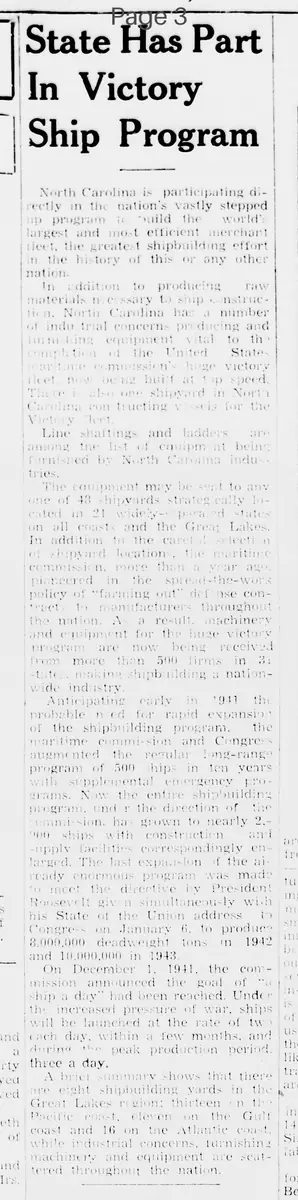
In Victory
Ship Program
North Carolina is participating directly in the nation's vastly stepped up program while the world's largest and most efficient merchant fleet, the greatest shipbuilding effort in the history of this or any other nation.
In addition to producing raw materials necessary to ship construction, North Carolina has number of industrial concerns producing and finishing equipment vital to the completion of the United States Maritime Commission's huge Victory fleet now being built at great speed.
There is also one shipyard in North Carolina constructing hulls for the Victory fleet.
Line shafting and ladders are among the items of equipment being produced by North Carolina industries.
The equipment may be sent to any one of 48 shipyards strategically located in 21 widely-scattered states on all coasts and the Great Lakes.
In addition to the careful selection of shipyard locations, the Maritime Commission more than a year ago pioneered in the speak-the-word policy of "farming out" defense contracts to manufacturers throughout the nation. As a result machinery and equipment for the huge Victory program are now being received from more than 500 firms in 31 states making shipbuilding a nationwide industry.
Anticipating early in '41 the probable need for rapid expansion of the shipbuilding program, the Maritime Commission and Congress augmented the regular long-range program of 500 ships in ten years with supplemental emergency programs. Now the entire shipbuilding program, under the direction of the Commission, has grown to nearly 2,000 ships with construction and supply facilities correspondingly enlarged.
The last expansion of the already enormous program was made at the direction of President Roosevelt given simultaneously with his State of the Union address to Congress on January 6, to produce 8,000,000 deadweight tons in 1942 and 10,000,000 in 1943.
On December 1, 1941, the commission announced the goal of "a ship a day" had been reached. Under the increased pressure of war, ships will be launched at the rate of two each day, within a few months, and during the peak production period three a day.
A brief summary shows that there are eight shipbuilding yards in the Great Lakes region: thirteen on the Pacific coast, eleven on the Gulf coast and 16 on the Atlantic coast while industrial concerns, furnishing machinery and equipment are scattered throughout the nation.
What sub-type of article is it?
What keywords are associated?
What entities or persons were involved?
Where did it happen?
Domestic News Details
Primary Location
North Carolina
Event Date
December 1, 1941; January 6, 1942
Key Persons
Outcome
program expanded to nearly 2,000 ships; goal of 'a ship a day' reached; plans for two ships per day soon, three during peak; 8,000,000 deadweight tons in 1942 and 10,000,000 in 1943
Event Details
North Carolina participates directly in the nation's shipbuilding program for the world's largest and most efficient merchant fleet, the greatest shipbuilding effort in history. In addition to producing raw materials necessary for ship construction, North Carolina has numerous industrial concerns producing and finishing equipment vital to the completion of the United States Maritime Commission's huge Victory fleet now being built at great speed. There is also one shipyard in North Carolina constructing hulls for the Victory fleet. Line shafting and ladders are among the items of equipment being produced by North Carolina industries. The equipment may be sent to any one of 48 shipyards strategically located in 21 widely-scattered states on all coasts and the Great Lakes. In addition to the careful selection of shipyard locations, the Maritime Commission more than a year ago pioneered in the speak-the-word policy of 'farming out' defense contracts to manufacturers throughout the nation. As a result machinery and equipment for the huge Victory program are now being received from more than 500 firms in 31 states making shipbuilding a nationwide industry. Anticipating early in '41 the probable need for rapid expansion of the shipbuilding program, the Maritime Commission and Congress augmented the regular long-range program of 500 ships in ten years with supplemental emergency programs. Now the entire shipbuilding program, under the direction of the Commission, has grown to nearly 2,000 ships with construction and supply facilities correspondingly enlarged. The last expansion of the already enormous program was made at the direction of President Roosevelt given simultaneously with his State of the Union address to Congress on January 6, to produce 8,000,000 deadweight tons in 1942 and 10,000,000 in 1943. On December 1, 1941, the commission announced the goal of 'a ship a day' had been reached. Under the increased pressure of war, ships will be launched at the rate of two each day, within a few months, and during the peak production period three a day. A brief summary shows that there are eight shipbuilding yards in the Great Lakes region: thirteen on the Pacific coast, eleven on the Gulf coast and 16 on the Atlantic coast while industrial concerns, furnishing machinery and equipment are scattered throughout the nation.