Thank you for visiting SNEWPapers!
Sign up free
The Kentucky Gazette
Lexington, Fayette County, Kentucky
What is this article about?
Series of letters in July 1797 between James Monroe and Secretary of State Timothy Pickering, where Monroe demands reasons for his recall as U.S. minister to France and defends his conduct, while Pickering refuses an official explanation citing executive discretion.
Merged-components note: These are parts of the same diplomatic correspondence between Monroe and Pickering, which is foreign news; changed label from letter_to_editor for the second part.
Clippings
1 of 2
OCR Quality
Full Text
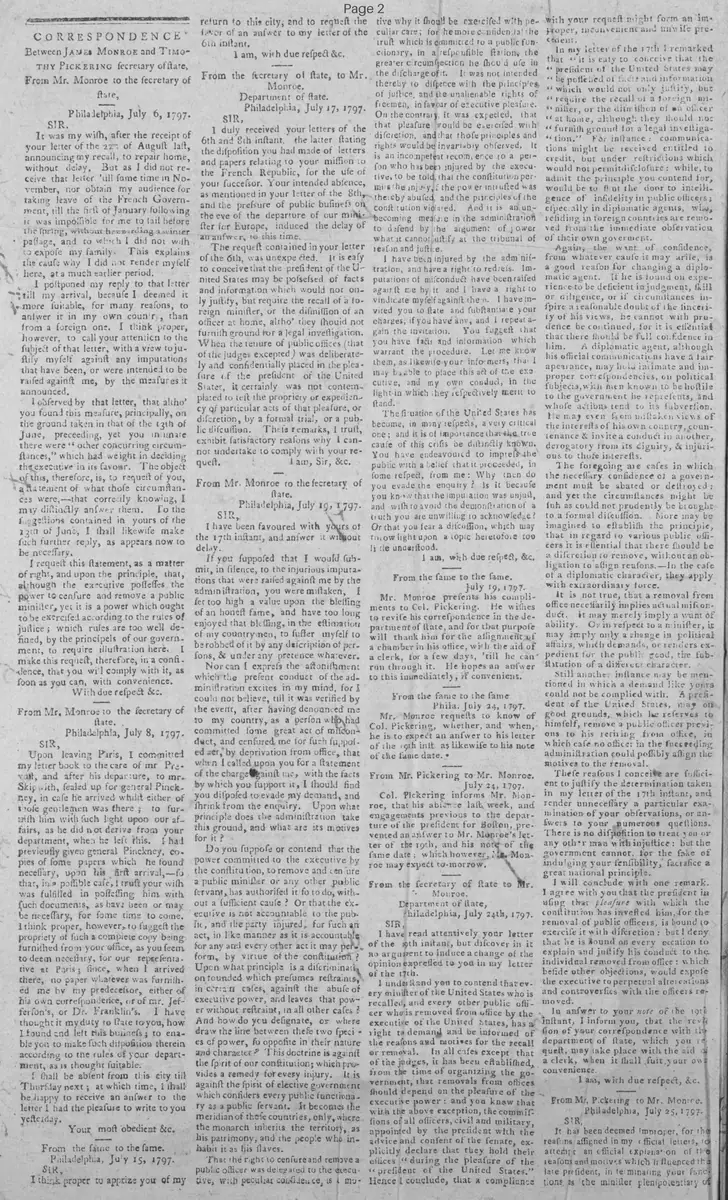
Between JAMES MONROE and TIMOTHY PICKERING secretary of state,
From Mr. Monroe to the secretary of state,
Philadelphia, July 6, 1797.
SIR.
It was my wish, after the receipt of your letter of the 22d of August last, announcing my recall, to repair home, without delay. But as I did not receive that letter 'till some time in November, nor obtain my audience for taking leave of the French Government, till the first of January following it was impossible for me to sail before the spring, without hazarding a winter passage, and to which I did not wish to expose my family. This explains the cause why I did not render myself here, at a much earlier period.
I postponed my reply to that letter till my arrival, because I deemed it more suitable, for many reasons, to answer it in my own country, than from a foreign one. I think proper, however, to call your attention to the subject of that letter, with a view to justify myself against any imputations that have been, or were intended to be raised against me, by the measures it announced.
I observed by that letter, that altho' you found this measure, principally, on the ground taken in that of the 25th of June, preceding, yet you intimate there were other concurring circumstances, which had weight in deciding the executive in its favour. The object of this, therefore, is, to request of you, a statement of what those circumstances were,--that correctly knowing, I may distinctly answer them. To the suggestions contained in yours of the 13th of June, I shall likewise make such further reply, as appears now to be necessary,
I request this statement, as a matter of right, and upon the principle, that, although the executive possesses the power to censure and remove a public minister, yet it is a power which ought to be exercised according to the rules of justice; which rules are too well defined, by the principles of our government, to require illustration here. I make this request, therefore, in a confidence, that you will comply with it, as soon as you can, with convenience.
With due respect &c.
From Mr. Monroe to the secretary of state.
Philadelphia, July 8, 1797.
SIR,
Upon leaving Paris, I committed my letter book to the care of mr Prevost, and after his departure, to mr. Skipwith, sealed up for general Pinckney. in case he arrived whilst either of those gentlemen was there ; to furnish him with such light upon our affairs, as he did not derive from your department, when he left this. I had previously given general Pinckney, copies of some papers which he found necessary, upon his first arrival, so that, in a possible case, I trust your wish was fulfilled in possessing him with such documents, as have been or may be necessary, for some time to come.
I think proper, however, to suggest the propriety of such a complete copy being furnished from your office, as you seem to deem necessary, for our representative at Paris; since, when I arrived there, no paper whatever was furnished me by my predecessor, either of his own correspondence, or of mr. Jefferson's, or Dr. Franklin's. I have thought it my duty to state to you, how I found and left this business; to enable you to make such disposition therein according to the rules of your department, as is thought suitable.
I shall be absent from this city till Thursday next; at which time, I shall be happy to receive an answer to the letter I had the pleasure to write to you yesterday.
Your most obedient &c.
From the same to the same.
Philadelphia, July 15, 1797.
SIR:
I think proper to apprise you of my return to this city, and to request the favor of an answer to my letter of the 6th instant.
I am, with due respect &c,
From the secretary of state, to Mr. Monroe.
Department of state.
Philadelphia, July 17, 1797.
SIR,
I duly received your letters of the 6th and 8th instant. the latter stating the disposition you had made of letters and papers relating to your mission to the French Republic, for the use of your successor. Your intended absence, as mentioned in your letter of the 8th, and the pressure of public business on the eve of the departure of our minister for Europe, induced the delay of an answer, to this time.
The request contained in your letter of the 6th, was unexpected. It is easy to conceive that the president of the United States may be possessed of facts and information which would not only justify, but require the recall of a foreign minister, or the dismission of an officer at home, altho' they should not furnish ground for a legal investigation. When the tenure of public offices (that of the judges excepted) was deliberately and confidentially placed in the pleasure of the president of the United States, it certainly was not contemplated to test the propriety or expediency of particular acts of that pleasure, or discretion, by a formal trial, or a public discussion. These remarks, I trust, exhibit satisfactory reasons why I cannot undertake to comply with your request.
I am, Sir, &c.
From Mr. Monroe to the secretary of state.
Philadelphia, July 19, 1797.
SIR,
I have been favoured with yours of the 17th instant, and answer it without delay.
If you supposed that I would submit, in silence, to the injurious imputations that were raised against me by the administration, you were mistaken, I set too high a value upon the blessing of an honest fame, and have too long enjoyed that blessing, in the estimation of my countrymen, to suffer myself to be robbed of it by any description of persons, & under any pretence whatever.
Nor can I express the astonishment which the present conduct of the administration excites in my mind. for I could not believe, till it was verified by the event, after having denounced me to my country, as a person who had committed some great act of misconduct, and censured me for such supposed act, by deprivation from office, that when I called upon you for a statement of the charge against me, with the facts by which you support it, I should find you disposed to evade my demand, and shrink from the enquiry. Upon what principle does the administration take this ground, and what are its motives for it ?
Do you suppose or contend that the power committed to the executive by the constitution, to remove and censure a public minister or any other public servant, has authorised it so to do, without a sufficient cause ? Or that the executive is not accountable to the public, and the party injured, for such an act, in like manner as it is accountable for any and every other act it may perform, by virtue of the constitution ?
Upon what principle is a discrimination founded which presumes restraints, in certain cases, against the abuse of executive power, and leaves that power without restraint, in all other cases? And how do you designate, or where draw the line between these two species of power, so opposite in their nature and character ? This doctrine is against the spirit of our constitution; which provides a remedy for every injury. It is against the spirit of elective government which considers every public functionary as a public servant. It becomes the meridian of these countries, only, where the monarch inherits the territory, as his patrimony, and the people who inhabit it as his slaves.
That the right to censure and remove a public officer was delegated to the executive, with peculiar confidence, is no reason why it should be exercised with peculiar care;for the more confidential the trust which is committed to a public functionary, in a responsible station, the greater circumspection he should use in the discharge of it. It was not intended thereby to dispense with the principles of justice and the unalienable rights of freemen, in favour of executive pleasure. On the contrary, it was expected, that that pleasure would be exercised with discretion, and that those principles and rights would be invariably observed. It is an incompetent recource to a person who has been injured by the executive, to be told, that the constitution permits the injury, if the power intrusted was thereby abused. and the principles of the constitution violated. And it is an unbecoming measure in the administration to defend by the argument of power what it cannot justify at the tribunal of reason and justice.
I have been injured by the administration, and have a right to redress. Imputations of misconduct have been raised against me by it and I have a right to vindicate myself against them. I have invited you to state and substantiate your charges, if you have any, and I repeat again the invitation. You suggest that you have facts and information which warrant the procedure. Let me know them, as likewise your informers, though I may be able to place this act of the executive, and my own conduct, in the light in which they respectively merit to stand.
The situation of the United States has become, in many respects, a very critical one: and it is of importance that the true cause of this crisis be distinctly known. You have endeavoured to impress the public with a belief that it proceeded. in some respect, from me: Why then do you evade the enquiry ? Is it because you know that the imputation was unjust, and wish to avoid the demonstration of a truth you are unwilling to acknowledge? Or that you fear a discussion, which may throw light upon a topic heretofore too little understood.
I am, with due respect, &c.
Mr. Monroe presents his compliments to Col. Pickering. He wishes to revise his correspondence in the department of state, and for that purpose will thank him for the assignment of a chamber in his office, with the aid of a clerk, for a few days, 'till he can run through it. He hopes an answer to this immediately, if convenient.
From the same to the same
Phila. July 24, 1797.
Mr. Monroe requests to know of Col. Pickering, whether, and when, he is to expect an answer to his letter of the 19th inst as likewise to his note of the same date.
From Mr. Pickering to Mr. Monroe.
July 24, 1797.
Col. Pickering informs Mr. Monroe, that his absence last week, and engagements previous to the departure of the president for Boston, prevented an answer to Mr. Monroe's letter of the 19th, and his note of the same date; which however, Mr. Monroe may expect to-morrow.
From the secretary of state to Mr. Monroe.
Department of state,
Philadelphia, July 24th, 1797.
SIR,
I have read attentively your letter of the 19th instant, but discover in it no argument to induce a change of the opinion expressed to you in my letter of the 17th.
I understand you to contend that every minister of the United States who is recalled, and every other public officer who is removed from office by the executive of the United States, has a right to demand and be informed of the reasons and motives for the recall or removal. In all cases except that of the judges, it has been established, from the time of organizing the government, that removals from offices should depend on the pleasure of the executive power : and you know that with the above exception, the commissions of all officers, civil and military, appointed by the president with the advice and consent of the senate, explicitly declare that they hold their offices "during the pleasure of the president of the United States."
Hence I conclude, that a compliance with your request might form an improper, inconvenient and unwise precedent.
In my letter of the 17th I remarked that it is easy to conceive that the "president of the United States may be possessed of facts and information " which would not only justify, but "require the recall of a foreign minister, or the dismission of an officer "at home, although they should not "furnish ground for a legal investigation." For instance : communications might be received entitled to credit, but under restrictions which would not permit disclosure: while, to admit the principle you contend for, would be to set the door to intelligence of infidelity in public officers; especially in diplomatic agents, who, residing in foreign countries are removed from the immediate observation of their own government.
Again, the want of confidence, from whatever cause it may arise, is a good reason for changing a diplomatic agent. If he is found on experience to be deficient in talent, skill or diligence, or if circumstances inspire a reasonable doubt of the sincerity of his views, he cannot with prudence be continued, for it is essential that there should be full confidence in him. A diplomatic agent, although his official communications have a fair appearance, may hold intimate and improper correspondences, on political subjects,with men known to be hostile to the government he represents, and whose actions tend to its subversion. He may even form mistaken views of the interests of his own country, countenance & invite conduct in another. derogatory from its dignity, & injurious to those interests.
The foregoing are cases in which the necessary confidence of a government must be abated or destroyed: and yet the circumstances might be such as could not prudently be brought to a formal discussion. More may be imagined to establish the principle, that in regard to various public officers it is essential that there should be a discretion to remove, without an obligation to assign reasons.-In the case of a diplomatic character, they apply with extraordinary force.
It is not true, that a removal from office necessarily implies actual misconduct. it may merely imply a want of ability. Or in respect to a minister, it may imply only a change in political affairs, which demands, or renders expedient for the public good, the substitution of a different character.
Still another instance may be mentioned in which a demand like yours could not be complied with. A president of the United States. may on good grounds, which he reserves to himself, remove a public officer previous to his retiring from office, in which case no officer in the succeeding administration could possibly assign the motives to the removal.
These reasons I conceive are sufficient to justify the determination taken in my letter of the 17th instant, and render unnecessary a particular examination of your observations, or answers to your numerous questions.
There is no disposition to treat you or any other man with injustice: but the government cannot, for the sake of indulging your sensibility, sacrifice a great national principle.
I will conclude with one remark. I agree with you that the president in exercising that pleasure with which the constitution has invested him. for the removal of public officers, is bound to exercise it with discretion : but I deny that he is bound on every occasion to explain and justify his conduct to the individual removed from office : which beside other objections, would expose the executive to perpetual altercations and controversies with the officers removed.
In answer to your note of the 19th instant, I inform you, that the revision of your correspondence with the department of state, which you request, may take place with the aid a clerk, when it shall suit your own convenience.
I am, with due respect, &c.
From Mr. Pickering to Mr. Monroe.
Philadelphia, July 25, 1797.
SIR,
It has been deemed improper, for the reasons assigned in my official letters, to attempt an official explanation of the reasons and motives which influenced the late president, in terminating your functions as the minister plenipotentiary of
the United States to the French republic
This I shall not venture to do, in any capacity. But it is in my power, as an individual citizen, to communicate the considerations which induced me, last summer, when called upon by the president, in the line of my office, to advise that this measure should be taken. If in this form my sentiments will give you any satisfaction, and you desire to receive them, they shall be furnished.
I have conversed with Mr. McHenry and Mr. Lee on this subject, and in like form you may receive their sentiments respectively. Mr. Wolcott being absent, I can say nothing in respect of him.
I am, with due respect, &c.
(To be continued.)
What sub-type of article is it?
What keywords are associated?
What entities or persons were involved?
Where did it happen?
Foreign News Details
Primary Location
Paris
Event Date
July 1797
Key Persons
Outcome
pickering refuses official reasons for monroe's recall, citing executive discretion; offers personal views and access to correspondence.
Event Details
James Monroe writes to Secretary Pickering demanding reasons for his recall as U.S. minister to France, defends his actions, and requests access to his correspondence. Pickering responds that the executive need not provide reasons for removals, explains principles of discretion, and allows review of documents while declining official explanation but offering personal insights.