Thank you for visiting SNEWPapers!
Sign up free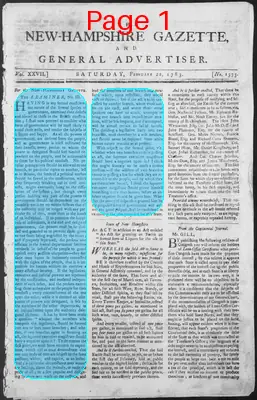
Editorial
February 22, 1783
The New Hampshire Gazette And General Advertiser
Portsmouth, Exeter, Rockingham County, New Hampshire
What is this article about?
In this installment of 'The Examiner,' the author advocates for a republican government with separated legislative, executive, and judicial powers to prevent usurpation and ensure accountability to the people. He supports a bicameral legislature to temper passions and questions granting the executive an absolute veto, critiquing British prerogatives.
Clipping
OCR Quality
98%
Excellent
Full Text
For the New-Hampshire Gazette.
THE EXAMINER. NO. III.
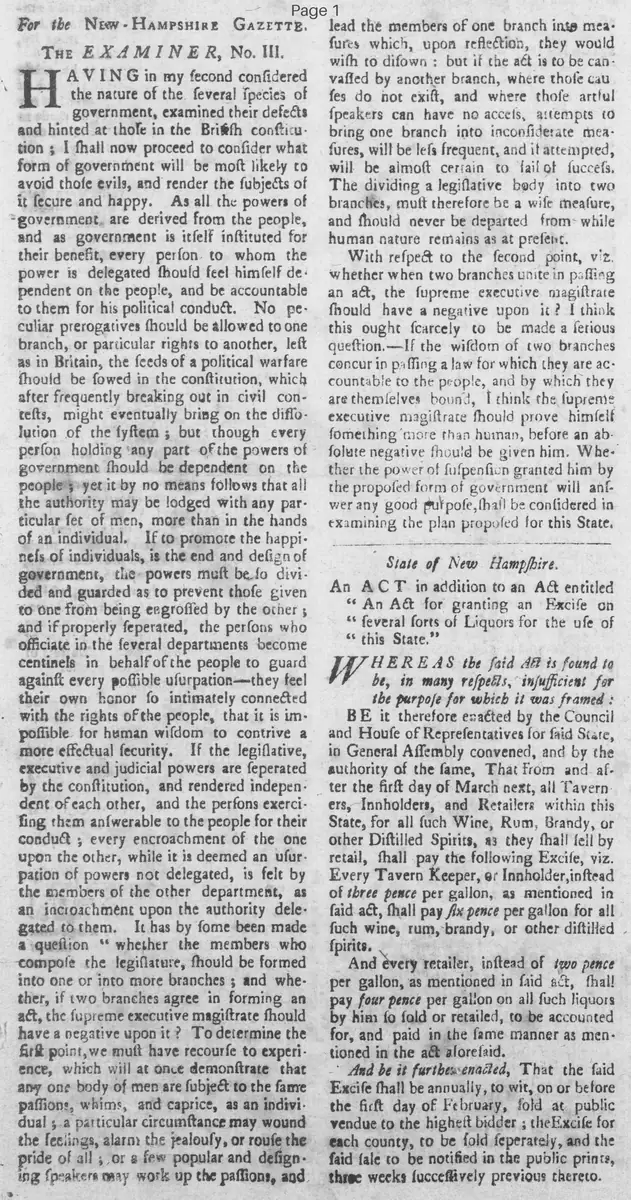
HAVING in my second considered the nature of the several species of government, examined their defects and hinted at those in the British constitution; I shall now proceed to consider what form of government will be most likely to avoid those evils, and render the subjects of it secure and happy. As all the powers of government are derived from the people, and as government itself is instituted for their benefit, every person to whom the power is delegated should feel himself dependent on the people, and be accountable to them for his political conduct. No peculiar prerogatives should be allowed to one branch, or particular rights to another, as in Britain. The seeds of a political warfare should be sowed in the constitution, which after frequently breaking out in civil contests, might eventually bring on the dissolution of the system; but though every person holding any part of the powers of government should be dependent on the people; yet it by no means follows that all the authority may be lodged with any particular set of men, more than in the hands of an individual. If to promote the happiness of individuals, is the end and design of government, the powers must be so divided and guarded as to prevent those given to one from being engrossed by the other; and if properly separated, the persons who officiate in the several departments become sentinels in behalf of the people to guard against every possible usurpation--they feel their own honor so intimately connected with the rights of the people, that it is impossible for human wisdom to contrive a more effectual security. If the legislative, executive and judicial powers are separated by the constitution, and rendered independent of each other, and the persons exercising them answerable to the people for their conduct; every encroachment of the one upon the other, while it is deemed an usurpation of powers not delegated, is felt by the members of the other department, as an encroachment upon the authority delegated to them. It has by some been made a question "whether the members who compose the legislature, should be formed into one or into more branches: and whether, if two branches agree in forming an act, the supreme executive magistrate should have a negative upon it?" To determine the first point, we must have recourse to experience, which will at once demonstrate that any one body of men are subject to the same passions, whims, and caprice, as an individual; a particular circumstance may wound the eclat, alarm the jealousy, or rouse the pride of all; or a few popular and designing speakers may work up the passion, and lead the members of one branch into measures which, upon reflection, they would wish to disown: but if the act is to be canvassed by another branch, where those causes do not exist, and where those artful speakers can have no access, attempts to bring one branch into inconsiderate measures, will be less frequent, and if attempted, will be almost certain to fail of success. The dividing a legislative body into two branches, must therefore be a wise measure, and should never be departed from while human nature remains as at present. With respect to the second point, viz. whether when two branches unite in passing an act, the supreme executive magistrate should have a negative upon it? I think this ought scarcely to be made a serious question.--If the wisdom of two branches concur in passing a law for which they are accountable to the people, and by which they are themselves bound. I think the supreme executive magistrate should prove himself something more than human, before an absolute negative should be given him. Whether the power of suspension granted him by the proposed form of government will answer any good purpose, shall be considered in examining the plan proposed for this State.
THE EXAMINER. NO. III.
HAVING in my second considered the nature of the several species of government, examined their defects and hinted at those in the British constitution; I shall now proceed to consider what form of government will be most likely to avoid those evils, and render the subjects of it secure and happy. As all the powers of government are derived from the people, and as government itself is instituted for their benefit, every person to whom the power is delegated should feel himself dependent on the people, and be accountable to them for his political conduct. No peculiar prerogatives should be allowed to one branch, or particular rights to another, as in Britain. The seeds of a political warfare should be sowed in the constitution, which after frequently breaking out in civil contests, might eventually bring on the dissolution of the system; but though every person holding any part of the powers of government should be dependent on the people; yet it by no means follows that all the authority may be lodged with any particular set of men, more than in the hands of an individual. If to promote the happiness of individuals, is the end and design of government, the powers must be so divided and guarded as to prevent those given to one from being engrossed by the other; and if properly separated, the persons who officiate in the several departments become sentinels in behalf of the people to guard against every possible usurpation--they feel their own honor so intimately connected with the rights of the people, that it is impossible for human wisdom to contrive a more effectual security. If the legislative, executive and judicial powers are separated by the constitution, and rendered independent of each other, and the persons exercising them answerable to the people for their conduct; every encroachment of the one upon the other, while it is deemed an usurpation of powers not delegated, is felt by the members of the other department, as an encroachment upon the authority delegated to them. It has by some been made a question "whether the members who compose the legislature, should be formed into one or into more branches: and whether, if two branches agree in forming an act, the supreme executive magistrate should have a negative upon it?" To determine the first point, we must have recourse to experience, which will at once demonstrate that any one body of men are subject to the same passions, whims, and caprice, as an individual; a particular circumstance may wound the eclat, alarm the jealousy, or rouse the pride of all; or a few popular and designing speakers may work up the passion, and lead the members of one branch into measures which, upon reflection, they would wish to disown: but if the act is to be canvassed by another branch, where those causes do not exist, and where those artful speakers can have no access, attempts to bring one branch into inconsiderate measures, will be less frequent, and if attempted, will be almost certain to fail of success. The dividing a legislative body into two branches, must therefore be a wise measure, and should never be departed from while human nature remains as at present. With respect to the second point, viz. whether when two branches unite in passing an act, the supreme executive magistrate should have a negative upon it? I think this ought scarcely to be made a serious question.--If the wisdom of two branches concur in passing a law for which they are accountable to the people, and by which they are themselves bound. I think the supreme executive magistrate should prove himself something more than human, before an absolute negative should be given him. Whether the power of suspension granted him by the proposed form of government will answer any good purpose, shall be considered in examining the plan proposed for this State.
What sub-type of article is it?
Constitutional
What keywords are associated?
Separation Of Powers
Bicameral Legislature
Executive Veto
Government Accountability
British Constitution Defects
What entities or persons were involved?
British Constitution
Editorial Details
Primary Topic
Ideal Republican Government With Separation Of Powers
Stance / Tone
Advocacy For Balanced Government And Critique Of British System
Key Figures
British Constitution
Key Arguments
Powers Of Government Derive From The People And Must Ensure Accountability
No Peculiar Prerogatives To Branches As In Britain To Avoid Political Warfare
Separation Of Legislative, Executive, And Judicial Powers Prevents Usurpation
Bicameral Legislature Checks Passions And Inconsiderate Measures
Executive Should Not Have Absolute Veto On Laws Passed By Two Branches