Thank you for visiting SNEWPapers!
Sign up free
Richmond Enquirer
Richmond, Richmond County, Virginia
What is this article about?
In the Virginia House of Delegates on February 16, 1839, Mr. Botts of Henrico delivers a speech rebutting Mr. Pendleton's defense of William C. Rives for U.S. Senator, accusing Rives of opportunism and criticizing Whig supporters for compromising principles to secure election.
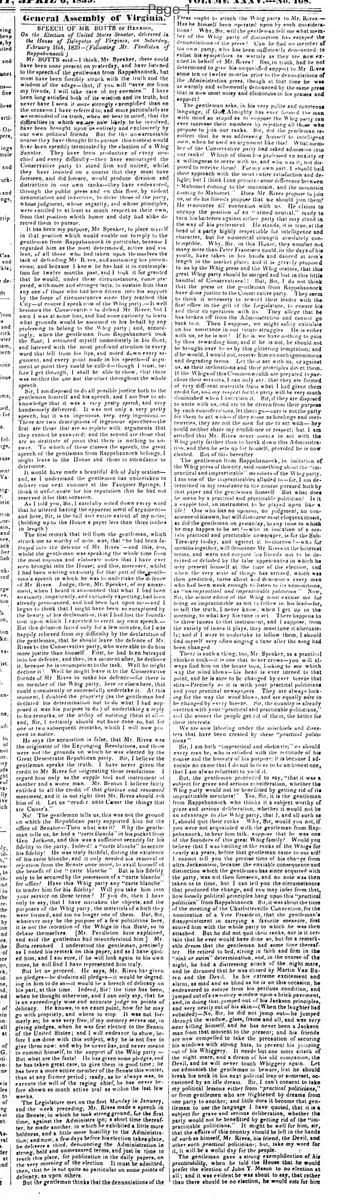
Merged-components note: These components form a continuous political speech by Mr. Botts on the election of a United States Senator, spanning adjacent columns on page 1 and continuing to page 2 in sequential reading order.
Clippings
1 of 2
OCR Quality
Full Text
SPEECH OF MR. BOTTS of Henrico,
On the Election of United States Senator, delivered in the House of Delegates of Virginia, on Saturday, February 16th, 1839—(Following Mr. Pendleton of Rappahannock)
Mr BOTTS said—I think, Mr Speaker, there could have been none present on yesterday, and have listened to the speech of the gentleman from Rappahannock, but must have been forcibly struck with the truth and the wisdom of the adage—that, if you will "save me from my friends, I will take care of my enemies." I have been long satisfied both of its wisdom and its truth, but never have I seen it more strangely exemplified than on the occasion I have referred to; and more particularly are we reminded of its truth, when we bear in mind, that the difficulties in which we are now likely to be involved have been brought upon us entirely and exclusively by our own political friends But for the unwarrantable course they have thought fit to pursue this contest would have been speedily terminated by the election of a Whig Senator. They have been productive of every mischief and every difficulty—they have encouraged the Conservative party to stand firm and united, whilst they have insisted on a course that they must have foreseen, and did foresee, would produce division and distraction in our own ranks—they have endeavored, through the public press and on this floor, by violent denunciation and invective, to drive those of the party, whose judgment, whose sagacity, and whose principles, were entitled to at least as much respect as their own, from that position which honor and duty had alike directed them to pursue.
It has been my purpose, Mr Speaker, to place myself in that position which would enable me to reply to the gentleman from Rappahannock in particular, because I regarded him as the most determined, active and violent, of all those who had taken upon themselves the task of defending Mr Rives, and sustaining his pretensions; and because I knew he has had it in contemplation for twelve months past, and I took it for granted that he would, under these circumstances. come prepared, with more and stronger facts, to sustain him than any one of those who had been driven into his support by the force of circumstances since they reached this city—of course I speak now of the Whig party.—It well becomes the Conservatives to defend Mr Rives; but I own I was at some loss, and had some curiosity to learn what grounds would be assumed in his behalf by any professing to belong to the Whig party ; and, accordingly, when the gentleman from Rappahannock took the floor, I stationed myself immediately in his front, and listened with the most profound attention to every word that fell from his lips, and noted down every argument, and every point made in his speech—if argument or point they could be called—though I trust, before I get through, I shall be able to show, that there was neither the one nor the other throughout the whole speech.
Sir, I am disposed to do all possible justice both to the gentleman himself and his speech, and I am free to acknowledge that it was a very pretty speech, and very handsomely delivered. It was not only a very pretty speech, but it was ingenious, very. very ingenious.— There are two descriptions of ingenious speeches—the first are those that are so replete with arguments that they cannot be answered: and the second are those that are so destitute of point that there is nothing to answer. To which of these classes the speech, the great speech of the gentleman from Rappahannock belongs. I might leave to the House and those in attendance to determine.
It would have made a beautiful 4th of July oration— and, as I understand the gentleman has undertaken to deliver one next summer at the Fauquier Springs, I think it unfortunate for his reputation that he had not reserved it for that occasion.
As I told you, Sir, I carefully noted down every word that he uttered having the apparent merit of argument— and here, Sir, is the full and entire extent of my notes; (holding up to the House a paper less than three inches in length)
The first remark that fell from the gentleman, which struck me as worthy of note, was, that 'he had been betrayed into the defence of Mr Rives'—and this, too, whilst the gentleman was speaking the whole time from the most copious and elaborate notes that I have ever seen brought into the House; and this, moreover, whilst I had been waiting anxiously for that part of the gentleman's speech in which he was to undertake the defence of Mr Rives. Judge, then, Mr. Speaker, of my amazement, when I heard it announced that what I had been anxiously, impatiently, and curiously expecting, had been already pronounced, and had been lost upon me—and I began to think that I might have been so enraptured by the beauty of his declamation, that I had lost the foundation upon which I expected to erect my own speech.— But this delusion lasted only for a few minutes, for I was happily relieved from my difficulty by the declaration of the gentleman, that he should leave the defence of Mr. Rives to the Conservative party, who were able to do him more justice than himself. First, he had been betrayed into his defence, and then, in a moment after, he declines it, because he is incompetent to the task. Well he might decline it ! Well he might leave it to the Conservative friends of Mr Rives to make his defence—for there is no member of the Whig party. here or elsewhere. that could consistently or successfully undertake it. At this moment, I doubted the propriety (as the gentleman had declared his determination not to do what I had supposed it was his purpose to do.) of undertaking a reply to his remarks, or the utility of noticing them at all: and, Sir, I certainly should not have done so, but for one or two subsequent remarks, which I will now proceed to notice.
He says the accusation is false, that Mr. Rives was the originator of the Expunging Resolutions, and there were not the grounds on which he was elected by the Great Democratic Republican party. Sir, I believe the gentleman speaks the truth. I have never given the credit to Mr Rives for originating those resolutions. I regard him only as the supple tool and instrument of another and a worse man. Mr. Benton I believe fairly entitled to all the credit of that glorious and renowned movement, and it is not right that Mr. Rives should rob him of it. Let us "render unto Caesar the things that are Caesar's.'
No! The gentleman tells us, this was not the ground on which the Republican party supported him for the office of Senator—Then what was it? Why the gentleman tells us, he had a "carte blanche" in his pocket from Gen Jackson, and this was a sufficient security for his fidelity to the party. Indeed! a "carte blanche" to secure his fidelity! He was truly faithful, during the existence of his carte blanche, and it only needed his removal or rejection from the Senate once more, to avail himself of the benefit of the " carte blanche " But is his fidelity only to be secured by the possession of a "carte blanche for office? Have this Whig party any "carte blanche to tender him for his fidelity?' Will you take him into your service on these terms? If you do, then I have only to say, that I have mistaken the objects, and the purposes of the Whig party, the materials of which they were formed, and am no longer one of them. But, Sir, whatever may be the purpose of a few politicians here, it is not the intention of the Whigs in this State, so to debase themselves. [Mr. Pendleton here explained, and said the gentleman had misunderstood him'] Mr. Botts resumed I understood the gentleman, precisely as I noted his remark on this paper, and as I have quoted him, and I am sure, if he will look again to his own notes, he will find I have represented him truly.
But let us proceed. He says, Mr. Rives has given no pledges—he disdains all pledges—it would be degrading in him to do so—it would be a breach of delicacy on his part, at this time. Indeed, Sir! the time has been, when he thought otherwise, and I can only say, that he is an exceedingly wise and accurate judge on points of delicacy. He knows, to an exact point, how far he may go with propriety, and where to stop. 'It was not formerly so; he was very free, if my memory serves me, in giving pledges, when he was first elected to the Senate of the United States; and I will endeavor to show, before I am done with this subject, why he is not free to give them now: and why he never has, and never means to commit himself, to the support of the Whig party —
But what are the facts? He has given some pledges, and he has taken great care, to give them in good time; he has been a more active member of the Senate this winter, than at any former period; ready, as he always was, to execute the will of the raging chief, he has never before shown so much active zeal as within the last few weeks.
The Legislature met on the first Monday in January, and the week preceding, Mr. Rives made a speech in the Senate, in which he took strong ground, for the first time, against the Administration; a short time thereafter, he made another. in which he exhibited a little more boldness, and a little more hostility to the Administration; and now, a few days before his election takes place, delivers third in strong, bold and unmeasured terms, and just in time to reach this place for publication in the daily papers on the very morning of the election It must be admitted, then, that he is not quite so particular on some points of delicacy, as upon others.
But the gentlemen thinks that the denunciations of the Press ought to attach the Whig party to Mr. Rives.— Has he himself been operated upon by such considerations: Why, Sir, will the gentleman tell me what member of the Whig party of distinction has escaped the denunciations of the press: Can he find no member of his own party. who has been sufficiently denounced: to enlist his sympathies as warmly as they are now ex. cited in behalf of Mr. Rives? But, in truth, had he not determined to give his unqualified support to Mr Rives some ten or twelve months prior to the denunciations of the Administration press, though at that time he was as warmly and vehemently denounced by the same press that is now most noisy and clamorous in his praises and support?
The gentleman asks, in his very polite and courteous language, if God Almighty has ever formed the man with mind so stupid as to suppose the Whig party can ever increase their numbers by rejecting all those who propose to join our ranks. Sir, did the gentleman recollect that he was addressing himself to intelligent men, when he used an argument like this? What member of the Conservative party had asked admission into our ranks? Which of them has professed an anxiety or a willingness to serve with us, and who was it, not disposed to receive them: For my own part. I should hail their approach with the most entire satisfaction and delight; but I think I can perceive some difference between "Mahomet coming to the mountain, and the mountain coming to Mahomet " Does Mr Rives propose to join us, or do his friends propose that we should join them?
He renounces all connexion with us. He claims to occupy the position of an " armed neutral." ready to turn his batteries against either party that may stand in the way of his preferment He stands, it is true, at the head of a party highly respectable for intelligence and character, but for numerical strength absolutely contemptible. Why. Sir. in this House, they number not many more than Peter Francisco could, in the days of his youth, have taken in his hands and danced at arm's length in the market place; and it is gravely proposed to us by the Whig press and the Whig orators, that this great Whig party should be merged and lost in this little handful of Conservatives!: But, Sir, I do not think that the press or the gentleman from Rappahannock have done justice to the Conservative party. They seem to think it necessary to reward their leader with the first office in the gift of the Legislature, to ensure his and their co operation with us." They allege that he has broken off from the Administration and cannot go back to it. Then I suppose, we might safely calculate on his assistance in our future struggles He is either with us, or he is not! If he is, we have nothing to gain by thus rewarding him; and if he is not, he should not be brought over to us by this glittering temptation; and if he would, I would not, receive him on such ignominious and degrading terms. Let them act with us, or against us, as their inclinations and their principles direct them.
If the Whigs of this Commonwealth are prepared to purchase their services, I can only say, that they are formed of very different materials from what I had given them credit for, and my respect for the party will be very much diminished when I ascertain it. Sir, if they are disposed to unite with us, and are to be driven from their purpose by such considerations, let them go—ours is not the party for them to act with—if they come as hirelings and mercenaries, they are not the men for me to act with- they could neither share my confidence or respect; but I am satisfied that Mr. Rives never means to act with the Whig party farther than to break down this Administration, and then he sets up for himself, provided he is now elected. But of this hereafter
The gentleman from Rappahannock, in imitation of the Whig press of this city. said something about the "impractical and impracticable" members of the Whig party.
I am one of the impracticables alluded to—for. I am determined in my resistance to the course pursued both by that paper and the gentleman himself But what does he mean by a practical and practicable politician? Is it a supple tool, an instrument to be played upon like a fife?' 'One who has no opinion, no judgment, no conscience of his own, but will discourse most eloquent music, as did the gentleman yesterday, to any tune to which he may happen to be set?—who in imitation of a certain practical and practicable newspaper. is for the Sub. Treasury to-day, and against it to-morrow?—who for months together, will denounce Mr Rives in the bitterest terms, and warn and conjure his friends not to be deceived or deluded by the false appearances in which he may present himself at the time of the election, and when the very state of things has arrived. which was then predicted, turns about and denounces every man who had been weak enough to listen to its admonitions, as "an impractical and impracticable politician" Now, Sir, the senior editor of the Whig must excuse me for being so impracticable as not to follow in his lead—for, to tell the truth, I never know, when I get up in the morning, to what key his tune is set. There happens to be three tuners to that instrument, and I suppose, from the variety of tunes it plays, they must tune it alternately; and if I were to undertake to follow them, I should find myself very often singing a tune after the song had been changed
There is such a thing, too, Mr. Speaker, as a practical chicken cock—it is one that never crows—you will always find him on the house tops, looking to see which way the wind blows—his head is ever turned to that point, and he is sure to be changed by every breeze that stirs—Precisely so it is with your practical politicians and your practical newspapers They are always looking for the way the wind blows, and are equally sure to be changed by every breeze. Sir, the country is already overrun with: your "practical and practicable politicians a:d the sooner the people get rid of them, the better for their interests.
We are now laboring under the mischiefs and disasters that have been created by these "practical politicians Sir, I am both "impractical and obstinate;" so should every man be, who is satisfied with the rectitude of his course and the honesty of his purpose: it is because I advocate no cause that I do not believe to be an honest one, that I am always reluctant to yield it.
But, the gentleman proceeded to say, "that it was a subject for grave and serious consideration, whether the Whig party would not be benefitted by getting rid of its impracticable members!" Yes, Sir, it is the gentleman from Rappahannock who thinks it a subject worthy of grace and serious deliberation, whether it would not be an advantage to ,the Whig party, that I, and all such as I, should quit their ranks " Why, Sir, would you not, if you were not acquainted with the gentleman from Rap. pahannock, to hear him talk, suppose that he was one of the founders of this great Whig family? Would you believe that I was battling in the ranks of the Whigs for nearly six years, before that gentleman came to our aid?
I cannot tell you the precise time of his change from ultra Jacksonism, because the enviable consequence and distinction which the gentleman has since acquired with the party, was not then foreseen, and no note was then taken as to time, but I can tell you the circumstances that produced the change, and you may infer from that how loosely political principles hang upon this "practical politician" from Rappahannock Sir, it was about the time of the meeting of the Charlottesville Convention.for the nomination of a Vice President, that the gentleman's disappointment in carrying a favorite measure, first soured him with the whole party to which he was then attached But he did not quit their ranks, nor is it certain that he ever would have done so, but for a remarkable dream that the gentleman had some time thereafter. He retired to bed, strong in faith and firm in the "sink or swim" determination, and, in the course of the night, he had a distressing attack of the night mare, and he dreamed that he was chased by Martin Van Buren and the Devil. In his extreme excitement and alarm, as mad and as blind as he is on this occasion, he endeavored to escape from his perilous condition, and jumped out of a two-story window upon a brick pavement, and, in doing that. jumped out of his Jackson principles, and very nearly out of his skin—(When the laughter had subsided)—No, Sir, he did not jump out—he jumped through the window, glass, frame and all, and was very near killing himself and from that moment to the present; and his friends are now compelled to take the precaution of securing his windows with strong bars, to prevent his jumping out of his Whiggery. It needs but one more attack of the night mare, and a dream of his old companion, the Devil, and he will never touch Whiggery again. Let me admonish the gentleman to beware, lest he should break his neck in his next political leap or somerset, occasioned by an idle dream. " Sir, I can't consent to take my political lessons either from "practical politicians, or from gentlemen who are frightened by dreams from one party to another; and little does it become that gentleman to use the language I have quoted, that it is a subject for grave and serious deliberation, whether the party would not be benefitted by getting rid of the "im. practicable politicians." It might be well for him, sir, that the affairs of this country should be left in the hands of such as himself, Mr. Rives, his friend, the Devil, and other such practical politicians; but, take my word for it, it will be a woful day for the people.
The gentleman gave a strong exemplification of his practicability, when he told the House that he would prefer the election of John Y. Mason to no election at all; and it was evident he was about to say, that rather than there should be no election, he would vote for him—but his readiness and presence of mind admonished arrested the sentiment when only half uttered. Here him of the difficulties that would surround him, and he is, in truth, practicability with a vengeance! Rather than he would do nothing, he would do mischief, and the greatest conceivable mischief that it would be in his power to do! Now, so far do I differ with him, that I would greatly prefer no election to seeing either Mr. Rives or Mr. Mason elected—and as long as it is possible for my vote to defeat either or both, neither of them shall be elected. I carry my impracticability to this full and entire extent.
That if this alliance was not formed, (unholy, unrighteous, mischievous and ruinous, as it must be, to all who participate in it,) that the Whigs would find themselves in the Spring in a condition, that they had often promised themselves: that of 'looking up,' for they would be flat on their backs, and could look no other way. Now, sir, this is precisely the way in which I wish to fall, if fall I must; but it is precisely that, in which the gentleman from Rappahannock will never be found. Sir, when I do fall, it shall be with my feet to the foe, and face to heaven, holding on even in the agonies of death, to the principles for which we have fought, and for which alone we deserve to conquer. Not so with the member from Rappahannock; he will fall in his retreat from his principles, and desertion from his friends; he will not have the courage to look up; he will have fallen upon his face, and will bury it in the very dust for shame.
(Remainder in our next)
What sub-type of article is it?
What themes does it cover?
What keywords are associated?
What entities or persons were involved?
Where did it happen?
Story Details
Key Persons
Location
House Of Delegates Of Virginia
Event Date
1839 02 16
Story Details
Mr. Botts criticizes Mr. Pendleton's support for Mr. Rives in the U.S. Senate election, accusing Rives of opportunism and lack of fidelity to Whig principles, while defending his own steadfastness and mocking Pendleton's political shifts.