Thank you for visiting SNEWPapers!
Sign up free
National Gazette
Philadelphia, Philadelphia County, Pennsylvania
What is this article about?
On January 29, 1793, a U.S. Senate committee reported on standardizing measures and weights, proposing a uniform iron rod as the base standard, defining units like foot, acre, bushel, and pound, with divisions into cents and mills for ease of use.
Clipping
OCR Quality
Full Text
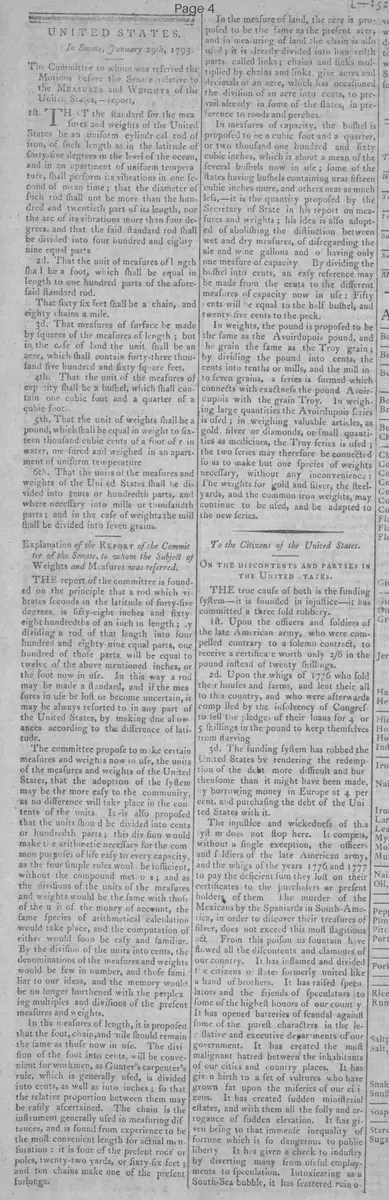
In Senate, January 29th, 1793.
The Committee to whom was referred the Motions before the Senate relative to the Measures and Weights of the United States,—report,
1st. That the standard for the measures and weights of the United States be an uniform cylindrical rod of iron, of such length as in the latitude of forty-five degrees in the level of the ocean, and in an apartment of uniform temperature, shall perform its vibrations in one second of mean time: that the diameter of such rod shall not be more than the hundred and twentieth part of its length, nor the arc of its vibrations more than four degrees, and that the said standard rod shall be divided into four hundred and eighty nine equal parts
2d. That the unit of measures of length shall be a foot, which shall be equal in length to one hundred parts of the aforesaid standard rod. That sixty six feet shall be a chain, and eighty chains a mile.
3d. That measures of surface be made by squares of the measures of length; but in the case of land the unit shall be an acre, which shall contain forty-three thousand five hundred and sixty square feet.
4th. That the unit of the measures of capacity shall be a bushel, which shall contain one cubic foot and a quarter of a cubic foot.
5th. That the unit of weights shall be a pound, which shall be equal in weight to sixteen thousand cubic cents of a foot of rain water, measured and weighed in an apartment of uniform temperature
6th. That the units of the measures and weights of the United States shall be divided into cents or hundredth parts, and where necessary into mills or thousandth parts; and in the case of weights the mill shall be divided into seven grains.
Explanation of the Report of the Committee of the Senate, to whom the Subject of Weights and Measures was referred.
THE report of the committee is founded on the principle that a rod which vibrates seconds in the latitude of forty-five degrees, is fifty-eight inches and sixty-eight hundredths of an inch in length;—by dividing a rod of that length into four hundred and eighty nine equal parts, one hundred of those parts will be equal to twelve of the above mentioned inches, or the foot now in use. In this way a rod may be made a standard, and if the measures in use be lost or become uncertain, it may be always resorted to in any part of the United States, by making due allowances according to the difference of latitude.
The committee propose to make certain measures and weights now in use, the units of the measures and weights of the United States, that the adoption of the system may be the more easy to the community, as no difference will take place in the contents of the units. It is also proposed that the units should be divided into cents or hundredth parts; this division would make the arithmetic necessary for the common purposes of life easy to every capacity, as the four simple rules would be sufficient, without the compound methods; and as the divisions of the units of the measures and weights would be the same with those of the unit of the money of account, the same species of arithmetical calculation would take place, and the computation of either would soon be easy and familiar.
By the division of the units into cents, the denominations of the measures and weights would be few in number, and those familiar to our ideas, and the memory would be no longer burdened with the perplexing multiples and divisions of the present measures and weights.
In the measures of length, it is proposed that the foot, chain, and mile should remain the same as those now in use. The division of the foot into cents, will be convenient for workmen, as Gunter's carpenter's rule, which is generally used, is divided into cents, as well as into inches; so that the relative proportion between them may be easily ascertained. The chain is the instrument generally used in measuring distances, and is found from experience to be the most convenient length for actual mensuration: it is four of the present rods or poles, twenty-two yards, or sixty-six feet: and ten chains make one of the present furlongs.
What sub-type of article is it?
What keywords are associated?
Where did it happen?
Domestic News Details
Primary Location
United States
Event Date
January 29th, 1793
Event Details
The Senate committee reported on standardizing measures and weights using a uniform iron rod vibrating seconds at 45 degrees latitude as the base, defining foot (100 parts of rod), chain (66 feet), mile (80 chains), acre (43,560 sq ft), bushel (1.25 cubic ft), pound (16,000 cubic cents of rainwater), with divisions into cents and mills.