Thank you for visiting SNEWPapers!
Sign up free
The Patowmac Guardian, And Berkeley Advertiser
Martinsburg, Shepherdstown, Berkeley County, Jefferson County, West Virginia
What is this article about?
U.S. Congress (1st Congress, 2nd session) proceedings in Philadelphia from Feb. 25-Mar. 3, 1791: Senate debates open sessions rule (fails), approves Bank bill; House passes Treasury supplemental, petitions, reports; multiple bills signed by President Washington; resolves mint establishment; adjourns sine die with thanks to Speaker Muhlenberg.
Merged-components note: Continuation of congressional proceedings across pages, forming a single coherent report.
Clippings
1 of 2
OCR Quality
Full Text
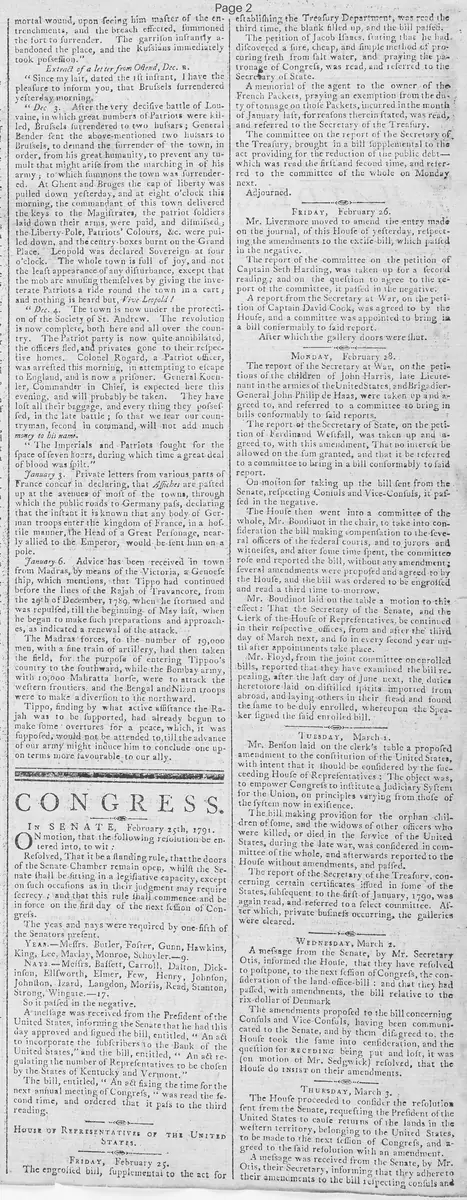
In SENATE, February 25th, 1791.
On motion, that the following resolution be entered into, to wit:
Resolved, That it be a standing rule, that the doors of the Senate-Chamber remain open, whilst the Senate shall be sitting in a legislative capacity, except on such occasions as in their judgment may require secrecy; and that this rule shall commence and be in force on the first day of the next session of Congress.
The yeas and nays were required by one-fifth of the Senators present.
Yeas.—Messrs. Butler, Foster, Gunn, Hawkins, King, Lee, Maclay, Monroe, Schuyler.—9.
Nays.—Messrs. Bassett, Carroll, Dalton, Dickinson, Ellsworth, Elmer, Few, Henry, Johnson, Johnston, Izard, Langdon, Morris, Read, Stanton, Strong, Wingate.—17.
So it passed in the negative.
A message was received from the President of the United States, informing the Senate that he had this day approved and signed the bill, entitled, "An act to incorporate the subscribers to the Bank of the United States," and the bill, entitled, "An act regulating the number of Representatives to be chosen by the States of Kentucky and Vermont."
The bill, entitled, "An act fixing the time for the next annual meeting of Congress," was read the second time, and ordered that it pass to the third reading.
HOUSE OF REPRESENTATIVES OF THE UNITED STATES,
Friday, February 25.
The engrossed bill, supplemental to the act for establishing the Treasury Department, was read the third time, the blank filled up, and the bill passed.
The petition of Jacob Isaacs, stating that he had discovered a sure, cheap, and simple method of procuring fresh from salt water, and praying the patronage of Congress, was read, and referred to the Secretary of State.
A memorial of the agent to the owner of the French Packets, praying an exemption from the duty of tonnage on those Packets, incurred in the month of January last, for reasons therein stated, was read, and referred to the Secretary of the Treasury.
The committee on the report of the Secretary of the Treasury, brought in a bill supplemental to the act providing for the reduction of the public debt—which was read the first and second time, and referred to the committee of the whole on Monday next.
Adjourned.
Friday, February 26.
Mr. Livermore moved to amend the entry made on the journal, of this House of yesterday, respecting the amendments to the excise-bill, which passed in the negative.
The report of the committee on the petition of Captain Seth Harding, was taken up for a second reading; and on the question to agree to the report of the committee, it passed in the negative.
A report from the Secretary at War, on the petition of Captain David Cook, was agreed to by the House, and a committee was appointed to bring in a bill conformably to said report.
After which the gallery doors were shut.
Monday, February 28.
The report of the Secretary at War, on the petitions of the children of John Harris, late Lieutenant in the armies of the United States, and Brigadier-General John Philip de Haas, were taken up and agreed to, and referred to a committee to bring in bills conformably to said reports.
The report of the Secretary of State, on the petition of Ferdinand Westfall, was taken up and agreed to, with this amendment, That no interest be allowed on the sum granted, and that it be referred to a committee to bring in a bill conformably to said report.
On motion for taking up the bill sent from the Senate, respecting Consuls and Vice-Consuls, it passed in the negative.
The House then went into a committee of the whole, Mr. Boudinot in the chair, to take into consideration the bill making compensation to the several officers of the federal courts, and to jurors and witnesses, and after some time spent, the committee rose and reported the bill, without any amendment: several amendments were proposed and agreed to by the House, and the bill was ordered to be engrossed and read a third time to-morrow.
Mr. Boudinot laid on the table a motion to this effect: That the Secretary of the Senate, and the Clerk of the House of Representatives, be continued in their respective offices, from and after the third day of March next, and so in every second year until after appointments take place.
Mr. Floyd, from the joint committee on enrolled bills, reported that they have examined the bill repealing, after the last day of June next, the duties heretofore laid on distilled spirits imported from abroad, and laying others in their stead and found the same to be duly enrolled, whereupon the Speaker signed the said enrolled bill.
Tuesday, March 1.
Mr. Benson laid on the clerk's table a proposed amendment to the constitution of the United States, with intent that it should be considered by the succeeding House of Representatives: The object was, to empower Congress to institute a Judiciary System for the Union, on principles varying from those of the system now in existence.
The bill making provision for the orphan children of some, and the widows of other officers who were killed, or died in the service of the United States, during the late war, was considered in committee of the whole, and afterwards reported to the House without amendments, and passed.
The report of the Secretary of the Treasury, concerning certain certificates issued in some of the States, subsequent to the first of January, 1790, was again read, and referred to a select committee. After which, private business occurring, the galleries were cleared.
Wednesday, March 2.
A message from the Senate, by Mr. Secretary Otis, informed the House, that they have resolved to postpone, to the next Session of Congress, the consideration of the land-office-bill: and that they had passed, with amendments, the bill relative to the rix-dollar of Denmark.
The amendments proposed to the bill concerning Consuls and Vice Consuls, having been communicated to the Senate, and by them disagreed to, the House took the same into consideration, and the question for Receding being put and lost, it was (on motion of Mr. Sedgwick) resolved, that the House do insist on their amendments.
Thursday, March 3.
The House proceeded to consider the resolution sent from the Senate, requesting the President of the United States to cause returns of the lands in the western territory, belonging to the United States, to be made to the next session of Congress, and agreed to the said resolution with an amendment.
A message was received from the Senate, by Mr. Otis, their Secretary, informing that they adhere to their amendments to the bill respecting consuls and Vice-Consuls; also that they have passed a resolution for the establishment of a mint; to which they request the concurrence of this House; and the said resolution was read a first time.
The House took up for a second reading the resolution sent from the Senate for the establishment of a mint, and on the question to agree to the first part of the resolution, it was resolved in the affirmative; an amendment was proposed to the second part of the resolution, which was agreed to, and on the question to agree to the second part of said resolution as amended, the yeas and nays being demanded, it was resolved in the affirmative, Ayes 25, Noes 21.
Thursday Evening, March 3.
A message from the Senate informed the House, that they concur in the resolution for the safe-keeping of prisoners, &c. also that they have considered the bill for carrying into effect the Consular Convention, and the bill for the relief of David Cook, and resolved that said bills do not pass to a second reading.
Seven enrolled bills and resolutions were signed by the Speaker:
A message from the President of the United States, by Mr. Secretary Lear, informed the House, that the following acts have received his approbation and signature, viz. An act making compensations to the commissioners of loans, for their extra services: an act in addition to an act establishing the salaries of the officers of the Treasury Department, their assistants and clerks.
An act to provide compensations for the officers of the judicial courts, and for jurors and witnesses, and for other purposes.
An act making further provision for the collection of the duties on teas, and to prolong the time for the collection of those on wines.
An act to continue in force an act for the temporary establishment of the Post-Office.
An act supplementary to the act making further provision for the public debt, and a resolution for the safe keeping of prisoners, confined under the authority of the United States.
A message from the Senate informed the House, that the President had signed the following acts, which originated in the Senate:
An act to continue in force the act therein-mentioned, and to make further provision for invalid pensioners, and for the support of Light-Houses.
An act for granting lands to the settlers at Vincennes, in the Illinois country.
The Secretary then informed the House, that the Senate having finished the legislative business before them, are ready to adjourn.
On motion of Mr. Vining, the following was unanimously agreed to:
Resolved, That the thanks of the House of Representatives of the United States be presented to Frederick Augustus Muhlenberg, in testimony of their approbation of his conduct in the Chair, and in the execution of the difficult and important trust reposed in him as Speaker of the said House.
To which the Speaker made the following reply:
"Gentlemen of the House of Representatives.
This unexpected mark of your approbation of my conduct has made so deep an impression on my mind, that I cannot find words to express the high sense of gratitude I entertain on this occasion.
I have not vanity sufficient to suppose that my feeble, though well-meant endeavours, merit so great a reward; for it was your kind indulgence and support alone which enabled me to go through the duties of the station which you were pleased to assign me: but I shall ever consider this distinguished and honourable testimony as the pleasing circumstance of my life.
Gentlemen, I most sincerely thank you. May every possible happiness attend you, and every individual of this body; and may your zealous endeavours to promote the welfare of our beloved country, which I have so long, and so often, been a witness to, be crowned with unbounded success."
On motion of Mr. Jackson, the following resolution was unanimously agreed to—That the Speaker communicate to the Mayor and Corporation of the city, and the Commissioners of the county of Philadelphia, the thanks of this House for the elegant and convenient accommodations furnished by them for the use of Congress.
The House then adjourned, sine die.
What sub-type of article is it?
What keywords are associated?
What entities or persons were involved?
Where did it happen?
Domestic News Details
Primary Location
Philadelphia
Event Date
February 25 To March 3, 1791
Key Persons
Outcome
various bills passed and signed into law, including the bank of the united states incorporation, compensation for officers, and others; congress adjourned sine die.
Event Details
Detailed proceedings of the U.S. Senate and House of Representatives, covering resolutions on open doors, bill approvals like the Bank of the United States and Treasury acts, petitions from individuals like Jacob Isaacs and Seth Harding, reports from secretaries, amendments to bills on consuls, mint establishment, and final thanks to the Speaker and accommodations in Philadelphia.