Thank you for visiting SNEWPapers!
Sign up free
Editorial
February 13, 1886
The Examiner
Hartford, Hartford County, Connecticut
What is this article about?
Editorial condemns monopolies as sources of social inequality and slavery, contrasting historical royal patents with modern corporate giants in railroads, telegraphs, petroleum, and food that control government and commerce, leading to rising support for socialism and government intervention.
Clipping
OCR Quality
95%
Excellent
Full Text
THE CURSE OF MONOPOLY.
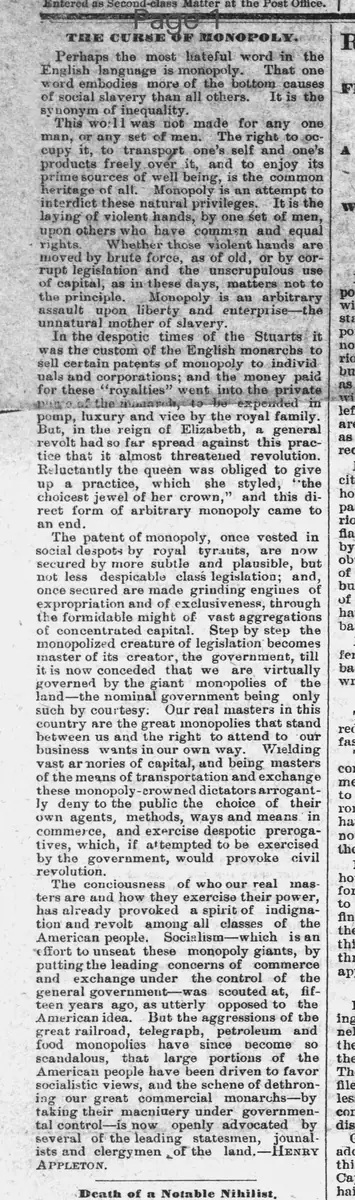
Perhaps the most hateful word in the English language is monopoly. That one word embodies more of the bottom causes of social slavery than all others. It is the synonym of inequality. This world was not made for any one man, or any set of men. The right to occupy it, to transport one's self and one's products freely over it, and to enjoy its prime sources of well being, is the common heritage of all. Monopoly is an attempt to interdict these natural privileges. It is the laying of violent hands, by one set of men, upon others who have common and equal rights. Whether those violent hands are moved by brute force, as of old, or by corrupt legislation and the unscrupulous use of capital, as in these days, matters not to the principle. Monopoly is an arbitrary assault upon liberty and enterprise--the unnatural mother of slavery.
In the despotic times of the Stuarts it was the custom of the English monarchs to sell certain patents of monopoly to individuals and corporations; and the money paid for these "royalties" went into the private purse of the monarch, to be expended in pomp, luxury and vice by the royal family. But, in the reign of Elizabeth, a general revolt had so far spread against this practice that it almost threatened revolution. Reluctantly the queen was obliged to give up a practice, which she styled, the "choicest jewel of her crown," and this direct form of arbitrary monopoly came to an end.
The patent of monopoly, once vested in social despots by royal tyrants, are now secured by more subtle and plausible, but not less despicable class legislation; and once secured are made grinding engines of expropriation and of exclusiveness, through the formidable might of vast aggregations of concentrated capital. Step by step the monopolized creature of legislation becomes master of its creator, the government, till it is now conceded that we are virtually governed by the giant monopolies of the land-the nominal government being only such by courtesy; Our real masters in this country are the great monopolies that stand between us and the right to attend to our business wants in our own way. Wielding vast armories of capital, and being masters of the means of transportation and exchange these monopoly-crowned dictators arrogantly deny to the public the choice of their own agents, methods, ways and means in commerce, and exercise despotic prerogatives, which, if attempted to be exercised by the government, would provoke civil revolution.
The consciousness of who our real masters are and how they exercise their power, has already provoked a spirit of indignation and revolt among all classes of the American people. Socialism-which is an effort to unseat these monopoly giants, by putting the leading concerns of commerce and exchange under the control of the general government-was scouted at, fifteen years ago, as utterly opposed to the American idea. But the aggressions of the great railroad, telegraph, petroleum and food monopolies have since become so scandalous. that large portions of the American people have been driven to favor socialistic views, and the scheme of dethroning our great commercial monarchs-by taking their machinery under governmental control-is now openly advocated by several of the leading statesmen, journalists and clergymen ,of the land,-HENRY APPLETON.
Perhaps the most hateful word in the English language is monopoly. That one word embodies more of the bottom causes of social slavery than all others. It is the synonym of inequality. This world was not made for any one man, or any set of men. The right to occupy it, to transport one's self and one's products freely over it, and to enjoy its prime sources of well being, is the common heritage of all. Monopoly is an attempt to interdict these natural privileges. It is the laying of violent hands, by one set of men, upon others who have common and equal rights. Whether those violent hands are moved by brute force, as of old, or by corrupt legislation and the unscrupulous use of capital, as in these days, matters not to the principle. Monopoly is an arbitrary assault upon liberty and enterprise--the unnatural mother of slavery.
In the despotic times of the Stuarts it was the custom of the English monarchs to sell certain patents of monopoly to individuals and corporations; and the money paid for these "royalties" went into the private purse of the monarch, to be expended in pomp, luxury and vice by the royal family. But, in the reign of Elizabeth, a general revolt had so far spread against this practice that it almost threatened revolution. Reluctantly the queen was obliged to give up a practice, which she styled, the "choicest jewel of her crown," and this direct form of arbitrary monopoly came to an end.
The patent of monopoly, once vested in social despots by royal tyrants, are now secured by more subtle and plausible, but not less despicable class legislation; and once secured are made grinding engines of expropriation and of exclusiveness, through the formidable might of vast aggregations of concentrated capital. Step by step the monopolized creature of legislation becomes master of its creator, the government, till it is now conceded that we are virtually governed by the giant monopolies of the land-the nominal government being only such by courtesy; Our real masters in this country are the great monopolies that stand between us and the right to attend to our business wants in our own way. Wielding vast armories of capital, and being masters of the means of transportation and exchange these monopoly-crowned dictators arrogantly deny to the public the choice of their own agents, methods, ways and means in commerce, and exercise despotic prerogatives, which, if attempted to be exercised by the government, would provoke civil revolution.
The consciousness of who our real masters are and how they exercise their power, has already provoked a spirit of indignation and revolt among all classes of the American people. Socialism-which is an effort to unseat these monopoly giants, by putting the leading concerns of commerce and exchange under the control of the general government-was scouted at, fifteen years ago, as utterly opposed to the American idea. But the aggressions of the great railroad, telegraph, petroleum and food monopolies have since become so scandalous. that large portions of the American people have been driven to favor socialistic views, and the scheme of dethroning our great commercial monarchs-by taking their machinery under governmental control-is now openly advocated by several of the leading statesmen, journalists and clergymen ,of the land,-HENRY APPLETON.
What sub-type of article is it?
Economic Policy
Social Reform
What keywords are associated?
Monopoly
Social Slavery
Inequality
Class Legislation
Railroad Monopolies
Socialism
Government Control
What entities or persons were involved?
Monopolies
Stuarts
Elizabeth
Railroad Monopolies
Telegraph Monopolies
Petroleum Monopolies
Food Monopolies
Henry Appleton
Editorial Details
Primary Topic
Critique Of Monopolies As Assaults On Liberty
Stance / Tone
Strongly Anti Monopoly
Key Figures
Monopolies
Stuarts
Elizabeth
Railroad Monopolies
Telegraph Monopolies
Petroleum Monopolies
Food Monopolies
Henry Appleton
Key Arguments
Monopoly Embodies Inequality And Social Slavery
Monopoly Interdicts Natural Privileges Of Liberty And Enterprise
Historical Royal Monopolies Ended Under Elizabeth Due To Revolt
Modern Monopolies Secured By Class Legislation Control Government
Monopolies Deny Public Choice In Commerce And Exercise Despotic Power
Aggressions Of Monopolies Provoke Indignation And Support For Socialism
Socialism Advocated To Place Commerce Under Government Control