Thank you for visiting SNEWPapers!
Sign up free
Editorial
August 27, 1937
Worcester Democrat And The Ledger Enterprise
Pocomoke City, Worcester County, Maryland
What is this article about?
The editorial criticizes the failure of the 'basic rule' speed law, attributing most fatal accidents to excessive speed, and calls for fixed speed limits, strict enforcement, and nationwide modernization of traffic codes to curb rising automobile deaths.
Clipping
OCR Quality
100%
Excellent
Full Text
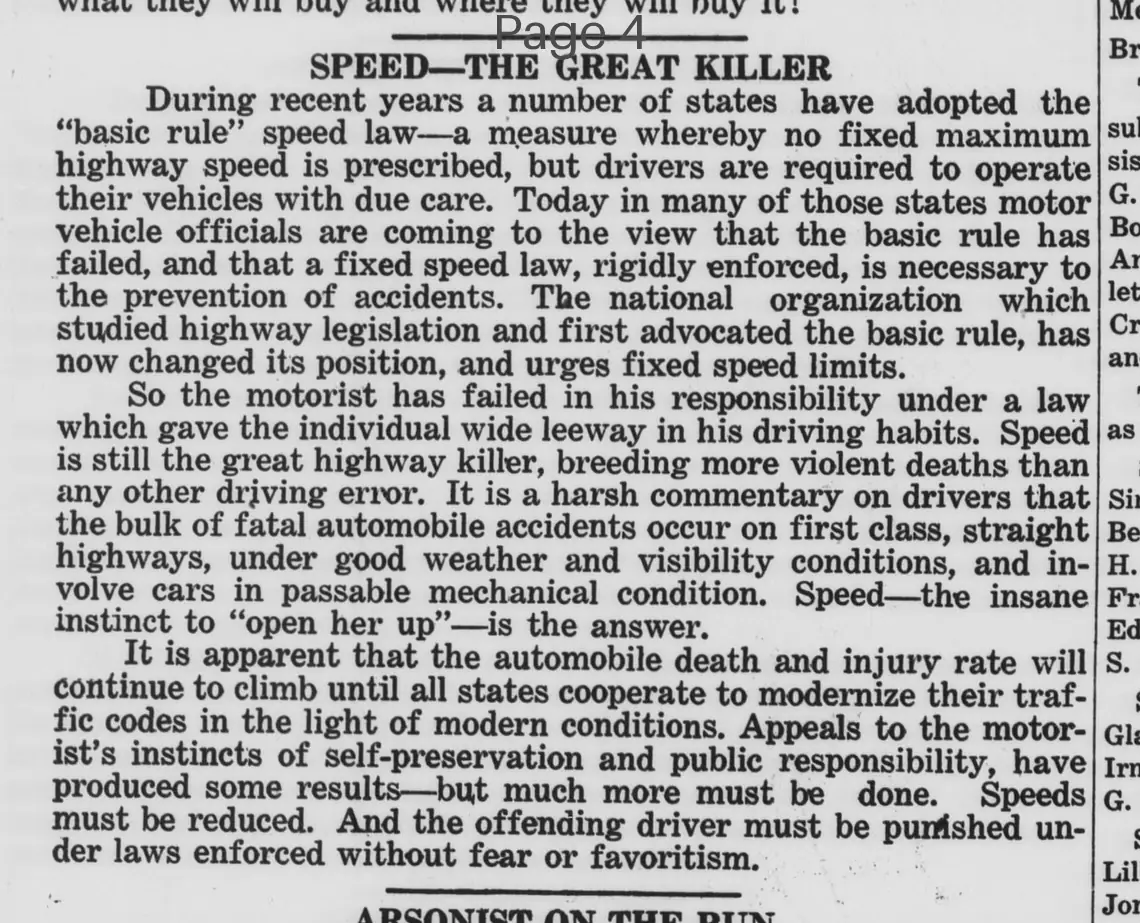
SPEED-THE GREAT KILLER
During recent years a number of states have adopted the "basic rule" speed law-a measure whereby no fixed maximum highway speed is prescribed, but drivers are required to operate their vehicles with due care. Today in many of those states motor vehicle officials are coming to the view that the basic rule has failed, and that a fixed speed law, rigidly enforced, is necessary to the prevention of accidents. The national organization which studied highway legislation and first advocated the basic rule, has now changed its position, and urges fixed speed limits.
So the motorist has failed in his responsibility under a law which gave the individual wide leeway in his driving habits. Speed is still the great highway killer, breeding more violent deaths than any other driving error. It is a harsh commentary on drivers that the bulk of fatal automobile accidents occur on first class, straight highways, under good weather and visibility conditions, and involve cars in passable mechanical condition. Speed-the insane instinct to "open her up"-is the answer.
It is apparent that the automobile death and injury rate will continue to climb until all states cooperate to modernize their traffic codes in the light of modern conditions. Appeals to the motorist's instincts of self-preservation and public responsibility, have produced some results-but much more must be done. Speeds must be reduced. And the offending driver must be punished under laws enforced without fear or favoritism.
During recent years a number of states have adopted the "basic rule" speed law-a measure whereby no fixed maximum highway speed is prescribed, but drivers are required to operate their vehicles with due care. Today in many of those states motor vehicle officials are coming to the view that the basic rule has failed, and that a fixed speed law, rigidly enforced, is necessary to the prevention of accidents. The national organization which studied highway legislation and first advocated the basic rule, has now changed its position, and urges fixed speed limits.
So the motorist has failed in his responsibility under a law which gave the individual wide leeway in his driving habits. Speed is still the great highway killer, breeding more violent deaths than any other driving error. It is a harsh commentary on drivers that the bulk of fatal automobile accidents occur on first class, straight highways, under good weather and visibility conditions, and involve cars in passable mechanical condition. Speed-the insane instinct to "open her up"-is the answer.
It is apparent that the automobile death and injury rate will continue to climb until all states cooperate to modernize their traffic codes in the light of modern conditions. Appeals to the motorist's instincts of self-preservation and public responsibility, have produced some results-but much more must be done. Speeds must be reduced. And the offending driver must be punished under laws enforced without fear or favoritism.
What sub-type of article is it?
Legal Reform
Social Reform
What keywords are associated?
Speed Limits
Highway Safety
Traffic Laws
Automobile Accidents
Driver Responsibility
What entities or persons were involved?
Motor Vehicle Officials
National Organization
Editorial Details
Primary Topic
Advocacy For Fixed Speed Limits And Stricter Traffic Enforcement
Stance / Tone
Critical Of Drivers' Irresponsibility And Urging Modernization Of Traffic Laws
Key Figures
Motor Vehicle Officials
National Organization
Key Arguments
Basic Rule Speed Law Has Failed
Fixed Speed Limits Are Necessary To Prevent Accidents
Speed Is The Primary Cause Of Fatal Highway Accidents
Fatal Accidents Often Occur On Good Roads Under Ideal Conditions
Appeals To Self Preservation Have Been Insufficient
All States Must Cooperate To Reduce Speeds And Punish Offenders Rigidly