Thank you for visiting SNEWPapers!
Sign up free
Daily National Intelligencer
Washington, District Of Columbia
What is this article about?
In a U.S. congressional committee debate on the direct tax post-War of 1812, Mr. Tucker advocates retaining part of the tax to fund military maintenance, navy expansion, and rapid public debt reduction, stressing national preparedness against future threats while countering objections on republicanism and state rights.
Merged-components note: Continuation of the full narrative article on the debate regarding the direct tax, spanning from page 2 to page 3. The second component's label changed from 'domestic_news' to 'story' as it forms part of a cohesive, detailed article rather than brief local news.
Clippings
1 of 2
OCR Quality
Full Text
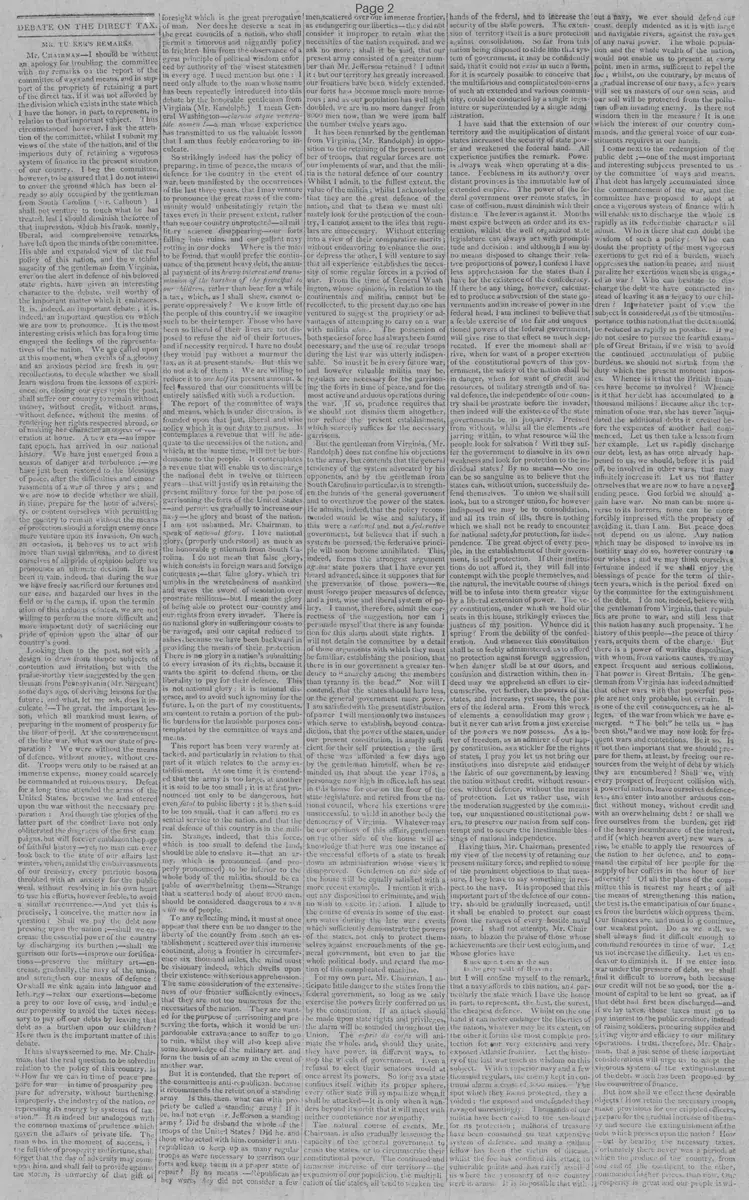
MR. TUCKER'S REMARKS.
Mr. Chairman—I should be without an apology for troubling the committee with my remarks on the report of the committee of ways and means, and in support of the propriety of retaining a part of the direct tax, if it was not afforded by the division which exists in the state which I have the honor, in part, to represent, in relation to that important subject. Thus circumstanced however, I ask the attention of the committee, whilst I submit my views of the state of the nation, and of the imperious duty of retaining a vigorous system of finance in the present situation of our country. I beg the committee, however, to be assured that I do not intend to cover the ground which has been already so ably occupied by the gentleman from South Carolina (Mr. Calhoun). I shall not venture to touch what he has treated, lest I should diminish the force of that impression, which his frank, manly, liberal, and comprehensive remarks, have left upon the minds of the committee. His able and expanded view of the real policy of this nation, and the watchful sagacity of the gentleman from Virginia, ever on the alert in defence of his beloved state rights, have given an interesting character to the debate, well worthy of the important matter which it embraces. It is, indeed, an important debate; it is, indeed, an important question on which we are now to pronounce. It is the most interesting crisis which has for a long time engaged the feelings of the representatives of the nation. We are called upon at this moment, when events of a gloomy and an anxious period are fresh in our recollections, to decide whether we shall learn wisdom from the lessons of experience, or, closing our eyes upon the past, shall suffer our country to remain without money, without credit, without arms, without defence, without the means of rendering her rights respected abroad, or of making her character an object of veneration at home. A new era—an important epoch, has arrived in our national history. We have just emerged from a season of danger and turbulence; we have just been restored to the blessings of peace, after the difficulties and embarrassments of a war of three years; and we are now to decide whether we shall, in time, prepare for the hour of adversity, or content ourselves with permitting the country to remain without the means of protection, should a foreign enemy once more venture upon its invasion. On such an occasion, it behoves us to act with more than usual calmness, and to divest ourselves of all pride of opinion before we pronounce an ultimate decision. It has been in vain, indeed, that during the war we have freely sacrificed our fortunes and our ease, and hazarded our lives in the field or in the camp, if, upon the termination of this arduous contest, we are not willing to perform the more difficult and more important duty of sacrificing our pride of opinion upon the altar of our country's good.
Looking then to the past, not with a design to draw from thence subjects of contention and irritation, but with the praise-worthy view suggested by the gentleman from Pennsylvania (Mr. Sargeant) some days ago, of deriving lessons for the future; and what, let me ask, does it inculcate—The great, the important lesson, which all mankind must learn, of preparing in the moment of prosperity for the hour of peril. At the commencement of the late war, what was our state of preparation? We were without the means of defence, without money, without credit. Troops were only to be raised at an immense expense, money could scarcely be commanded at ruinous usury. Defeat for a long time attended the arms of the United States, because we had entered upon the war without the necessary preparation: And though the glories of the latter part of the conflict have not only obliterated the disgraces of the first campaigns, but will forever emblazon the page of faithful history—yet, no man can ever look back to the state of our affairs last winter, when, amidst the embarrassments of our treasury, every patriotic bosom throbbed with an anxiety for the public weal, without resolving in his own heart to use his efforts, however feeble, to avoid a similar recurrence.—And yet this is precisely, I conceive, the matter now in question: Shall we pay the debt now pressing upon the nation;—shall we increase the essential power of the country by discharging its burthen;—shall we garrison our forts—improve our fortifications—preserve the military art—encrease, gradually, the navy of the union, and strengthen our means of defence? Or shall we sink again into languor and lethargy—relax our exertions—become a prey to our love of ease, and indulge our propensity to avoid the taxes necessary to pay off our debts by leaving that debt as a burthen upon our children?
Here then is the important matter of this debate.
It has always seemed to me, Mr. Chairman, that the real question to be solved in relation to the policy of this country, is "How far we can in time of peace prepare for war in time of prosperity prepare for adversity, without burthening improperly, the industry of the nation, or repressing its energy by systems of taxation." It is indeed but analogous with the common maxims of prudence which govern the affairs of private life. The man who, in the moment of success, in the full tide of prosperity and fortune, shall forget that the day of adversity may come upon him, and shall fail to provide against the storm, is unworthy of that gift of foresight which is the great prerogative of man. Nor does he deserve a seat in the great councils of a nation, who shall permit a timorous and niggardly policy to frighten him from the observance of a great principle of political wisdom enforced by authority of the wisest statesmen in every age. I need mention but one: I need only allude to the man whose name has been repeatedly introduced into this debate by the honorable gentleman from Virginia (Mr. Randolph.) I mean General Washington—ciarum atque venerabile nomen!—a man whose experience has transmitted to us the valuable lesson that I am thus feebly endeavoring to inculcate.
So strikingly indeed has the policy of preparing, in time of peace, the means of defence for the country in the event of war, been manifested by the occurrences of the last three years, that I may venture to pronounce the great mass of the community would unhesitatingly retain the taxes even in their present extent, rather than see our country unprotected—all military science disappearing—our forts falling into ruins, and our gallant navy rotting in our docks. Where is the man to be found, that would prefer the continuance of the present heavy debt, the annual payment of its heavy interest and transmission of the burthen of the principal to our children, rather than bear for a while a tax, which, as I shall shew, cannot operate oppressively? We know little of the people of this country, if we imagine such to be their temper. Those who have been so liberal of their lives are not disposed to refuse the aid of their fortunes, and if necessity required, I have no doubt they would pay without a murmur the tax, as it at present stands. But this we do not ask of them: We are willing to reduce it to one half its present amount, & feel assured that our constituents will be entirely satisfied with such a reduction.
The report of the committee of ways and means, which is under discussion, is founded upon that just, liberal and wise policy which it is our duty to pursue. It contemplates a revenue that will be adequate to the necessities of the nation, and which, at the same time, will not be burthensome to the people. It contemplates a revenue that will enable us to discharge the national debt in twelve or thirteen years—that will justify us in retaining the present military force for the purpose of garrisoning the forts of the United States—and permit us gradually to increase our navy—the glory and boast of the nation.
I am not ashamed, Mr. Chairman, to speak of national glory. I love national glory, (properly understood) as much as the honorable gentleman from South Carolina. I do not mean that false glory, which consists in foreign wars and foreign conquests;—that false glory, which triumphs in the wretchedness of mankind and waves the sword of desolation over prostrate millions—but I mean the glory of being able to protect our country and our rights from every invader. There is no national glory in suffering our coasts to be ravaged, and our capital reduced to ashes, because we have been backward in providing the means of their protection. There is no glory in a nation's submitting to every invasion of its rights, because it wants the spirit to defend them, or the liberality to pay for their defence. This is not national glory; it is national disgrace, and to avoid such ignominy for the future, I, on the part of my constituents, am content to retain a portion of the public burdens for the laudable purposes contemplated by the committee of ways and means.
This report has been very warmly attacked, and particularly in relation to that part of it which relates to the army establishment. At one time it is contended that the army is too large, at another it is said to be too small; it is at first pronounced not only to be dangerous, but even fatal to public liberty: it is then said to be too small, that it can afford no essential service to the nation, and that the real defence of this country is in the militia. Strange, indeed, that this force, which is too small to defend the land, should be able to enslave it—that an army, which is pronounced (and properly pronounced) to be inferior to the whole body of the militia, should be capable of overwhelming them—Strange that a scattered body of about 8000 men, should be considered dangerous to several millions of people.
To any reflecting mind, it must at once appear that there can be no danger to the liberty of the country from such an establishment; scattered over this immense continent, along a frontier in circumference six thousand miles, the mind must be visionary indeed, which dwells upon their existence with serious apprehension. The same consideration of the extensiveness of our frontier sufficiently evinces, that they are not too numerous for the necessities of the nation. They are wanted for the purpose of garrisoning and preserving the forts, which it would be unpardonable extravagance to suffer to go to ruin, whilst they will also keep alive some knowledge of the military art, and form the basis of an army in the event of another war.
But it is contended, that the report of the committee is anti-republican, because it recommends the retention of a standing army. Is this, then, what can with propriety be called a standing army? If it be, had not even Mr. Jefferson a standing army? Did he disband the whole of the troops of the United States? Did he, and those who acted with him, consider it anti-republican to keep up as many regular troops as were necessary to garrison our forts and keep them in a proper state of repair? By no means—Republican as they were, they did not consider a few men, scattered over our immense frontier as endangering our liberties—they did not consider it improper to retain what the necessities of the nation required, and we ask no more; shall it be said, that our present army consisted of a greater number than Mr. Jefferson retained? I admit it: but our territory has greatly increased our frontiers have been widely extended. our forts have become much more numerous; and as our population has well nigh doubled, we are in no more danger from 8000 men now, than we were from half the number twelve years ago.
It has been remarked by the gentleman from Virginia, (Mr. Randolph) in opposition to the retaining of the present number of troops, that regular forces are not our implements of war, and that the militia is the natural defence of our country. Whilst I admit, to the fullest extent, the value of the militia; whilst I acknowledge that they are the great defence of the nation, and that to them we must ultimately look for the protection of the country, I cannot assent to the idea that regulars are unnecessary. Without entering into a view of their comparative merits; without endeavoring to enhance the one, or depress the other, I will venture to say that all experience establishes the necessity of some regular forces in a period of war. From the time of General Washington, whose opinions, in relation to the continentals and militia, cannot but be recollected, to the present day, no one has ventured to suggest the propriety or advantages of attempting to carry on a war with militia alone. The possession of both species of force has always been found necessary, and the use of regular troops during the last war was utterly indispensable. So must it be in every future war; and however valuable militia may be, regulars are necessary for the garrisoning the forts in time of peace, and for the most active and arduous operations during the war. If so, prudence requires that we should not dismiss them altogether, nor reduce the present establishment, which scarcely suffices for the necessary garrisons.
But the gentleman from Virginia, (Mr. Randolph) does not confine his objections to the army, but contends that the general tendency of the system advocated by his opponents, and by the gentleman from South Carolina in particular, is to strengthen the hands of the general government and to overthrow the power of the states. He admits, indeed, that the policy recommended would be wise and salutary, if this were a national and not a federative government, but believes that if such a system be pursued, the federative principle will soon become annihilated. This, indeed, forms the strongest argument against state powers that I have ever yet heard advanced, since it supposes that for the preservation of those powers—we must forego proper measures of defence. and a just, wise and liberal system of policy. I cannot, therefore, admit the correctness of the suggestion, nor can I persuade myself that there is any foundation for this alarm about state rights. I will not detain the committee by a detail of those arguments with which they must be familiar, establishing the position, that there is in our government a greater tendency to "anarchy among the members than tyranny in the head." Nor will I contend, that the states should have less, or the general government more power. I am satisfied with the present distribution of power. I will mention only two instances which serve to establish, beyond contradiction, that the power of the states, under our present constitution, is amply sufficient for their self protection; the first of these was afforded a few days ago by the gentleman himself, when he reminded us, that about the year 1798, a personage now high in office, left his seat in this house for one on the floor of the state legislature, and retired from the national council, where his exertions were unsuccessful, to wield in another body the democracy of Virginia. Whatever may be our opinions of this affair, gentlemen on the other side of the house will acknowledge that here was one instance of the successful efforts of a state to break down an administration whose views it disapproved. Gentlemen on our side of the house will be equally satisfied with a more recent example. I mention it without any disposition to criminate, and with no wish to excite irritation. I allude to the course of events in some of the eastern states during the late war; events which sufficiently demonstrate the powers of the states, not only to protect themselves against encroachments of the general government, but even to jar the whole political body, and retard the motion of this complicated machine.
For my own part, Mr. Chairman, I anticipate little danger to the states from the federal government, so long as we only exercise the powers fairly conferred on us by the constitution. If an attack should be made upon state rights and privileges, the alarm will be sounded throughout the Union. The esprit du corps will animate the whole, and, should they unite, they have power, in different ways, to stop the wheels of government. Even a refusal to elect their senators would at once arrest its powers. So long as a state confines itself within its proper sphere, every other state will sympathize when it shall be attacked—It is only when it wanders beyond its orbit that it will meet with neither countenance nor sympathy.
The natural course of events, Mr. Chairman, is also gradually lessening the capacity of the general government to crush the states, or to circumscribe their constitutional power. The continued and immense increase of our territory—the expansion of our population, the multiplication of the states, all tend to weaken the hands of the federal, and to increase the security of the state powers. The extension of territory itself is a sure protection against consolidation. So far from this nation being disposed to slide into that system of government, it may be confidently said, that it could not exist in such a form, for it is scarcely possible to conceive that the multifarious and complicated concerns of such an extended and various community, could be conducted by a single legislature or superintended by a single administration.
I have said that the extension of our territory and the multiplication of distant states increased the security of state power and weakened the federal band. All experience justifies the remark. Power is always weak when operating at a distance. Feebleness in its authority over distant provinces is the immutable law of extended empire. The power of the federal government over remote states, in case of collision, must diminish with their distance. The lever is against it. Months must expire between an order and its execution, whilst the well organized state legislature can always act with promptitude and decision: and although I am by no means disposed to change their relative proportions of power, I confess I have less apprehension for the states than I have for the existence of the confederacy.
If there be any thing, however, calculated to produce a subversion of the state governments and an increase of power in the federal head, I am inclined to believe that a feeble exercise of the fair and unquestioned powers of the federal government, will give rise to that effect so much deprecated. If ever the moment shall arrive, when for want of a proper exertion of the constitutional powers of this government, the safety of the nation shall be in danger, when for want of credit and resources, of military strength and of naval defence, the independence of our country shall be prostrate before the invader, then indeed will the existence of the state governments be in jeopardy. Pressed from without, whilst all the elements are jarring within, to what resource will the people look for salvation? Will they suffer the government to dissolve in its own weakness and look for protection to the individual states? By no means—No one can be so sanguine as to believe that the states can, without union, successfully defend themselves. To union we shall still look, but to a stronger union, for however indisposed we may be to consolidation, and all its train of ills, there is nothing which we shall not be ready to encounter for national safety, for protection, for independence. The great object of every people, in the establishment of their government, is self protection. If their institutions do not afford it, they will fall into contempt with the people themselves, and the natural, the inevitable course of things will be to infuse into them greater vigor by a liberal extension of power. The very constitution, under which we hold our seats in this house, strikingly evinces the justness of my position. Whence did it spring? From the debility of the confederation. And whenever this constitution shall be so feebly administered, as to afford no protection against foreign aggression, when danger shall be at our doors, and confusion and distraction within, then indeed may we apprehend an effort to circumscribe, yet farther, the powers of the states, and increase, yet more, the powers of the federal arm. From this wreck of elements a consolidation may grow; but it never can arise from a just exercise of the powers we now possess. As a lover of freedom, as an admirer of our happy constitution, as a stickler for the rights of states, I pray you let us not bring our institutions into disrepute and endanger the fabric of our government, by leaving the nation without credit, without resources, without defence, without the means of protection. Let us rather use, with the moderation suggested by the committee, our unquestioned constitutional powers, to preserve our nation from self contempt and to secure the inestimable blessings of national independence.
Having thus, Mr. Chairman, presented my view of the necessity of retaining our present military force, and replied to some of the prominent objections to that measure, I beg leave to say something in respect to the navy. It is proposed that this important part of the defence of our country, should be gradually increased, until it shall be enabled to protect our coast from the ravages of every hostile naval power. I shall not attempt, Mr. Chairman, to blazon the praise of those whose achievements are their best eulogium, and whose glories have
Such upon them as the sun
In the grey vault of Heaven;
but I will confine myself to the remark, that a navy affords to this nation, and particularly the state which I have the honor in part, to represent, the best, the surest, the cheapest defence. Whilst on the one hand it can never endanger the liberties of the nation, whatever may be its extent, on the other it forms the most complete protection for our very extensive and very exposed Atlantic frontier. Let the history of the last war teach us wisdom on this subject. With a superior navy and a few thousand regulars, the enemy kept in continual alarm a coast of 3000 miles.—The spot which they found protected, they avoided; the exposed and undefended they ravaged unresistingly. Thousands of our militia have been called to the sea-board for its protection; millions of treasure have been consumed on that expensive system of defence, and many a gallant fellow has been the victim of disease. whilst the foe has confined his attack to vulnerable points and has rarely assailed us where the yeomanry of our country were in arms. It is impossible that without a navy, we ever should defend our coast, deeply indented as it is with large and navigable rivers, against the ravages of any naval power. The whole population and the whole wealth of the nation, would not enable us to present at every point, men in arms, sufficient to repel the foe; whilst, on the contrary, by means of a gradual increase of our navy, a few years will see us masters of our own seas, and our soil will be protected from the pollution of an invading enemy. Is there not wisdom then in the measure? It is one which the interest of our country commands, and the general voice of our constituents requires at our hands.
I come next to the redemption of the public debt;—one of the most important and interesting subjects presented to us by the committee of ways and means. That debt has largely accumulated since the commencement of the war, and the committee have proposed to adopt at once a vigorous system of finance which will enable us to discharge the whole as rapidly as its redeemable character will admit. Who is there that can doubt the wisdom of such a policy? Who can doubt the propriety of the most vigorous exertions to get rid of a burden, which oppresses the nation in peace, and must paralyze her exertions when she is engaged in war? Who can hesitate to discharge the debt we have contracted instead of leaving it as a legacy to our children? In whatever point of view the subject is considered, it is of the utmost importance to this nation, that the debt should be reduced as rapidly as possible. if we do not desire to pursue the fearful example of Great Britain, if we wish to avoid the continued accumulation of public burdens, we should not shrink from the duty which the present moment imposes. Whence is it that the British finances have become so involved? Whence is it that her debt has accumulated to a thousand millions? Because after the termination of one war, she has never "liquidated the additional debts it created before the expences of another had commenced. Let us then take a lesson from her example. Let us rapidly discharge our debt, lest, as has once already happened to us, we should, before it is paid off, be involved in other wars, that may infinitely increase it. Let us not flatter ourselves that we are now to have a never ending peace. God forbid we should again have war. No man can be more averse to its horrors, none can be more forcibly impressed with the propriety of avoiding it, than I am. But peace does not depend on us alone. Any nation which may be disposed to involve us in hostility may do so, however contrary to our wishes; and we may think ourselves fortunate indeed if we shall enjoy the blessings of peace for the term of thirteen years, which is the period fixed on by the committee for the extinguishment of the debt. I do not, indeed, believe with the gentleman from Virginia, that republics are prone to war, and still less that this nation has any such propensity. The history of this people—the peace of thirty years, acquits them of the charge. But there is a power of warlike disposition, with whom, from various causes, we may expect frequent and serious collisions. That power is Great Britain. The gentleman from Virginia has indeed admitted that other wars with that powerful people are not only probable, but certain. It is one of the evil consequences, as he alleges, of the war from which we have emerged. "The bolt" he tells us "has been shot," and we may now look for frequent wars and contentions. Be it so. Is it not then important that we should prepare for them, at least, by freeing our resources from the weight of debt by which they are encumbered? Shall we, with every prospect of frequent collision with a powerful nation, leave ourselves defenceless, and enter into another arduous conflict without money, without credit and with an overwhelming debt? or shall we free ourselves from the burden, get rid of the heavy incumbrance of the interest, and if (which heaven avert) new wars arise, be enabled to apply the resources of the nation to her defence, and to command the capital of her people for the supply of her coffers in the hour of her adversity? Of all the plans of the committee this is nearest my heart; of all the means of strengthening this nation, the best is, the emancipation of our finances from the burdens which oppress them. Our finances are, and must long continue, our weakest point. Do as we will, we shall always find it difficult enough to command resources in time of war. Let us not increase the difficulty. Let us endeavor to diminish it. If we enter into war under the pressure of debt, we shall find it difficult to borrow, both because our credit will not be so good, nor the amount of capital to be lent so great, as if that debt had first been discharged—and if we lay taxes, those taxes must go to pay interest to the public creditor, instead of raising soldiers, procuring supplies and giving vigor and efficacy to our military operations. I trust, therefore, Mr. Chairman, that a just sense of these important considerations will urge us to adopt the vigorous system of the extinguishment of the debt, which has been proposed by the committee of finance.
But how shall we effect these desirable objects? How retain the necessary troops, make provisions for our crippled officers, prepare for the gradual increase of the navy and secure the extinguishment of the debt which presses upon the nation? How—but by bearing the necessary taxes. Fortunately there never was a period, at which the produce of the country, from one end of the continent to the other, commanded higher prices than now. Our prosperity is great and our people are willing to pay something towards the important objects I have been contemplating. They will perceive that all the taxes have been reduced to about one half their former amount, and those which were peculiarly oppressive or disagreeable have been entirely removed. I feel the fullest confidence that they will approve the measures which proposes to retain a portion, rather than forego the advantages we have in view.
There remain but a few remarks, in relation to the direct tax in particular, with which I shall trouble the committee. It has been severely animadverted on as unequal and oppressive. I cannot believe it. If indeed there be an inequality, I am surprised to hear the complaints from the quarter whence they have proceeded. If unequal, it must operate against those states where the nominal price of the land bears the greatest proportion to its real value. It must therefore, be unfavorable to thickly settled states, and favorable to the people of the South and the West, whose population is more dispersed and whose lands are not estimated at their intrinsic worth. But the inequality if it existed cannot be very important, since the tax itself is so light: amounting in the state of Virginia, to only fourteen cents on one hundred dollars value, or about seven dollars on an estate worth five thousand. The people of these states are too intelligent to be led to regard a tax like this as odious and oppressive.
I know not Mr. Chairman, whether it be in order to allude to the probable course, which may be pursued in the other branch of the Legislature (the Senate.) Let it be recollected that, by the law of the last session, the direct tax was rendered permanent and it cannot now be removed without the consent of that Branch. There is reason to suppose, that if an entire repeal of the tax should pass this house, the Senate may reject it, and gentlemen will, probably be left to the alternative of taking a permanent tax of six millions, or a tax for one year of three millions. If, then, they are averse to the direct tax, they ought to support the resolution upon your table, rather than encounter the still greater evil which will ensue from its rejection.
In tendering my thanks to the committee for their polite attention to my lame and uninteresting remarks, I will conclude with expressing my earnest solicitude that we may pursue the path, on the present important occasion, that leads to the happiness and honour of our common country.
What sub-type of article is it?
What themes does it cover?
What keywords are associated?
What entities or persons were involved?
Where did it happen?
Story Details
Key Persons
Location
U.S. Congress, Committee Of Ways And Means
Event Date
After The War Of Three Years (Circa 1815)
Story Details
Mr. Tucker delivers a speech supporting the retention of part of the direct tax to fund national defense, including maintaining a standing army of about 8000 men, gradually increasing the navy, and extinguishing the public debt in 12-13 years, drawing lessons from the recent War of 1812 and countering arguments against it as anti-republican or threatening state rights.