Thank you for visiting SNEWPapers!
Sign up free
Story
October 7, 1902
The Silver Messenger
Challis, Custer County, Idaho
What is this article about?
A correspondent debunks a Missouri paper's claim that February 1886 had no full moon, confirming it occurred on the 18th via almanac. Notes Februaries 1893 and 1866 lacked one, a common event every 20-30 years due to the moon's 29-day cycle and February's 28 days.
Clipping
OCR Quality
98%
Excellent
Full Text
Februarys Without Full Moon.
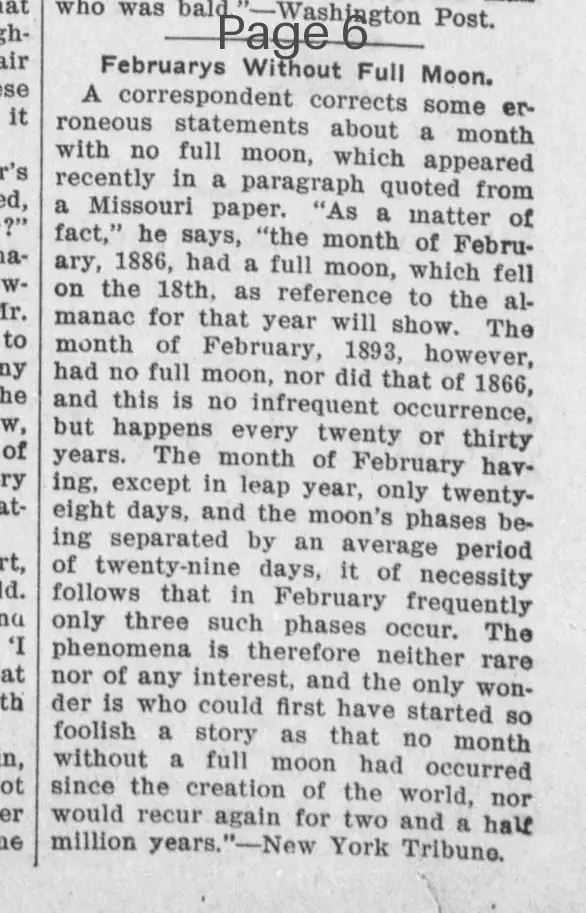
A correspondent corrects some erroneous statements about a month with no full moon, which appeared recently in a paragraph quoted from a Missouri paper. "As a matter of fact," he says, "the month of February, 1886, had a full moon, which fell on the 18th, as reference to the almanac for that year will show. The month of February, 1893, however, had no full moon, nor did that of 1866, and this is no infrequent occurrence, but happens every twenty or thirty years. The month of February having, except in leap year, only twenty-eight days, and the moon's phases being separated by an average period of twenty-nine days, it of necessity follows that in February frequently only three such phases occur. The phenomena is therefore neither rare nor of any interest, and the only wonder is who could first have started so foolish a story as that no month without a full moon had occurred since the creation of the world, nor would recur again for two and a half million years."—New York Tribune.
A correspondent corrects some erroneous statements about a month with no full moon, which appeared recently in a paragraph quoted from a Missouri paper. "As a matter of fact," he says, "the month of February, 1886, had a full moon, which fell on the 18th, as reference to the almanac for that year will show. The month of February, 1893, however, had no full moon, nor did that of 1866, and this is no infrequent occurrence, but happens every twenty or thirty years. The month of February having, except in leap year, only twenty-eight days, and the moon's phases being separated by an average period of twenty-nine days, it of necessity follows that in February frequently only three such phases occur. The phenomena is therefore neither rare nor of any interest, and the only wonder is who could first have started so foolish a story as that no month without a full moon had occurred since the creation of the world, nor would recur again for two and a half million years."—New York Tribune.
What sub-type of article is it?
Curiosity
Historical Event
What themes does it cover?
Nature
Deception
What keywords are associated?
Full Moon
February
Lunar Phases
Almanac Correction
Astronomical Phenomenon
Story Details
Event Date
February 1886, February 1893, February 1866
Story Details
Correspondent corrects erroneous claim from Missouri paper that February 1886 had no full moon, confirming it on the 18th; notes 1893 and 1866 lacked one, common due to lunar cycle and February's length; dismisses exaggerated rarity as foolish.