Thank you for visiting SNEWPapers!
Sign up free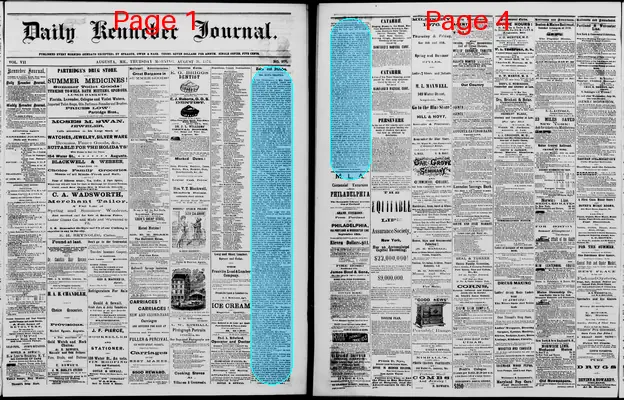
Literary
August 31, 1876
Daily Kennebec Journal
Augusta, Kennebec County, Maine
What is this article about?
On Christmas Eve in her boarding house, aging Mrs. Dunn shares with lonely boarder Mr. Royburne her painful memories of a youthful romance with Jules Alderney in Croftford, stirred by holiday nostalgia and music.
Merged-components note: Continuation of the serialized story 'Mrs. Dunn's Christmas' across pages.
Clippings

1 of 2
OCR Quality
95%
Excellent
Full Text
Tales and Sketches.
MRS. DUNN'S CHRISTMAS.
It was Christmas-eve in Mrs. Dunn's cozy parlor; the backlog blazed and snapped with a good will, as if it remembered the days when the sunshine crept into her heart; the candles burned with a clear radiance on the mantel. Outside the snow fell and drifted against the pane, the wind whistled loudly, as if to drown the Christmas bells that now seemed far away, and upon it rang out like clarion calls.
Mrs. Dunn herself sat before the highly polished fender with her knitting-a woman who had been pretty once, but no longer young now, with hair quite gray, and the traces of the tears that time had dried upon her pale cheeks, one might have said, just as the showers of long past ages have left their prints on the stiffened soil. Mrs. Dunn's tears had indeed been shed long ago, but they burned yet so surely as the twilight of Christmas-eve fell about her. To-night her house full of boarders had all betaken themselves their several ways, this one to spend the holiday with his partner's family, that one with his mother in the country, the other with his sweetheart, till nobody was left but Mr. Royburne-a man as gray and worn as herself-who had only his violin to keep Christmas. He sat now in the chimney-corner, drawing the bow across his violin, and bringing up long-past and half-forgotten scenes by the necromancy of his chords and melodies.
"One feels the need of a home on Christmas-eve, Mrs. Dunn," he said presently, breaking off the air of "Auld Lang Syne" suddenly. "Not but this is as much a home as I've ever known, and no bad substitute; yet perhaps it's only a sentimentality, but when a man reaches my time of life it goes hard with him to remember that he has found, as the poet says, his warmest welcome at an inn."
"No doubt, no doubt!" sighed Mrs. Dunn. "It seems as if a boarding-house were only a way-station to something more permanent. That's the way it used to seem to me when I was twenty-five. Do you know. I've got to kind of dread Christmas-eve as much as I used to love it; it's a sort of landmark now that shows how far we've wandered from the hopes and promises of youth. As you say, it's a night when one needs a fireside. in its true sense. and love and friends. and all they expected to have when life was young;" and Mrs. Dunn's voice trembled and broke, and Mr. Royburne drew out a chord that sounded like an "amen."
"You may laugh if you like at an old woman like me," she said when she had recovered herself; "but I had a blow in my young days that I've never got the better of-a love affair-"
"Yes? Let those laugh who win. We all keep a corner of our hearts where no one enters."
"And every Christmas time the pain bites deeper, till it seems as if I could not bear it, just as an old wound is said to throb and ache at its anniversary." Mr. Royburne tapped his violin gently, as much as to say, "We know what that is." but he looked curiously at his landlady. Having lived two years under her roof, and found her efficient in all the practical affairs of life, and always cheerful. it had hardly occurred to him that she had a more tender or romantic side, though he knew her to be companionable and even sympathetic, and with something in her voice, that brought up the image of a fair woman he had loved long ago.
"It was when I was barely twenty-five," she continued. I ought to have outgrown it and him by this time, but I'm afraid I'm not strongminded. There! I shall bore you to death. Mr. Royburne-there are some folks who have no mercy on a listener: but somehow I feel like talking about myself to-night."
"And I feel like hearing about yourself to-night. Pray go on; a love affair's like an air of Mozart, always sweet to listen to."
"Mine wasn't sweet to live through. I promise you. You see, I'd been left alone in the world. with a trifle of money. not enough to keep me without work; that is to say, there was Aunt Huldah, rich and alive, but I'd no expectations from her. and would to Heaven I'd had no realizations! Well, I wasn't quick enough to teach, and had no knack for millinery or mantua-making. and the hundred other employments women turn their hands to nowadays were unknown and untried by them then; so I put the little I had into a boarding-house. "I didn't live about here at that time--you see, it's an old craft with me-I lived in the western part of the State, at Croftford."
"Croftford!" echoed Mr. Royburne. stooping to pick up the bow he had let fall.
"Yes. You have been there? It's thought a pretty place of its size. The house I kept looked out on the Mall, where young folks went walking arm in arm in the long summer evenings, and sometimes the band played-such tunes! They don't seem like the same thing now-adays Oh, don't you feel well to-night, Mr. Royburne?" she asked, picking up a stitch in her knitting.
"As usual, thank you. Mrs. Dunn."
"Things come out so suddenly at times," she apologized. "I thought you must be going to have an ill turn just now. You looked quite ghastly, upon my word. Are you quite sure that you feel all right?"
"It was nothing, believe me-nothing more than a twinge of rheumatism, that one must expect at my age."
"Oh! where was I? You gave me such a start, I assure you."
"The young people were walking arm in arm on the Mall, and the band was playing," giving her the cue.
"Oh. yes, thanks. I'd been in the business about a year when he came across my path. I dare say it's silly for me, with my gray hairs and crow's-feet, but sometimes of a spring morning, when I open my window and the fresh fragrance steals upon me. I find myself forgetting my years and expecting him, just as I used to; and when I come to my senses presently, all the day seems vacant and dark, and I go about with weights at my heels, and the
(CONTINUED ON FOURTH PAGE.)
[Continued from first page.]
"Spring sun is behind a cloud. I don't suppose you can understand such nonsense."
"You don't know me," said the listener, turning his back upon her to snuff the candles.
"He wasn't one of my boarders, you know," she continued, but he was intimate with some of them, and as familiar in the house as need be, coming to dine and to lunch when it pleased him, till he knew the lay of the land as well as if it belonged to him. That was long before I knew that he cared or thought of me, for though my glass told me I wasn't ill-looking it has given over telling flattering tales nowadays--yet I'd never thought much about love and that sort of thing, being a practical body, and too busy to meddle with things I wasn't called on to worry about. He got into the way, when his friends were out, of knocking at the door of my private parlor, and dropping in till they came home, as a matter of convenience, I naturally supposed, because public parlors are dreary places to wait in at the best, and he was one of those men, I'd noticed, who love luxury and prettiness desperately. But one night when the moon was up, and the band was playing out on the Mall "The girl I left behind me," and I was leaning out the window, after casting up my accounts for the day and giving orders for breakfast, watching the love-sick people strolling about by twos and stopping to kiss each other in the shadow of the elms--somebody tossed a handful of cinnamon roses up at my window. Of all the roses that June blows that little old-fashioned cinnamon rose is the most fragrant to me; and it was he calling to me to come down and walk: and I went down, too readily--perhaps, and we walked through half a dozen tunes--such tunes as seemed like the music of the spheres with variations. Sometimes when I've been passing your room, Mr. Royburne, you've drawn out a strain or two of those very airs on your violin, and it seemed as if I smelled rose leaves, and I've had to sit down on the stairs to recover myself. However, I'd found out something I hadn't known when I went out--I had found out that I loved Jules Alderney, whether he loved me or not. It was an embarrassing piece of news to me; it was both pain and pleasure twisted together. It made me start at every step and get nervous at every knock, and I began to look in the glass with more attention, and worry about my face, and grow absent-minded about the bills and the housekeeping, till one night I met him on the stairs; he was going up and I was coming down, and we didn't do either, and--dear, dear, what an old fool I am! I can't think of that time without tears--and the band outside in the moonlight playing 'My love is like the red, red rose.' And yet he couldn't really have loved me, you know."
"I don't know anything of the kind," broke in Mr. Royburne, almost angrily; "I'm sure that he loved you."
[Continued to-Morrow].
M.L...A.
MRS. DUNN'S CHRISTMAS.
It was Christmas-eve in Mrs. Dunn's cozy parlor; the backlog blazed and snapped with a good will, as if it remembered the days when the sunshine crept into her heart; the candles burned with a clear radiance on the mantel. Outside the snow fell and drifted against the pane, the wind whistled loudly, as if to drown the Christmas bells that now seemed far away, and upon it rang out like clarion calls.
Mrs. Dunn herself sat before the highly polished fender with her knitting-a woman who had been pretty once, but no longer young now, with hair quite gray, and the traces of the tears that time had dried upon her pale cheeks, one might have said, just as the showers of long past ages have left their prints on the stiffened soil. Mrs. Dunn's tears had indeed been shed long ago, but they burned yet so surely as the twilight of Christmas-eve fell about her. To-night her house full of boarders had all betaken themselves their several ways, this one to spend the holiday with his partner's family, that one with his mother in the country, the other with his sweetheart, till nobody was left but Mr. Royburne-a man as gray and worn as herself-who had only his violin to keep Christmas. He sat now in the chimney-corner, drawing the bow across his violin, and bringing up long-past and half-forgotten scenes by the necromancy of his chords and melodies.
"One feels the need of a home on Christmas-eve, Mrs. Dunn," he said presently, breaking off the air of "Auld Lang Syne" suddenly. "Not but this is as much a home as I've ever known, and no bad substitute; yet perhaps it's only a sentimentality, but when a man reaches my time of life it goes hard with him to remember that he has found, as the poet says, his warmest welcome at an inn."
"No doubt, no doubt!" sighed Mrs. Dunn. "It seems as if a boarding-house were only a way-station to something more permanent. That's the way it used to seem to me when I was twenty-five. Do you know. I've got to kind of dread Christmas-eve as much as I used to love it; it's a sort of landmark now that shows how far we've wandered from the hopes and promises of youth. As you say, it's a night when one needs a fireside. in its true sense. and love and friends. and all they expected to have when life was young;" and Mrs. Dunn's voice trembled and broke, and Mr. Royburne drew out a chord that sounded like an "amen."
"You may laugh if you like at an old woman like me," she said when she had recovered herself; "but I had a blow in my young days that I've never got the better of-a love affair-"
"Yes? Let those laugh who win. We all keep a corner of our hearts where no one enters."
"And every Christmas time the pain bites deeper, till it seems as if I could not bear it, just as an old wound is said to throb and ache at its anniversary." Mr. Royburne tapped his violin gently, as much as to say, "We know what that is." but he looked curiously at his landlady. Having lived two years under her roof, and found her efficient in all the practical affairs of life, and always cheerful. it had hardly occurred to him that she had a more tender or romantic side, though he knew her to be companionable and even sympathetic, and with something in her voice, that brought up the image of a fair woman he had loved long ago.
"It was when I was barely twenty-five," she continued. I ought to have outgrown it and him by this time, but I'm afraid I'm not strongminded. There! I shall bore you to death. Mr. Royburne-there are some folks who have no mercy on a listener: but somehow I feel like talking about myself to-night."
"And I feel like hearing about yourself to-night. Pray go on; a love affair's like an air of Mozart, always sweet to listen to."
"Mine wasn't sweet to live through. I promise you. You see, I'd been left alone in the world. with a trifle of money. not enough to keep me without work; that is to say, there was Aunt Huldah, rich and alive, but I'd no expectations from her. and would to Heaven I'd had no realizations! Well, I wasn't quick enough to teach, and had no knack for millinery or mantua-making. and the hundred other employments women turn their hands to nowadays were unknown and untried by them then; so I put the little I had into a boarding-house. "I didn't live about here at that time--you see, it's an old craft with me-I lived in the western part of the State, at Croftford."
"Croftford!" echoed Mr. Royburne. stooping to pick up the bow he had let fall.
"Yes. You have been there? It's thought a pretty place of its size. The house I kept looked out on the Mall, where young folks went walking arm in arm in the long summer evenings, and sometimes the band played-such tunes! They don't seem like the same thing now-adays Oh, don't you feel well to-night, Mr. Royburne?" she asked, picking up a stitch in her knitting.
"As usual, thank you. Mrs. Dunn."
"Things come out so suddenly at times," she apologized. "I thought you must be going to have an ill turn just now. You looked quite ghastly, upon my word. Are you quite sure that you feel all right?"
"It was nothing, believe me-nothing more than a twinge of rheumatism, that one must expect at my age."
"Oh! where was I? You gave me such a start, I assure you."
"The young people were walking arm in arm on the Mall, and the band was playing," giving her the cue.
"Oh. yes, thanks. I'd been in the business about a year when he came across my path. I dare say it's silly for me, with my gray hairs and crow's-feet, but sometimes of a spring morning, when I open my window and the fresh fragrance steals upon me. I find myself forgetting my years and expecting him, just as I used to; and when I come to my senses presently, all the day seems vacant and dark, and I go about with weights at my heels, and the
(CONTINUED ON FOURTH PAGE.)
[Continued from first page.]
"Spring sun is behind a cloud. I don't suppose you can understand such nonsense."
"You don't know me," said the listener, turning his back upon her to snuff the candles.
"He wasn't one of my boarders, you know," she continued, but he was intimate with some of them, and as familiar in the house as need be, coming to dine and to lunch when it pleased him, till he knew the lay of the land as well as if it belonged to him. That was long before I knew that he cared or thought of me, for though my glass told me I wasn't ill-looking it has given over telling flattering tales nowadays--yet I'd never thought much about love and that sort of thing, being a practical body, and too busy to meddle with things I wasn't called on to worry about. He got into the way, when his friends were out, of knocking at the door of my private parlor, and dropping in till they came home, as a matter of convenience, I naturally supposed, because public parlors are dreary places to wait in at the best, and he was one of those men, I'd noticed, who love luxury and prettiness desperately. But one night when the moon was up, and the band was playing out on the Mall "The girl I left behind me," and I was leaning out the window, after casting up my accounts for the day and giving orders for breakfast, watching the love-sick people strolling about by twos and stopping to kiss each other in the shadow of the elms--somebody tossed a handful of cinnamon roses up at my window. Of all the roses that June blows that little old-fashioned cinnamon rose is the most fragrant to me; and it was he calling to me to come down and walk: and I went down, too readily--perhaps, and we walked through half a dozen tunes--such tunes as seemed like the music of the spheres with variations. Sometimes when I've been passing your room, Mr. Royburne, you've drawn out a strain or two of those very airs on your violin, and it seemed as if I smelled rose leaves, and I've had to sit down on the stairs to recover myself. However, I'd found out something I hadn't known when I went out--I had found out that I loved Jules Alderney, whether he loved me or not. It was an embarrassing piece of news to me; it was both pain and pleasure twisted together. It made me start at every step and get nervous at every knock, and I began to look in the glass with more attention, and worry about my face, and grow absent-minded about the bills and the housekeeping, till one night I met him on the stairs; he was going up and I was coming down, and we didn't do either, and--dear, dear, what an old fool I am! I can't think of that time without tears--and the band outside in the moonlight playing 'My love is like the red, red rose.' And yet he couldn't really have loved me, you know."
"I don't know anything of the kind," broke in Mr. Royburne, almost angrily; "I'm sure that he loved you."
[Continued to-Morrow].
M.L...A.
What sub-type of article is it?
Prose Fiction
Dialogue
What themes does it cover?
Love Romance
What keywords are associated?
Christmas Eve
Lost Love
Boarding House
Past Romance
Violin Melody
Croftford
Jules Alderney
What entities or persons were involved?
M.L...A.
Literary Details
Title
Mrs. Dunn's Christmas.
Author
M.L...A.
Subject
Reminiscences Of A Lost Love On Christmas Eve
Key Lines
One Feels The Need Of A Home On Christmas Eve, Mrs. Dunn.
It Seems As If A Boarding House Were Only A Way Station To Something More Permanent.
Every Christmas Time The Pain Bites Deeper, Till It Seems As If I Could Not Bear It, Just As An Old Wound Is Said To Throb And Ache At Its Anniversary.
I Had Found Out That I Loved Jules Alderney, Whether He Loved Me Or Not.
I'm Sure That He Loved You.