Thank you for visiting SNEWPapers!
Sign up free
The New Hampshire Gazette And Historical Chronicle
Portsmouth, Greenland, Rockingham County, New Hampshire
What is this article about?
Extract of a 1771 letter describing the Regulator movement in North Carolina, where settlers protested excessive fees and taxes by officials. Grievances led to petitions, riots, and the Battle of Alamance on May 16, 1771, resulting in rebel defeat, hangings, and destruction by Governor's forces.
Merged-components note: This is a continuation of the same story about the Regulators in North-Carolina, explicitly indicated by 'For the Remainder see the last Page' on page 1 and the matching content starting with the petition on page 4.
Clippings
1 of 2
OCR Quality
Full Text
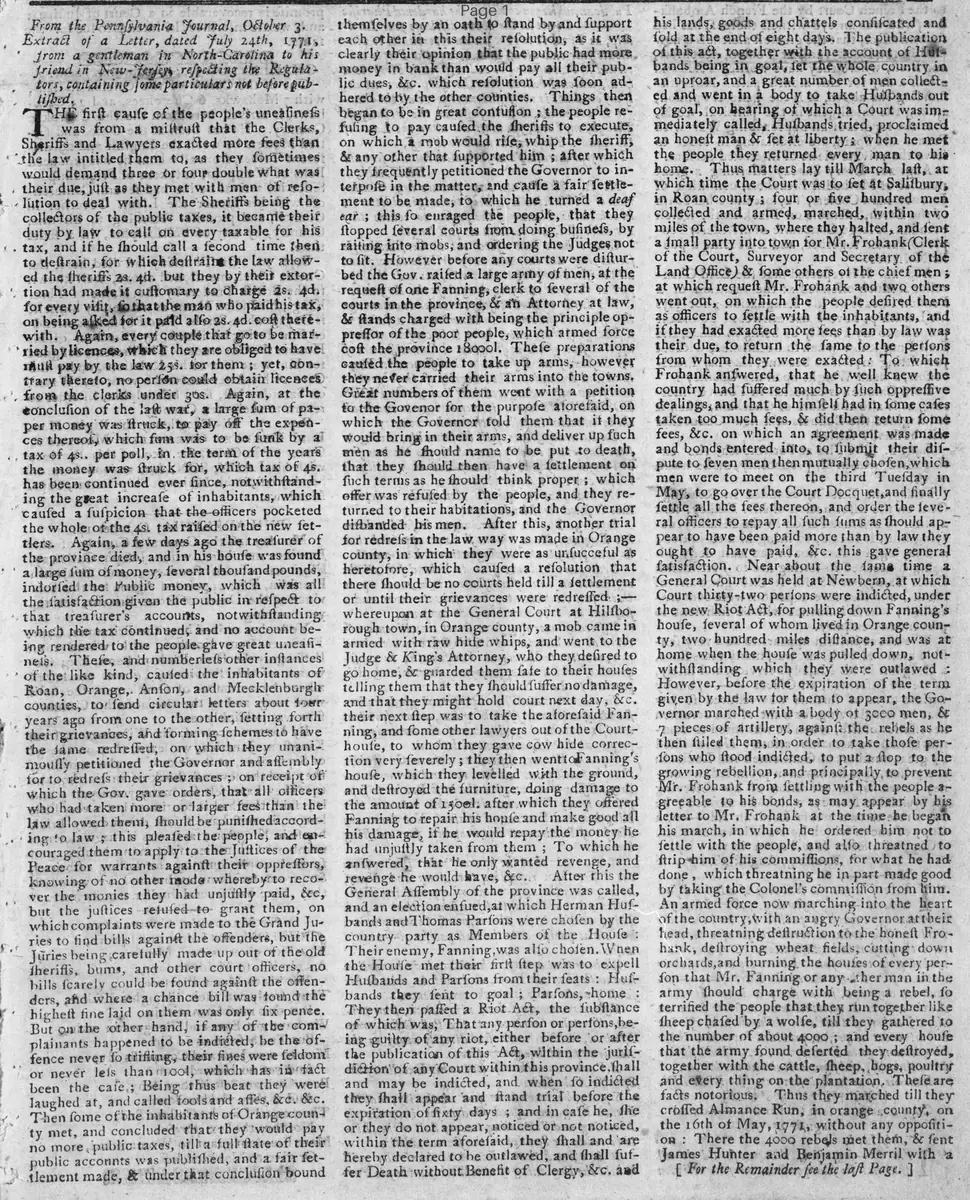
Extract of a Letter, dated July 24th, 1771, from a gentleman in North-Carolina to his friend in New-Jersey respecting the Regulators, containing some particulars not before published.
The first cause of the people's uneasiness was from a mistrust that the Clerks, Sheriffs and Lawyers exacted more fees than the law entitled them to, as they sometimes would demand three or four double what was their due, just as they met with men of resolution to deal with. The Sheriffs being the collectors of the public taxes, it became their duty by law to call on every taxable for his tax, and if he should call a second time then to distrain, for which distrain the law allowed the sheriffs 2s. 4d. but they by their extortion had made it customary to charge 2s. 4d. for every visit, so that the man who paid his tax, on being asked for it paid also 2s. 4d. cost therewith. Again, every couple that go to be married by licences, which they are obliged to have must pay by the law 2s. for them; yet, contrary thereto, no person could obtain licences from the clerks under 6s. Again, at the conclusion of the last war, a large sum of paper money was struck, to pay off the expenses thereof, which sum was to be sunk by a tax of 4s. per poll, in the term of the years the money was struck for, which tax of 4s. has been continued ever since, notwithstanding the great increase of inhabitants, which caused a suspicion that the officers pocketed the whole of the s. tax raised on the new settlers. Again, a few days ago the treasurer of the province died, and in his house was found a large sum of money, several thousand pounds, endorsed the Public money, which was all the satisfaction given the public in respect to that treasurer's accounts, notwithstanding which the tax continued; and no account being rendered to the people gave great uneasiness. These, and numberless other instances of the like kind, caused the inhabitants of Rowan, Orange, Anson, and Mecklenburgh counties, to send circular letters about four years ago from one to the other, setting forth their grievances, and forming schemes to have the same redressed; on which they unanimously petitioned the Governor and assembly for to redress their grievances; on receipt of which the Gov. gave orders, that all officers who had taken more or larger fees than the law allowed them, should be punished according to law; this pleased the people, and encouraged them to apply to the Justices of the Peace for warrants against their oppressors, knowing of no other mode whereby to recover the monies they had unjustly paid, &c., but the justices refused to grant them, on which complaints were made to the Grand Juries to find bills against the offenders, but the Juries being carefully made up out of the old sheriffs. bums, and other court officers, no bills scarcely could be found against the offenders, and where a chance bill was found the highest fine laid on them was only six pence. But on the other hand if any of the complainants happened to be indicted, be the offence never so trifling, their fines were seldom or never less than 100l, which has in fact been the case. Being thus beat they were laughed at, and called fools and asses, &c. &c. Then some of the inhabitants of Orange county met, and concluded that they would pay no more public taxes, till a full state of their public accounts was published, and a fair settlement made, & under that conclusion bound themselves by an oath to stand by and support each other in this their resolution, as it was clearly their opinion that the public had more money in bank than would pay all their public dues, &c. which resolution was soon adhered to by the other counties. Things then began to be in great confusion; the people refusing to pay caused the sheriffs to execute, on which a mob would rise, whip the sheriff, & any other that supported him; after which they frequently petitioned the Governor to interpose in the matter, and cause a fair settlement to be made, to which he turned a deaf ear; this so encouraged the people, that they stopped several courts from doing business, by rising into mobs; and ordering the Judges not to sit. However before any courts were disturbed the Gov. raised a large army of men; at the request of one Fanning, clerk to several of the courts in the province, & an Attorney at law, & stands charged with being the principle oppressor of the poor people, which armed force cost the province 8000l. These preparations caused the people to take up arms, however they never carried their arms into the towns. Great numbers of them went with a petition to the Governor for the purpose aforesaid, on which the Governor told them that if they would bring in their arms, and deliver up such men as he should name to be put to death, that they should then have a settlement on such terms as he should think proper; which offer was refused by the people, and they returned to their habitations, and the Governor disbanded his men. After this, another trial for redress in the law way was made in Orange county, in which they were as unsuccessful as heretofore, which caused a resolution that there should be no courts held till a settlement or until their grievances were redressed;-- whereupon at the General Court at Hillsborough town, in Orange county, a mob came in armed with raw hide whips, and went to the Judge & King's Attorney, who they desired to go home, & guarded them safe to their houses telling them that they should suffer no damage, and that they might hold court next day, &c. their next step was to take the aforesaid Fanning, and some other lawyers out of the Court-house, to whom they gave cow hide correction very severely; they then went to Fanning's house, which they levelled with the ground, and destroyed the furniture, doing damage to the amount of 1500l: after which they offered Fanning to repair his house and make good all his damage, if he would repay the money he had unjustly taken from them; To which he answered, that he only wanted revenge, and revenge he would have. &c.. After this the General Assembly of the province was called, and an election ensued, at which Herman Husbands and Thomas Parsons were chosen by the country party as Members of the House: Their enemy, Fanning, was also chosen. When the House met their first step was to expel Husbands and Parsons from their seats: Husbands they sent to goal; Parsons, home: They then passed a Riot Act, the substance of which was, That any person or persons, being guilty of any riot, either before or after the publication of this Act, within the jurisdiction of any Court within this province, shall and may be indicted, and when so indicted they shall appear and stand trial before the expiration of sixty days; and in case he, he or they do not appear, noticed or not noticed, within the term aforesaid, they shall and are hereby declared to be outlawed, and shall suffer Death without Benefit of Clergy, &c. and his lands, goods and chattels confiscated and sold at the end of eight days. The publication of this act, together with the account of Husbands being in goal, set the whole country in an uproar, and a great number of men collected and went in a body to take Husbands out of goal, on hearing of which a Court was immediately called, Husbands tried, proclaimed an honest man & set at liberty; when he met the people they returned every man to his home. Thus matters lay till March last, at which time the Court was to sit at Salisbury, in Rowan county; four or five hundred men collected and armed, marched within two miles of the town, where they halted, and sent a small party into town for Mr. Frohock (Clerk of the Court, Surveyor and Secretary of the Land Office) & some others of the chief men; at which request Mr. Frohock and two others went out, on which the people desired them as officers to settle with the inhabitants, and if they had exacted more fees than by law was their due, to return the same to the persons from whom they were exacted: To which Frohock answered, that he well knew the country had suffered much by such oppressive dealings: and that he himself had in some cases taken too much fees, & did then return some fees, &c. on which an agreement was made and bonds entered into, to submit their dispute to seven men then mutually chosen, which men were to meet on the third Tuesday in May, to go over the Court Docket, and finally settle all the fees thereon, and order the several officers to repay all such sums as should appear to have been paid more than by law they ought to have paid, &c. this gave general satisfaction. Near about the same time a General Court was held at Newbern, at which Court thirty-two persons were indicted, under the new Riot Act, for pulling down Fanning's house, several of whom lived in Orange county, two-hundred miles distance, and was at home when the house was pulled down, notwithstanding which they were outlawed: However, before the expiration of the term given by the law for them to appear, the Governor marched with a body of 2000 men, & 7 pieces of artillery, against the rebels as he then styled them, in order to take those persons who stood indicted, to put a stop to the growing rebellion, and principally to prevent Mr. Frohock from settling with the people agreeable to his bonds, as may appear by his letter to Mr. Frohock at the time he began his march, in which he ordered him not to settle with the people, and also threatened to strip him of his commissions, for what he had done, which threatening he in part made good by taking the Colonel's commission from him. An armed force now marching into the heart of the country, with an angry Governor at their head, threatening destruction to the honest Frohock, destroying wheat fields, cutting down orchards, and burning the houses of every person that Mr. Fanning or any other man in the army should charge with being a rebel, so terrified the people that they run together like sheep chased by a wolf, till they gathered to the number of about 4000; and every house that the army found deserted they destroyed, together with the cattle, sheep, hogs, poultry and every thing on the plantation. These are facts notorious. Thus they marched till they crossed Alamance Run, in Orange county, on the 16th of May, 1771, without any opposition: There the 4000 rebels met them, & sent James Hunter and Benjamin Merrill with a
For the Remainder see the last Page.
petition to the Governor, and orders to treat with his Honour for peace : To which the Governor answered by his Aid de Camp, that the people must come in, deliver up their arms, pay off their taxes, swear to be subject to all the laws of their country, and deliver such men as he should name to be put to death, otherwise there would be bloodshed in one hour and ten minutes.
Before the expiration of the time the Aid de Camp returned and asked if they wanted more time ; they answered: Yes : He then promised to get them two hours more, which gave the people great hopes of an accommodation. The army during this, was marching up, & the people moved off to give them room; and as soon as the Aid de Camp returned, a field piece was fired in the midst of the people which killed one man and frightened 3700 from off the ground, leaving only 300 to settle the matter, who returned the fire briskly for some time, when the Governor hung out a flag and beat a parley ; but they, knowing nothing of the mode of war, continued their fire, on which the Governor concluded that they were determined to give no quarter, and again fired on them, which continued about two hours & a quarter, when Hunter and his men fled, and left the field to the Governor. How many of the country were killed is uncertain ; however this we know, that there are but thirty missing : Some say there was but nine killed, and that the Governor lost a great number of men ? how that matter is, time only must shew.
The Governor took some prisoners, of whom he hanged seven : The first man was hanged in the camp, because Mr. Fanning said that he helped to pull down his house, when in fact the poor man was not there at the time. Benjamin Merrill was one of the number hanged ; a man in general esteem for his honesty, integrity, piety, and moral good life. The Governor now calls in the inhabitants by proclamation, declaring the King's pardon shall be given to all that come in ; They immediately go in and comply therewith. "He then proceeds, on the 21st of May, (the day that their accounts, by their bonds, was to have been settled) to the houses of those people that entered into bonds as above, and destroyed every thing that was in his power to destroy by fire and sword, then marched his army back, with orders to punish all such as should be so hardy as to complain ; and thus his Honour returned victorious to his palace at Newbern."
O that my head was water and my eyes a fountain of tears, that I might weep day and night for the slain of my people.
What sub-type of article is it?
What themes does it cover?
What keywords are associated?
What entities or persons were involved?
Where did it happen?
Story Details
Key Persons
Location
North Carolina (Rowan, Orange, Anson, Mecklenburgh Counties)
Event Date
May 16, 1771
Story Details
Settlers in North Carolina, known as Regulators, protested excessive fees and taxes by officials through petitions and refusals to pay, leading to riots, destruction of Fanning's house, passage of Riot Act, and confrontation at Alamance Run where Governor's forces defeated them, resulting in hangings and destruction.