Thank you for visiting SNEWPapers!
Sign up free
The Evening Times
Grand Forks, Grand Forks County, North Dakota
What is this article about?
The U.S. Tariff Board prepares to submit its woolen industry report to Congress in December 1911, followed by cotton, amid plans for tariff revisions under President Taft, focusing on reducing high rates in schedule K while protecting industries.
Clipping
OCR Quality
Full Text
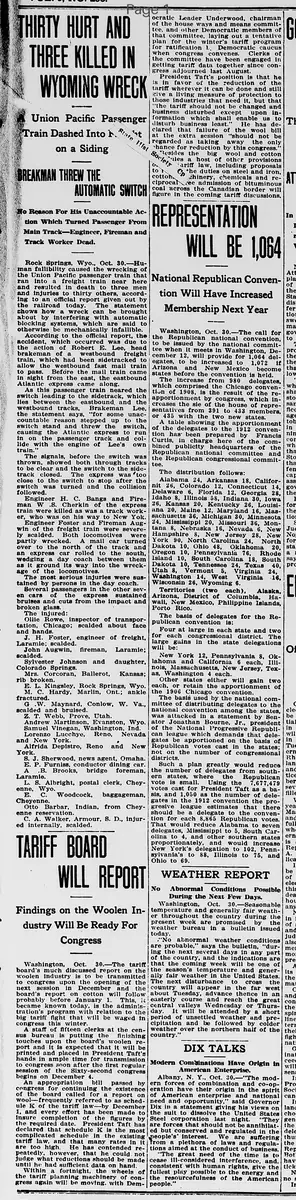
Findings on the Woolen Industry Will Be Ready For Congress
Washington, Oct. 30.—The tariff board's much discussed report on the woolen industry is to be transmitted to congress upon the opening of the next session in December and the board's report on cotton will follow probably before January 1. This, it became known today, is the administration's program with relation to the big tariff fight that will be waged in congress this winter.
A staff of fifteen clerks at the census bureau is putting the finishing touches upon the board's woolen report and it is expected that it will be printed and placed in President Taft's hands in ample time for transmission to congress soon after the first regular session of the Sixty-second congress begins on December 4.
An appropriation bill passed by congress for continuing the existence of the board called for a report on wool—frequently referred to as schedule K of the tariff law—by December 1, and every effort has been made to insure completion of the figures by the required date. President Taft has declared that schedule K is the most complicated schedule in the existing tariff law, and that many rates in it are too high. He has contended repeatedly, however, that he could not judge what reductions should be made until he had sufficient data on hand.
Within a fortnight, the wheels of the tariff planning machinery of congress again will be moving, with Democratic Leader Underwood, chairman of the house ways and means committee, and other Democratic members of that committee, laying out a tentative plan for the winter's tariff program for ratification by Democratic caucus when congress convenes. Clerks of the committee have been engaged in getting tariff data together since congress adjourned last August.
President Taft's position is that he is in favor of the reduction of the tariff wherever it can be done and still give a living measure of protection to those industries that need it, but that "the tariff should not be changed and business disturbed except upon information which shall enable us to disturb business least." He has declared that failure of the wool bill at the extra session "should not be regarded as taking away the only chance for reduction by this congress."
Besides the big wool and cotton schedules of the tariff law, including proposals to reduce the duties on steel and iron, machinery, chemicals and reciprocal free admission of bituminous coal across the Canadian border will figure in the coming tariff discussions.
What sub-type of article is it?
What keywords are associated?
What entities or persons were involved?
Where did it happen?
Story Details
Key Persons
Location
Washington
Event Date
Oct. 30
Story Details
The Tariff Board will transmit its report on the woolen industry to Congress in December, with the cotton report to follow before January 1, as part of the administration's tariff revision plans. Efforts are underway to complete the wool report by December 1, amid discussions on reducing complicated rates in schedule K. Democratic leaders are preparing a tentative tariff program, while President Taft advocates for informed reductions to protect industries without disturbing business.