Thank you for visiting SNEWPapers!
Sign up free
The National Intelligencer And Washington Advertiser
Washington, District Of Columbia
What is this article about?
This editorial, signed 'PUBLIUS,' argues in favor of a proposed constitutional amendment adopting the 'designating principle' (population-based representation) for electing the president. It counters objections from small states, asserting the amendment preserves union harmony, benefits small states long-term, and prevents large state oppression or combinations.
Merged-components note: These sequential components on page 1 form a single continuous editorial article discussing constitutional amendments, signed PUBLIUS.
Clipping
OCR Quality
Full Text
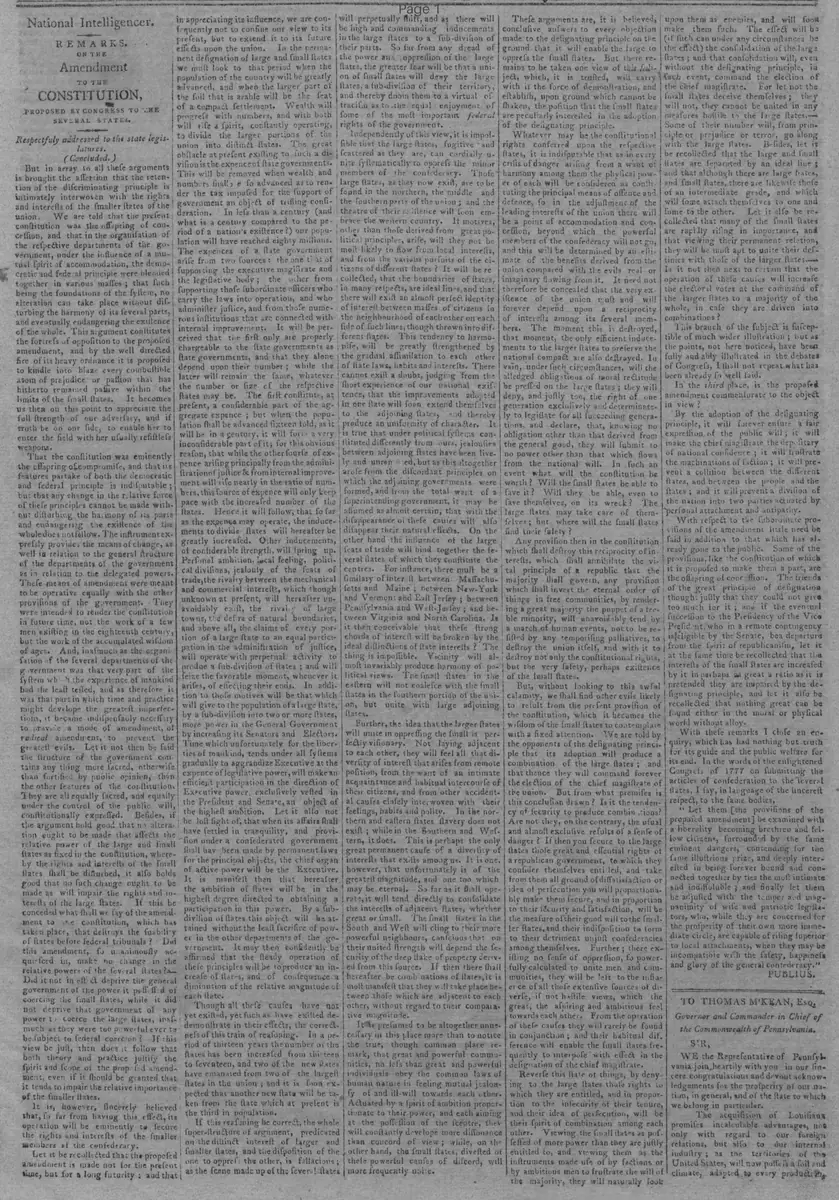
Respectfully addressed to the state legislatures.
(Concluded.)
But in reply to all these arguments is brought the assertion that the retention of the discriminating principle is intimately interwoven with the rights and interests of the smaller states of the union. We are told that the present constitution was the offspring of concession, and that in the organization of the respective departments of the government, under the influence of a mutual spirit of accommodation, the democratic and federal principle were blended together in various masses; that such being the foundations of the system, no alteration can take place without disturbing the harmony of its several parts, and eventually endangering the existence of the whole. This argument constitutes the fortress of opposition to the proposed amendment, and by the well directed fire of its heavy ordnance it is proposed to kindle into blaze every combustible atom of prejudice or passion that has hitherto remained passive within the limits of the small states. It becomes us then on this point to appreciate the full strength of our adversary, and if truth be on our side, to enable her to enter the field with her usually resistless weapons.
That the constitution was eminently the offspring of compromise, and that its features partake of both the democratic and federal principle is indisputable; but that any change in the relative force of these principles cannot be made without disturbing the harmony of its parts and endangering the existence of the whole does not follow. The instrument expressly provides the means of change, as well in relation to the general structure of the departments of the government as in relation to the delegated powers. These means of amendment were meant to be operative equally with the other provisions of the government. They were intended to render the constitution in future time, not the work of a few men existing in the eighteenth century, but the work of the accumulated wisdom of ages. And, inasmuch as the organization of the several departments of the government was that very part of the system which the experience of mankind had the least tested, and as therefore it was that part in which time and practice might develope the greatest imperfections, it became indispensably necessary to provide a mode of amendment, of radical amendment, to prevent the greatest evils. Let it not then be said the structure of the government contains any thing more sacred, otherwise than fortified by public opinion, than the other features of the constitution. They are all equally sacred, and equally under the control of the public will, constitutionally expressed. Besides, if the argument hold good that no alteration ought to be made that affects the relative power of the large and small states as fixed in the constitution, whereby the rights and interests of the small states shall be disturbed, it also holds good that no such change ought to be made as will impair the rights and interests of the large states. If this be conceded what shall we say of the amendment to the Constitution, which has taken place, that destroys the suability of states before federal tribunals? Did this amendment, so unanimously acquiesced in, make no change in the relative powers of the several states as Did it not in effect deprive the general government of the power it possessed of coercing the small states, while it did not deprive that government of any power to coerce the larger states, inasmuch as they were too powerful ever to be subject to federal coercion? If this view be just, then does it follow that both theory and practice justify the spirit and scope of the proposed amendment, even if it should be granted that it tends to impair the relative importance of the smaller States.
It is, however, sincerely believed that, so far from having this effect, its operation will be eminently to secure the rights and interests of the smaller members of the confederacy.
Let it be recollected that the proposed amendment is made not for the present time, but for a long futurity: and that
in appreciating its influence, we are consequently not to confine our view to its present, but to extend it to its future effects upon the union. In the permanent designation of large and small states we must look to that period when the population of the country will be greatly advanced, and when the larger part of the soil that is arable will be the seat of a compact settlement. Wealth will progress with numbers, and with both will rise a spirit, constantly operating, to divide the larger portions of the union into distinct states. The great obstacle at present existing to such a division is the expence of state governments. This will be removed when wealth and numbers shall be so advanced as to render the tax imposed for the support of government an object of trifling consideration. In less than a century (and what is a century compared to the period of a nation's existence?) our population will have reached eighty millions. The expences of a state government arise from two sources: the one that of supporting the executive magistrate and the legislative body; the other from supporting those subordinate officers who carry the laws into operation, and who administer justice, and from those numerous institutions that are connected with internal improvement. It will be perceived that the first only are properly chargeable to the state governments as state governments, and that they alone depend upon their number; while the latter will remain the same, whatever the number or size of the respective states may be. The first constitute, at present, a considerable part of the aggregate expence; but when the population shall be advanced sixteen fold, as it will be in a century, it will form a very inconsiderable part of it; for this obvious reason, that while the other source of expence arising principally from the administration of justice & from internal improvement will rise nearly in the ratio of numbers, this source of expence will only keep pace with the increased number of the states. Hence it will follow, that so far as the expences may operate, the inducements to divide states will hereafter be greatly increased. Other inducements, of considerable strength, will spring up. Personal ambition, local feeling, political divisions, jealousy of the seats of trade, the rivalry between the mechanical and commercial interests, which though unknown at present, will hereafter unavoidably exist, the rivalry of large towns, the desire of natural boundaries. and above all, the claims of every portion of a large state to an equal participation in the administration of justice, will operate with perpetual activity to produce a sub-division of states; and will seize the favorable moment, whenever it arises, of effecting their ends. In addition to those motives will be that which will give to the population of a large state, by a sub-division into two or more states, more power in the General Government by increasing its Senators and Electors. Time which unfortunately for the liberties of mankind, tends under all systems gradually to aggrandize Executive at the expence of legislative power, will make an efficient participation in the direction of Executive power, exclusively vested in the President and Senate, an object of the highest ambition. Let it also not be lost sight of, that when its affairs shall have settled in tranquility, and provision under a confederated government shall have been made by permanent laws for the principal objects, the chief organ of active power will be the Executive. It is manifest then that hereafter the ambition of states will be in the highest degree directed to obtaining a participation in this power. By a sub-division of states this object will be attained without the least sacrifice of power in the other departments of the government. It may then confidently be affirmed that the steady operation of these principles will be to produce an increase of States, and of consequence a diminution of the relative magnitude of each state.
Though all these causes have not yet existed, yet such as have existed demonstrate in their effects, the correctness of this train of reasoning. In a period of thirteen years the number of the states has been increased from thirteen to seventeen, and two of the new states have emanated from two of the largest states in the union; and it is soon expected that another new state will be taken from the state which at present is the third in population.
If this reasoning be correct, the whole super-structure of argument, predicated on the distinct interest of larger and smaller states, and the disposition of the one to oppress the other, is fallacious; as the scene made up of the several states will perpetually shift, and as there will be high and commanding inducements in the large states to a sub-division of their parts. So far from any dread of the power an oppression of the large states, the greater fear will be that a union of small states will deny the large states. a sub-division of their territory, and thereby doom them to a virtual ostracism as to the equal enjoyment of some of the most important federal rights of the government.
Independently of this view, it is impossible that the large states, fugitive and scattered as they are, can cordially unite systematically to oppress the minor members of the confederacy. Those large states, as they now exist, are to be found in the northern, the middle and the southern parts of the union; and the theatre of their influence will soon embrace the western country. If motives, other than those derived from great political principles, arise, will they not be most likely to flow from local interests, and from the various pursuits of the citizens of different states? It will be recollected, that the boundaries of states, in many respects, are ideal lines, and that there will exist an almost perfect identity of interest between masses of citizens in the neighbourhood of each other on each side of such lines, though thrown into different states. This tendency to harmonize, will be greatly strengthened by the gradual assimilation to each other of state laws. habits and interests. There cannot exist a doubt, judging from the short experience of our national existence, that the improvements adopted in one state will soon extend themselves to the adjoining states, and thereby produce an uniformity of character. It is true that under political systems constituted differently from ours, jealousies between adjoining states have been lively and unremitted, but as this altogether arose from the discordant principles on which the adjoining governments were formed, and from the total want of a superintending government, it may be assumed as almost certain, that with the disappearance of these causes will also disappear their natural effects. On the other hand the influence of the large seats of trade will bind together the several states of which they constitute the centres. For instance, there must be a similarity of interest between Massachusetts and Maine; between New-York and Vermont and East Jersey; between Pennsylvania and West-Jersey; and between Virginia and North Carolina. Is it then conceivable that these strong chords of interest will be broken by the ideal distinctions of state interests? The thing is impossible. Vicinity will almost invariably produce harmony of political views. The small states in the eastern will not coalesce with the small states in the southern portion of the union, but unite with large adjoining states.
Further, the idea that the larger states will unite in oppressing the small is perfectly visionary. Not lying adjacent to each other, they will feel all that diversity of interest that arises from remote position, from the want of an intimate acquaintance and habitual intercourse of their citizens, and from other accidental causes closely interwoven with their feelings, habits and polity. In the northern and eastern states slavery does not exist : while in the Southern and Western, it does. This is perhaps the only great permanent cause of a diversity of interests that exists among us. It is one, however, that unfortunately is of the greatest magnitude, and one too which may be eternal. So far as it shall operate, it will tend directly to consolidate the interests of adjacent states, whether great or small. The small states in the South and West will cling to their more powerful neighbours, conscious that on their united strength will depend the security of the deep stake of property derived from this source. If then there shall hereafter be combinations of states, it is most manifest that they will take place between those which are adjacent to each other, without regard to their comparative magnitude.
It is presumed to be altogether unnecessary in this place more than to notice the true, though common place remark, that great and powerful communities, no less than great and powerful individuals obey the common laws of human nature in feeling mutual jealousy of and ill-will towards each other. Actuated by a spirit of ambition proportionate to their power, and each aiming at the possession of the sceptre, there will constantly develope more dissonance than concord of view; while, on the other hand, the small states, divested of these powerful causes of discord, will more frequently unite.
These arguments are, it is believed, conclusive answers to every objection made to the designating principle on the ground that it will enable the large to oppress the small states. But there remains to be taken one view of this subject, which, it is trusted, will carry with it the force of demonstration, and establish, upon ground which cannot be shaken, the position that the small states are peculiarly interested in the adoption of the designating principle.
Whatever may be the constitutional rights conferred upon the respective States, it is indisputable that as in every crisis of danger arising from a want of harmony among them the physical power of each will be considered as constituting the principal means of offence and defence, so in the adjustment of the leading interests of the union there will be a point of accommodation and concession, beyond which the powerful members of the confederacy will not go, and this will be determined by an estimate of the benefits derived from the union compared with the evils real or imaginary flowing from it. It need not therefore be concealed that the very existence of the union must and will forever depend upon a reciprocity of interests among its several members. The moment this is destroyed, that moment, the only efficient inducements to the larger states to preserve the national compact are also destroyed. In vain, under such circumstances, will the alleged obligations of moral rectitude be pressed on the large states; they will deny, and justly too, the right of one generation exclusively and determinately to legislate for all succeeding generations, and declare, that, knowing no obligation other than that derived from the general good, they will submit to no power other than that which flows from the national will. In such an event what will the constitution be worth? Will the small states be able to save it? Will they be able, even to save themselves, on its wreck? The large states may take care of themselves; but where will the small states find their safety?
Any provision then in the constitution which shall destroy this reciprocity of interests, which shall annihilate the vital principle of a republic that the majority shall govern, any provision which shall invert the eternal order of things in free communities, by rendering a great majority the puppet of a feeble minority, will unavoidably tend by a march of human events, not to be resisted by any temporizing palliatives, to destroy the union itself, and with it to destroy not only the constitutional rights, but the very safety, perhaps existence of the small states.
But, without looking to this awful calamity, we shall find other evils likely to result from the present provision of the constitution, which it becomes the wisdom of the small states to contemplate with a fixed attention. We are told by the opponents of the designating principle that its adoption will produce a combination of the large states; and that thence they will command forever the election of the chief magistrate of the union. But from what premises is this conclusion drawn? Is it the tendency of security to produce combinations? Are not they, on the contrary, the usual and almost exclusive results of a sense of danger? If then you secure to the large states those great and essential rights of a republican government, to which they consider themselves entitled, and take from them all ground of dissatisfaction or idea of persecution you will proportionably make them secure, and in proportion to their security and satisfaction, will be the measure of their good will to the smaller states, and their indisposition to form to their detriment unjust confederacies among themselves. Further; there existing no sense of oppression, no powerfully calculated to unite men and communities, they will be left to the nicer exercise of all those extensive sources of diverse, if not hostile views, which the great, the aspiring and ambitious feel towards each other. From the operation of these causes they will rarely be found in conjunction; and their habitual difference will enable the small states frequently to interpose with effect in the designation of the chief magistrate.
Reverse this state of things, by denying to the large states those rights to which they are entitled, and in proportion to the insecurity of their tenure, and their idea of persecution, will be their spirit of combination among each other. Viewing the small states as possessed of more power than they are justly entitled to, and viewing them as the instruments made use of by factions, or by ambitious men to frustrate the will of the majority, they will naturally look
upon them as enemies, and will soon make them such. The effect will be (if such can under any circumstances be the effect) the consolidation of the large states; and that consolidation will, even without the designating principle, in such event, command the election of the chief magistrate. For let not the small states deceive themselves; they will not, they cannot be united in any measures hostile to the large states.-- Some of their number will, from principle or prejudice or terror, go along with the large states. Besides, let it be recollected that the large and small states are separated by an ideal line and that although there are large states, and small states, there are likewise those of an intermediate grade, and which will some attach themselves to one and some to the other. Let it also be recollected that many of the small states are rapidly rising in importance, and that viewing their permanent relation, they will be most apt to unite their destinies with those of the larger states.-- Is it not then next to certain that the operation of these causes will increase the electoral votes at the command of the larger states to a majority of the whole, in case they are driven into combinations?
This branch of the subject is susceptible of much wider illustration; but as the points, not here noticed, have been fully and ably illustrated in the debates of Congress, I shall not repeat what has been already so well said.
In the third place, is the proposed amendment commensurate to the object in view?
By the adoption of the designating principle, it will forever ensure a fair expression of the public will; it will make the chief magistrate the depository of national confidence : it will frustrate the machinations of faction : it will prevent a collision between the different states, and between the people and the states; and it will prevent a division of the nation into two parties actuated by personal attachment and antipathy.
With respect to the subordinate provisions of the amendment little need be said in addition to that which has already gone to the public. Some of the provisions, like the constitution of which it is proposed to make them a part, are the offspring of concession. The friends of the great principle of designation thought justly that they could not give too much for it : and if the eventual succession to the Presidency of the Vice President, who in a remote contingency is ineligible by the Senate, be a departure from the spirit of republicanism, let it at the same time be recollected that the interests of the small states are increased by it in perhaps as great a ratio as it is pretended they are impaired by the designating principle, and let it also be recollected that nothing great can be found either in the moral or physical world without alloy.
With these remarks I close an enquiry, which has had nothing but truth for its guide and the public welfare for its end. In the words of the enlightened Congress of 1777 on submitting the articles of confederation to the several states, I say, in language of the sincerest respect, to the same bodies,
" Let them [the provisions of the proposed amendment] be examined with a liberality becoming brethren and fellow citizens, surrounded by the same eminent dangers, contending for the same illustrious prize, and deeply interested in being forever bound and connected together by ties the most intimate and indissoluble ; and finally let them be adjusted with the temper and magnanimity of wise and patriotic legislators, who, while they are concerned for the prosperity of their own more immediate circle, are capable of rising superior to local attachments, when they may be incompatible with the safety, happiness and glory of the general confederacy."
PUBLIUS.
What sub-type of article is it?
What keywords are associated?
What entities or persons were involved?
Editorial Details
Primary Topic
Support For Constitutional Amendment Adopting Designating Principle For Presidential Election
Stance / Tone
Strongly Supportive Of Proposed Amendment Benefiting Small States And Union
Key Figures
Key Arguments